 THE GAME ARCHIVE
Anchoring and Movement: The Grapple That Opens the Map
The Anchor is the movement tool that reshapes traversal. Aim with the reticle and press F; once the Anchor latches onto a wall or an Akrid, it pulls the character to that location, reaching areas a normal jump cannot. Press F again at any time to release. While attached to a surface or creature, firing a weapon at close range lets you attack without letting go. When the reticle turns green, pressing F fires the Anchor. Rappelling and repositioning around a target follow from these same actions, which is why the ability extends beyond simple vertical climbing.
On keyboard and mouse, movement uses W, A, S, and D, the mouse aims and the left button shoots, Space jumps and L-Shift crouches. The Anchor sits on F, the dash on V, and the evade roll on C while moving. These options combine into mobility during combat: dash and evasive rolls reposition the character, and alternate control patterns assign 180-degree turns. Other keys cover actions around that movement, including Z for zoom, R to reload, E for melee attacks and the mouse wheel to change weapons.
T-ENG: Survival Economy, Thresholds and the Harmonizer
Thermal Energy, drawn from the bodies of the Akrid native to E.D.N. III, powers every activity on the planet and doubles as a survival timer. While a suit's life support runs, T-ENG drains continuously; once it hits zero, the Life Gauge begins to fall. The resource also gates Vital Suit use: a pilot needs more than 100 T-ENG to board, and reaching zero ejects the pilot from the machine. Replenishment comes from defeating Akrid, destroying tanks and drums, and activating Data Posts, so the survival economy pushes players toward fights and objectives rather than passive waiting.
The Harmonizer, special life support equipment mounted on the Snow Pirates' arms, absorbs T-ENG to recover the Life Gauge. It starts automatically when the player takes damage, and pressing Left Ctrl activates it manually. T-ENG can also be shared with teammates: scrolling the mouse wheel down and clicking the right button switches the current weapon to the T-ENG Supplier, and clicking the right button again fires it to supply allies. Data Posts tie into the same loop, granting radar coverage of the surrounding area, T-ENG replenishment, and battle gauge increases when activated by pressing Q repeatedly.
Weapons and Vital Suits Against the Akrid
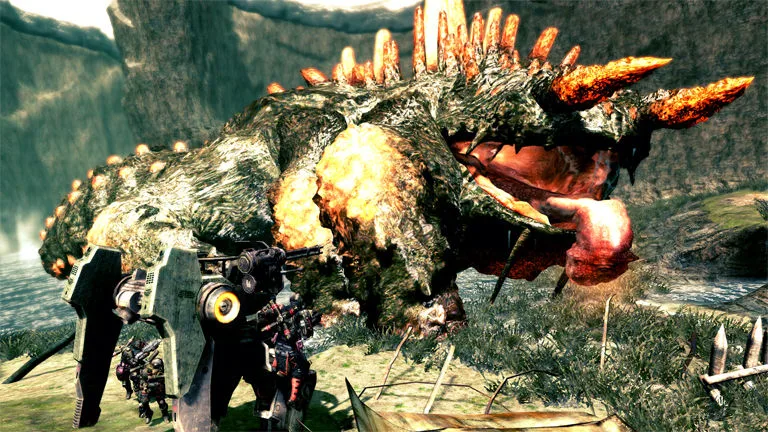
The arsenal spreads across the game rather than sitting in one loadout: machine guns, shotguns, rocket launchers, lasers, sniper rifles and grenades are found scattered through stages. Beyond picking up what lies around, more weapons are added to each category as you play, and the weapons customization screen lets you change settings and vary the types carried. Additional weapons enter those categories through pickup boxes or the LP2 Slot Machine. Switching between shooting and close-range attacks changes the battle pattern.
The largest hardware walks on two legs: heavily armed and armored Vital Suits return in greater numbers and variety than before. Some transform into other vehicles, some hold up to three players, and others take multiple players to operate. Against the giant Akrid, these machines pair with teamwork tactics and new weapons, since the team depends on each other to succeed and survive. The scale of the bosses tests both individual skill and the ability to work as a team.
Campaign Progression: Episodes, GJ Awards and Training
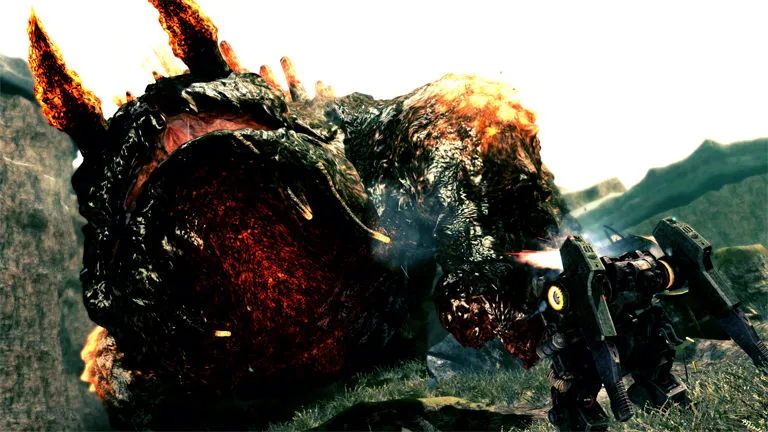
The campaign is built from six interconnected episodes, and control passes between heroes drawn from the various factions that split over Thermal Energy. Seeing the civil war on E.D.N. III from each side means the same events are revisited from different viewpoints as plot threads carry across episodes. Teams of up to four players online can join the campaign itself, so the story missions double as cooperative play rather than separating solo and co-op progress into different campaigns.
GJ Awards feed a scoring layer over that progression. Episode GJ comes from completing the tasks that appear during campaign play, and those points are reflected in the Area and Chapter result rankings; the manual also lists Battle GJ, based on play style, and Co-op GJ, earned through cooperative play with teammates. Each Award carries a gold, silver or bronze rank, with gold worth the most points. Players are advised to think carefully about how to complete the various tasks when going after Episode GJ.
Four-Player Co-op and 16-Player Multiplayer Modes
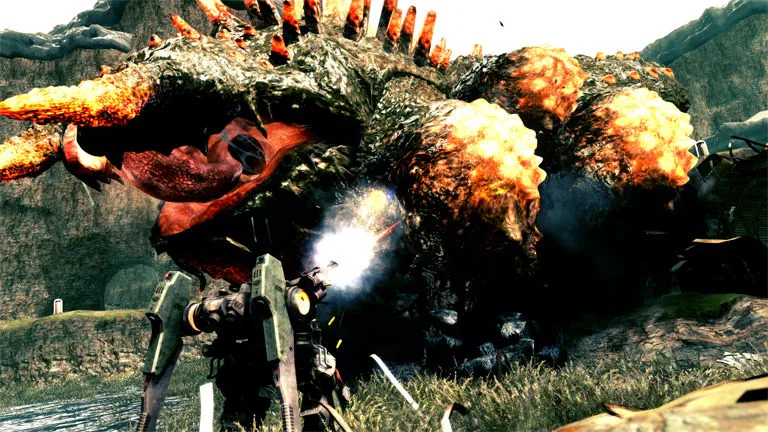
Online cooperative play accommodates up to four players who join the campaign itself, so the story missions serve as the cooperative mode rather than a separate track. The same teams tackle giant Akrid bosses, where the game's framing stresses teamwork: success and survival depend on the members supporting one another, using coordinated tactics, new weapons and a variety of Vital Suits against the oversized enemies. The scale of those encounters tests both individual battlefield skill and the group's ability to function as a unit, tying the campaign's faction story to shared play.
Competitive multiplayer runs 16-player matches across nine maps and five game modes, with more maps offered as downloadable content after release. Data Post Battle sends teams to activate Data Posts, and a team wins by activating more of them than the opposition or by activating every post on the map. Akrid Egg Battle asks players to carry the most Akrid Eggs to their respective goals. Fugitive pits a team of hunters against a team of fugitives, with outcomes tied to capturing or eliminating targets inside the time limits, while the elimination modes cover free-for-all and team play.
Sources & further reading.
- Lost Planet® 2 — official game profile Retrieved Oct 19, 2026
- Lost Planet® 2 — official game profile — publisher-supplied gameplay manual Retrieved Oct 19, 2026
First published .