 THE GAME ARCHIVE
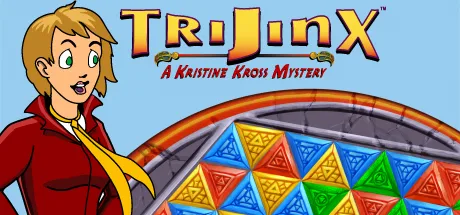
TriJinx: A Kristine Kross Mystery, developed by PlayFirst and released in 2010 for Windows and macOS, is a casual action-puzzle built around a simple verb and a twist: you click triangles to clear them, but the board itself can be turned. The game places the player in Egypt in 1935, trapped in the tomb of TriClops.
The basic task is to match triangles and clear colors while helping Kristine Kross on her quest to find her missing father and escape. What separates the game from a plain match-three is the documented ability to rotate the gameboard to create groups you can clear away, plus a small set of special pieces — scarabs, bombs, wild-card triangles, and color-shifting chameleons — that give the player decisions beyond spotting a row of same-colored shapes.
The Core Loop: Click, Clear, Rotate
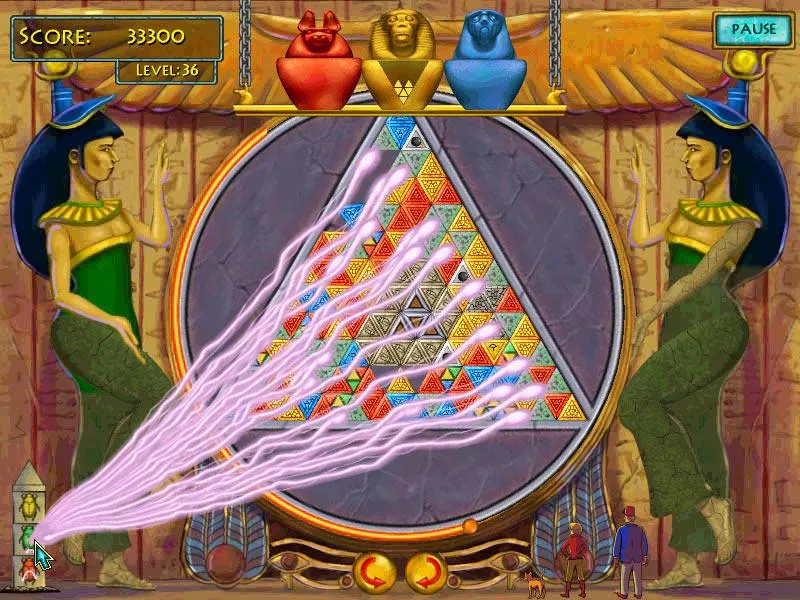
Mystical triangles fill the chamber, and the basic action is to click on three or more to make them disappear. That is the atomic move of the whole game: identify a valid group and remove it, opening space in the chamber. The complete loop is described as creating puzzle combinations through triangle matching and rotation, which is the clearest statement of how the two verbs fit together.
The rotation step is an answer to arrangement problems. When the triangles are laid out so that no clearable group presents itself, rotating the gameboard lets the player create groups they can clear away. The documented rules do not describe a fixed orientation or a limit on rotations, so the safe reading is that rotation is a tool for reshaping the board into workable groups rather than a cosmetic flourish.
Color is the rule that organizes all of this. The game is described as using color-based mechanics for triangle clearance and combinations, and the special pieces are defined by how they interact with color: scarabs clear a single color, bombs are assembled from same-color triangles, wild cards can stand in with any color, and chameleons change colors. A player who reads the board in terms of color distribution — which colors are clustered, which are buried, which are scarce — is reading it the way the systems are built.
The practical consequence is a two-stage decision on many turns. First, look for a group that can be clicked immediately; second, decide whether rotating the board converts a stubborn cluster into a valid group. Because clearing group after group is how the chamber empties, rotation and matching are woven into the same sequence rather than living in separate phases.
Scarabs, Bombs, Wild Cards, and Chameleons
Scarabs are the game's spendable resource. You earn them through play and then use them strategically to clear all triangles of a single color from the chamber. That is a sweeping effect: instead of chewing through one group at a time, a scarab erases every remaining triangle of one color at once. In color-based puzzles that is typically the way to remove a color that is scattered, where no single group exists to click directly.
Bombs follow a different route into play. Four smaller triangles of the same color can be formed into a bomb, and that bomb is the tool for blowing up stone blocks. Stone blocks sit outside the ordinary triangle-clearing loop: they are handled through bombs rather than by matching triangles alone. That gives the same-color grouping rule a second purpose — same-color triangles are both clearable groups and bomb components.
Wild cards soften the color rule. Multi-colored triangles serve as wild cards with any color, so they can fill the missing slot in a same-color group. Chameleons go further: they constantly change colors, and the game frames them as a way to complete powerful color combinations. A chameleon is therefore a piece whose value is time-sensitive — whatever color it contributes shifts — so the player who notices it early can build around it while the supporting color is present.
Together these pieces make resource management a real part of the loop. The documented strategic elements are to use scarabs, bombs, and chameleons deliberately rather than reflexively. Scarabs are for spreading a single color across the chamber, bombs for the stone blocks, and chameleons for the color combinations their shifting hues enable.
68 Gates, Ten Chambers, and the Race Against the Curse
Progress is framed as a run through the tomb: the player must pass through a series of 68 locked gates, and the documented goal is to blaze through ten exciting chambers while unlocking the ancient gates. Chamber unlocking is explicitly tied to story progress — the player unlocks the ten chambers as the story advances. That makes the gate count the visible measure of how far the player has pushed into the tomb.
The pressure comes from a curse. The 68 gates must be passed before the curse turns everyone on Kristine's team to stone, so the game is described as a race against time. The gate count and the curse are therefore two halves of one framing: opening gates is the way forward, and doing it before the curse completes is the condition for success.
Within that structure the puzzle work sits: matching triangles, rotating the board, and spending special pieces to clear chambers. The player's real progress is measured both by puzzles cleared and gates unlocked, and the labyrinth of brain-bending puzzles is the route the adventure takes through the tomb.
Adventure Mode and Three Extra Modes
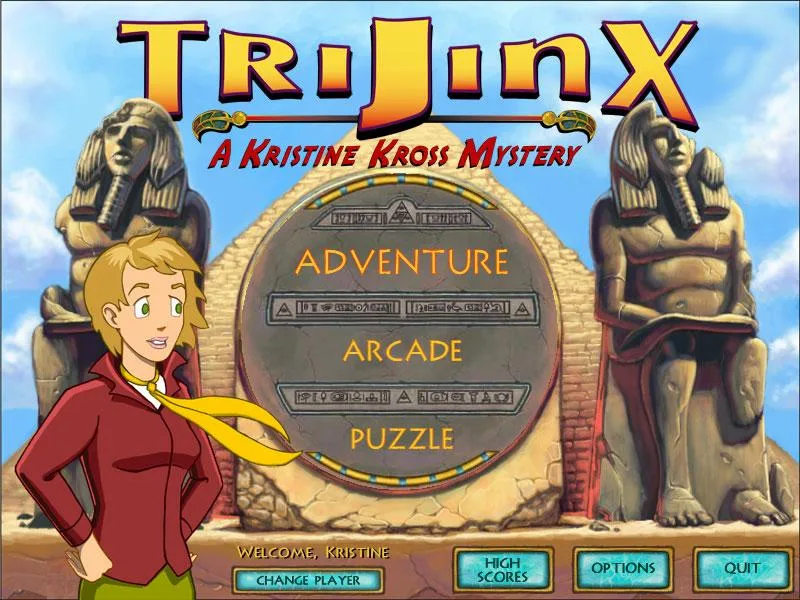
The main mode is Adventure Mode, described as having 68 levels of can't-stop gameplay. That is the mode that carries the story and the 68-gate progression. The narrative is part of the package: an intriguing story featuring professional voice actors and full color illustrations, with story twists that the game's own description says will pull in even puzzle purists.
Beyond the adventure, the game ships three additional unique modes of play: a fast-action Arcade mode and two strategic Puzzle modes. The design intent is audience breadth — the description says the game appeals to coffee breakers and competitive players alike. The documented difference between the extra modes is their pacing: one favors fast action, while the two Puzzle modes are characterized as strategic.
1935 Egypt and the Kristine Kross Mystery
The premise is Egypt in 1935, with the player trapped in the tomb of TriClops. Kristine Kross is on a quest to find her missing father and escape, and the deeper objective is to return the ancient artifact to the center of the tomb, rescue her dad, and unearth the secret of the TriJinx. The labyrinth of brain-bending puzzles is the road through those objectives, which is why the gate-and-chamber structure matters to the narrative rather than sitting apart from it.
The tomb is also where the game's title lives: the mystery of the TriClops and the secret of the TriJinx are the narrative hooks. The player is asked to unravel the mystery of the Triclops as the chambers give way, so the puzzle path and the story path are the same trip through the tomb.
Starting Guidance, Drawn From the Documented Rules
Two practical habits follow directly from the documented mechanics. First, read the board by color before clicking: since groups are formed from same-colored triangles and scarabs and bombs key off color, the color map of the chamber is the player's map. Second, treat rotation as a tool for the job it was documented for — rotating to create a group you can clear is an explicit mechanic, so it belongs in the same decision as the click itself.
Third, hold special pieces for the problem they solve. Scarabs clear an entire color at once, so they answer a chamber in which you want one color gone in a single move. Bombs exist to destroy stone blocks, so four same-color triangles are a resource to assemble when stone is the obstacle. Wild cards can stand in with any color, and chameleons' constant color changes make them the tool the game names for completing powerful color combinations.
Presentation: A Spectacular Animated Tomb
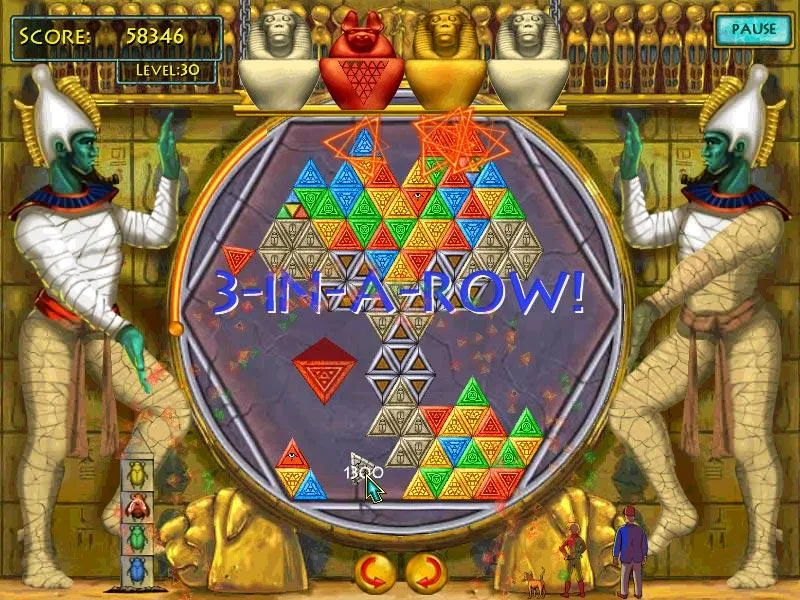
The presentation is theatrical: a spectacular animated world, a rich audio soundtrack with cinematic score and sound effects, plus full color illustrations and professional voice actors carrying the story. Those elements — animation, a cinematic score, and illustrated, voiced storytelling — give the tomb a staged, adventure-serial feel.
Version and Access Note
This feature describes TriJinx: A Kristine Kross Mystery as documented by PlayFirst in 2010 for Windows and macOS. The catalog entry lists PlayFirst as developer, a 2010 release year, and a Casual genre tag, with no publishers recorded. Any later re-release, bundle, or storefront repackaging should be treated as a separate offering until its own listing documents it.
Scroll sideways to see the full table →
| Fact | Documented Detail |
|---|---|
| Title | TriJinx: A Kristine Kross Mystery |
| Developer | PlayFirst |
| Release year | 2010 |
| Platforms | Windows, macOS |
| Genre | Casual action-puzzle |
| Setting | Egypt, 1935, tomb of TriClops |
| Core action | Click three or more matching triangles to clear them |
| Board manipulation | Rotate the gameboard to create groups |
| Resource | Scarabs clear all triangles of one color |
| Bomb rule | Four same-color triangles form a bomb to explode stone blocks |
| Flexible pieces | Multi-colored wild cards; color-changing chameleons |
| Progression | 68 locked gates across ten chambers |
| Main mode | Adventure Mode, 68 levels |
| Extra modes | Arcade plus two strategic Puzzle modes |
Sources & further reading.
- TriJinx: A Kristine Kross Mystery™ — official game profile Retrieved Oct 18, 2026
First published .