 THE GAME ARCHIVE
A War That Refuses to End
PlanetSide 2 asks a simple question: what happens when a first-person shooter stops treating a match as a self-contained event and instead lets the fighting roll on indefinitely? The game's answer is a free-to-play, massively multiplayer online first-person shooter in which empires and their soldiers wage an all-out planetary war. Battles persist, and the war never ends, which turns every session into a fragment of a much longer campaign rather than a discrete win or loss.
That framing matters because it changes what a player is actually doing moment to moment. Instead of fighting for a scoreboard, soldiers fight for territory that affects the wider conflict. The store description for this Steam entry places the game at a 2012 release on Windows, developed by Rogue Planet Games and published by Daybreak Game Company, and classifies it as Action, Massively Multiplayer, and Free To Play. This feature focuses on the documented gameplay systems rather than the metadata.
Three Empires and a Contested Planet
Every player chooses to align with one of three warring empires: the militaristic, authoritarian Terran Republic; the rebellious, freedom-fighting New Conglomerate; or the technocratic, alien-influenced Vanu Sovereignty. Empire choice is not cosmetic. Each empire has access to empire-specific weapons, attachments, vehicles, and abilities, so the faction you pick shapes both what you can field and how your side approaches a fight.
The conflict plays out across four enormous continent maps, each offering dozens of square kilometers of seamless, hand-crafted gameplay space. The environments range widely, from open fields and barren desert to armed and armored bases and the skies above them. Because every inch of that space is contestable, knowing your surroundings is framed as a prerequisite for victory rather than a bonus.
The Core Loop: Hold Ground, Gain Resources
The heart of PlanetSide 2 is not a single base capture. The war is not won by one decisive assault; the core gameplay is about holding crucial territories and controlling resources. Working strategically as a team to secure tactical positions has long-lasting effects that can shift the tide of battle, and controlling territories grants empires access to critical resources that support their war effort.
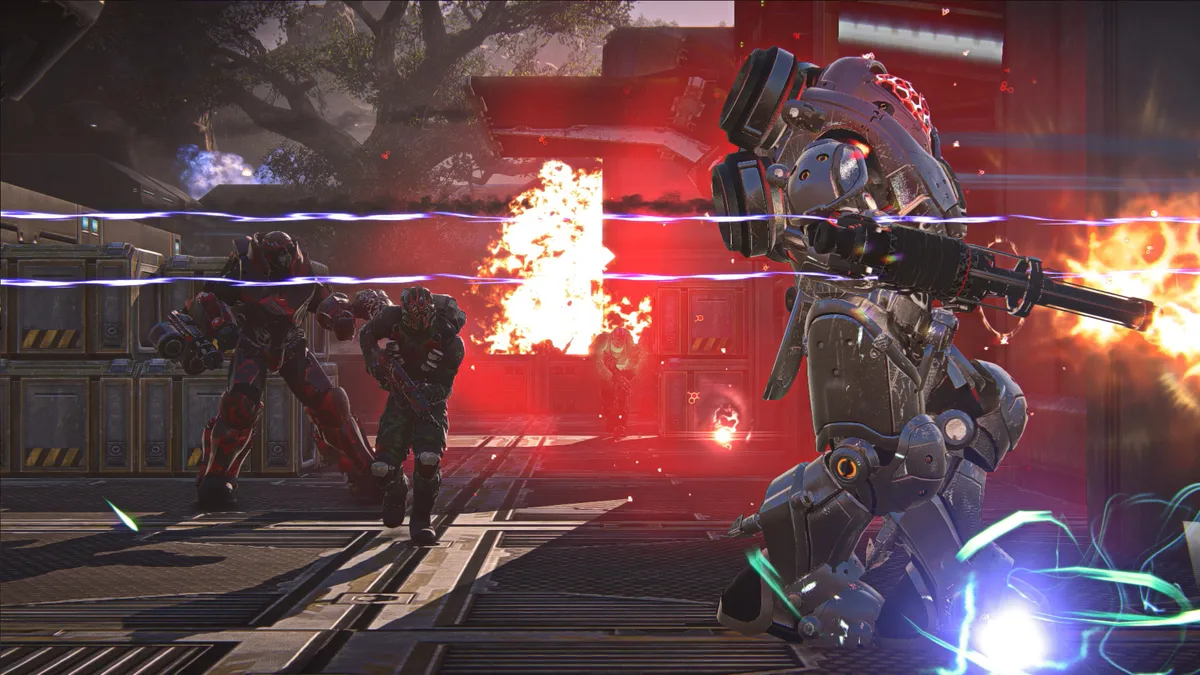
This is where the scale claim becomes concrete. Battles take place not between dozens of soldiers but between hundreds, and they unfold on foot, in ground vehicles, and in the air. Each battleground holds valuable resources and strategic positions, and the empire that can conquer and hold these territories is rewarded with the resources and means to keep pushing. Combat therefore spans three intertwined layers: infantry, ground vehicles, and air vehicles.
 View full image ↗
Six Classes, Six Jobs
Soldiers are built around six distinct classes, and the system is presented as a way to match a player's own preferences with what their squad needs. The six classes are Heavy Assault, Light Assault, Combat Medic, Infiltrator, Engineer, and MAX, and each has its own combat role within a squad.
- Heavy Assault: the dedicated foot soldier, built to rush into battle.
- Light Assault: uses a short-burst jetpack to reach spots heavies cannot, then attacks from unexpected angles.
- Combat Medic: keeps fellow soldiers alive and in fighting shape.
- Infiltrator: operates from silence and invisibility, whether with a knife from behind or a single sniper shot.
- Engineer: deploys crucial equipment, resupplies allies, and repairs vehicles so the war effort keeps moving.
- MAX: steps into a Mechanized Assault Exo-Suit, trading flesh for armor and hands for cannons.
The composition of a squad therefore matters as much as individual aim. Six classes create a wide spread of squad options and combat tactics, which is the mechanical reason large battles in PlanetSide 2 read differently from a standard team deathmatch: the fight is shaped by which support and specialist roles are present.
Progression: Growing a Soldier, Not Just a Loadout
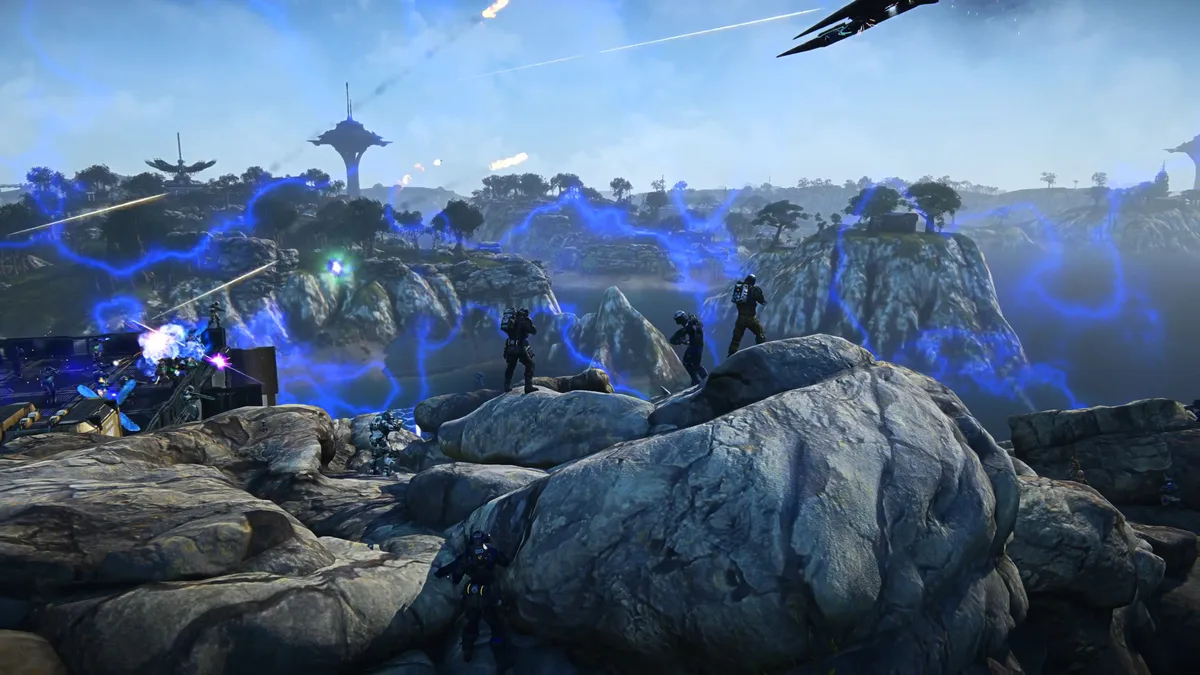
Progression in PlanetSide 2 is built on an extensive skill tree and class-based system. Players customize their soldier, weapons, and vehicles to match their playstyle and the needs of their squads, outfits, and empires. Growth is lateral as much as vertical: as a soldier masters each combat role, weapon, and vehicle, they unlock hundreds of weapons, attachments, gear, skills, and vehicles over time.
Weapons and vehicles can be extensively customized by preference or purpose using attachments, upgrades, and add-ons earned in the war. In practice, that means the same platform can be tuned for different jobs, and the choice of attachments is part of how a player fits into a squad rather than a purely personal preference.
 View full image ↗
Outfits and the Teamwork Layer
Larger coordination runs through Outfits, groups of like-minded soldiers who train together. Outfits can be small rapid response teams or massive clans, and they are described as vital to each empire's strategic organization. The design intent is that individual skill, team grit, and empire-wide coordination all feed the same ongoing war.
That coordination is also why the resource layer matters to players who never touch a command screen. Because holding tactical positions produces long-lasting effects, an outfit that organizes a defense is doing more than protecting one base for a few minutes; it is protecting the empire's access to the resources that let it keep fighting.
Starting Guidance Backed by the Source
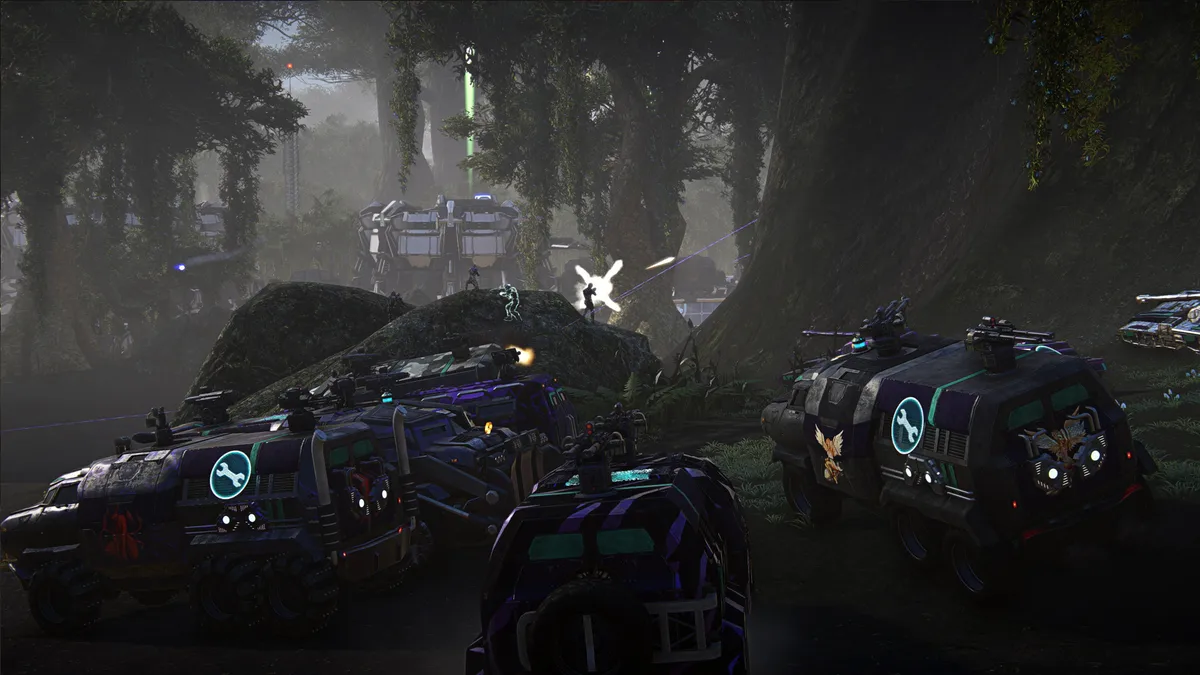
For readers deciding how to approach the game, the documented material supports a few straightforward starting points. Pick an empire deliberately, because each one has its own weapons, attachments, vehicles, and abilities. Expect the fight to span four continents and to involve hundreds of combatants, not a handful. Expect to fight on foot, in ground vehicles, and in the air. And expect that joining or forming an Outfit is the intended route to strategic play at empire scale.
 View full image ↗
What Makes the Design Distinctive
The distinguishing feature of PlanetSide 2 is the way it combines first-person shooter mechanics with a persistent territorial conflict. A single base capture does not decide anything; holding crucial territories and controlling resources does. That gives every fight a context beyond the immediate firefight, and it makes the map itself part of the strategy: open fields, desert, fortified bases, and the airspace above them are all contestable ground.
Because the war never ends, the game also never resets into a clean slate. The result is a shooter where the consequences of a fight are absorbed into a longer contest, and where the player's contribution is framed as one part of an empire-wide effort. That combination is what makes the title stand out in a genre usually built around discrete matches.
Fact Table
The table below records the catalog details associated with this Steam entry. Release year refers to this entry and is not a claim about the game's full release history.
Scroll sideways to see the full table →
| Field | Value |
|---|---|
| Game title | PlanetSide 2 |
| Release year (this entry) | 2012 |
| Platform (this entry) | Windows |
| Developer | Rogue Planet Games |
| Publisher | Daybreak Game Company |
| Genres | Action, Massively Multiplayer, Free To Play |
Sources & further reading.
- PlanetSide 2 — official game profile Retrieved Oct 10, 2026
First published .