 THE GAME ARCHIVE

Guiding a Puddle by Moving the World
Puddle strips the character out of the character-driven puzzle game. Instead of steering a figure, the player guides a body of fluid by tilting the environment to the left or the right. The tilt is the entire interaction: there is no avatar to jump, dash or aim, only a surface to angle and a liquid that answers to that angle. The developer and publisher both appear as Neko Entertainment, and the game is listed for Windows, macOS and Linux.
That single control creates the game's puzzle logic. Because the fluid is the subject and the world is the lever, progress is a negotiation between momentum and containment. The official description frames the challenge plainly: guide the puddle through a vast range of environments and puzzles, and conserve as much fluid as possible while crossing obstacles such as burning passageways, carnivorous plants and electric currents.
Tilting as the Core Skill
Every level is solved with the same instrument. Angling the world to the left or right moves the fluid, and the publisher's instructions are explicit that this must be done carefully, taking friction, gravity and temperature into account. Those three factors are the vocabulary of the game's physics. The player is not asked to memorize them as separate meters but to read them as a combined situation: how the current stretch of environment resists the puddle, how it pulls it onward, and how heat or cold affects what the fluid does.
The practical consequence is that a tilt is never neutral. A shift that sends the fluid briskly across one surface may leave it stalled or scattered on another, because the same angle is filtered through friction, gravity and temperature before it becomes motion. Players who treat the tilt as an on/off push will run into trouble; players who treat it as continuous nudging, adjusting to what the environment does back, are playing the game as designed.
Input is flexible rather than locked to a mouse or keyboard scheme: the game lists support for Bluetooth or USB game controllers. That detail matters more than it might for a different genre, because the tilt mechanic rewards fine, sustained adjustment, and a connected controller lets the player treat the environment angle as an analog dial rather than a tap.
Four Fluids and Their Unique Properties
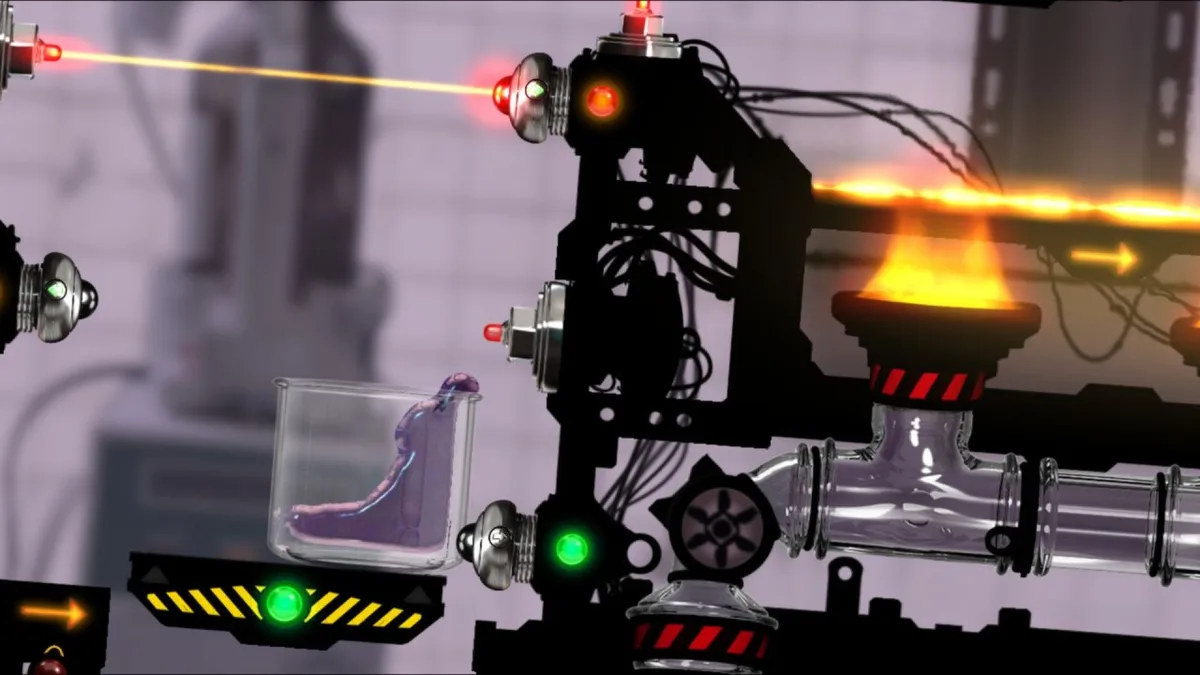
The fluid itself is a second variable layered on top of the environment. Puddle names four substances: water, oil, nitroglycerin and molten lava. The official text describes using the unique properties of each type of fluid in original environments, which tells the player that these are not cosmetic skins. Each fluid brings its own behavior, and the puzzle is partly the puzzle of working out how this particular liquid responds to a given slope and a given hazard.
Because friction, gravity and temperature apply to every fluid, the four substances turn those three factors into a matrix of decisions. A stretch of level that feels manageable with one liquid may demand a completely different rhythm with another. Water, oil, nitroglycerin and molten lava each ask the player to reconsider how much tilt to apply, when to ease off, and how to keep the puddle together as it moves. The named fluids also carry obvious real-world connotations — oil slips, nitroglycerin is volatile, lava is molten — but the game's guiding instruction is simply to use their unique properties rather than to treat them interchangeably.
The four fluids sit inside a wider variety of environments. The store description sells "a range of original environments," and the combination of fluid type and environment is where the game's variety comes from: the same tilt vocabulary, a different set of physical conditions. Players who pay attention to which material they are carrying can anticipate how a stretch of level will behave before committing to a large tilt.
Conserving Fluid Across Hostile Obstacles
The governing objective is conservation. The official description directs the player to conserve as much fluid as possible while crossing a variety of obstacles. That phrasing turns each level into a resource problem with a success threshold: much of the puddle should survive the journey. Because the fluid is the player's sole unit of progress, losing it is losing ground. The design pressure is to reach the far side with as much of the body of liquid intact as possible, which favors controlled tilting over flamboyant tilting.
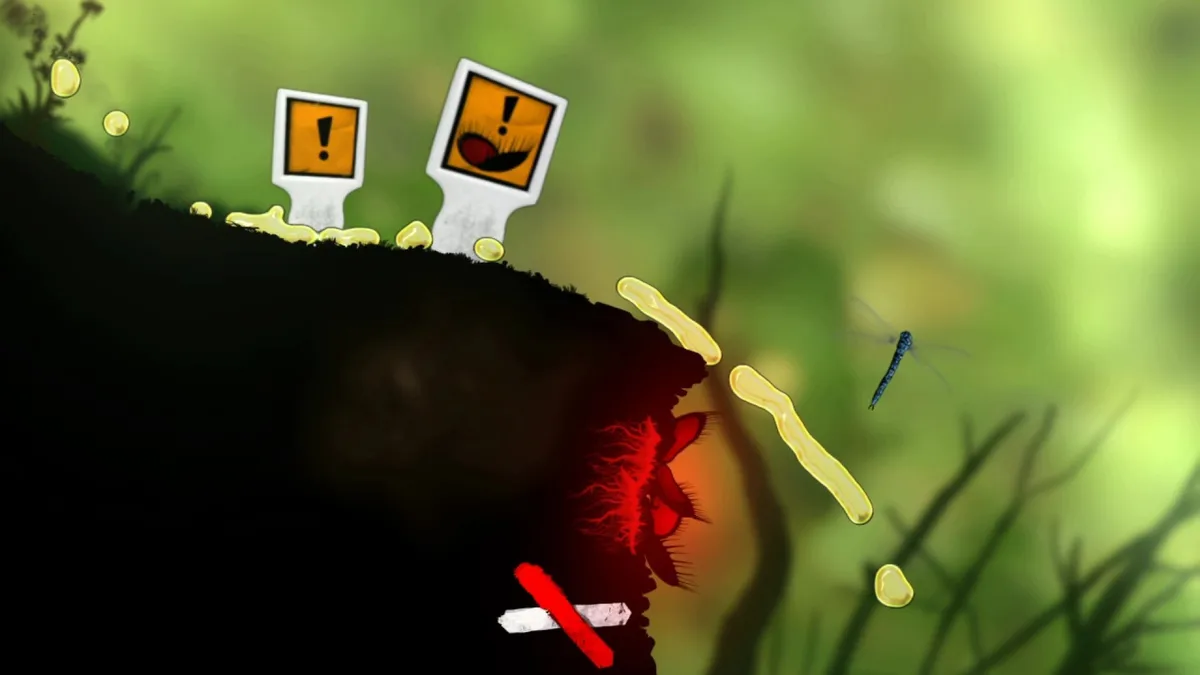
Three obstacle types are named. Burning passageways test whether the fluid can be moved through heat; carnivorous plants represent a living hazard that threatens the puddle; electric currents add an electrical danger to the route. These are not just decorations on a slope — they are the level's stated hazards, and they are the places where the friction, gravity and temperature rule set matters most. A player preparing to cross them has to decide how much momentum the puddle needs and how much it can afford to leave behind.
The interaction of fluid type and hazard is the heart of the puzzle design. A route crowded with burning passageways, plants and currents is a sequence of decisions rather than a single dash. The player tilts, observes, corrects, and tilts again, keeping the fluid's volume in mind at each step. The official material does not enumerate which fluid meets which obstacle, but it does establish that the player should use each liquid's properties to deal with original environments — which is the invitation to experiment within a level.
49 Levels, Two Difficulties and the Laboratory
The campaign is 49 levels long. Each level applies the same tilt-and-conserve rule to a new arrangement of environment, fluid and hazard, which makes the level count a sequence of escalating situations rather than a single long puzzle. Two difficulty modes, normal and extreme, are offered. The official text names them but does not describe how they differ, so the reasonable expectation is that extreme tightens the same conservation challenge — any specific claim about altered physics or scoring rules would go beyond what has been published.
Alongside the main levels sits Laboratory mode, which the official feature list describes as having dozens of objects, backgrounds and liquids to unlock. This is the game's collection layer: playing the campaign opens up an expanding set of materials for the laboratory. The Laboratory is best understood as the experimental counterpart to the structured levels — the place where the full set of unlockable objects, backgrounds and liquids becomes available.
Puddle also includes a leaderboard that lets the player see the scores of players from all over the world, and a medals feature that lets the player compare the medals they have won with those of their friends. These community features give the conservation objective a public dimension: the amount of fluid saved and the medals earned are things to measure against other players. The three progression elements — 49 levels, the Labororatory unlocks, and the leaderboard-and-medals comparison — describe a game that rewards careful, repeatable improvement rather than a single playthrough.
Starting Guidance for New Players
Approach each level as a conservation problem first and a speed problem second. The official instruction is to conserve as much fluid as possible, which means the priority is keeping the puddle together rather than racing it to the end. Tilt in smaller increments than you think you need, watch how the current surface answers, and adjust. On stretches where friction, gravity and temperature are pulling in different directions, patient correction is more reliable than one committed swing of the world.
Identify the fluid before you judge the obstacle. Water, oil, nitroglycerin and molten lava are explicitly different, and the game expects you to use their unique properties. When the environment puts a burning passageway, a carnivorous plant or an electric current between you and the goal, treat it as a test of the specific liquid in play rather than as a generic hazard. Before a difficult section, it is worth testing a small tilt to learn the fluid's response, then committing to the crossing.
If a controller is available, connect it. The game supports Bluetooth or USB game controllers, and the tilt mechanic benefits from fine, sustained control. Finally, use normal difficulty to learn the campaign's rhythm and the Laboratory to explore the fluids and objects once they unlock; the leaderboard and medal comparisons exist for players ready to measure their conservation against others.
What Sets Puddle Apart
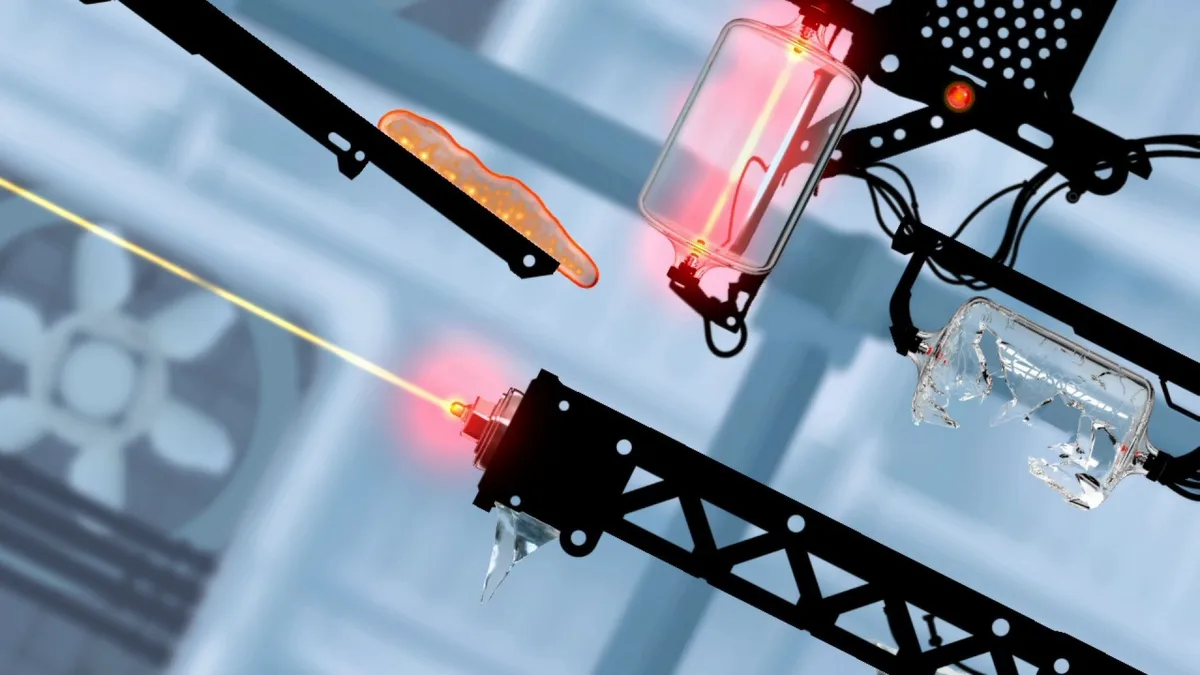
The design identity is fluid simulation as the star of the show. The puddle is not a character with a health bar; it is a shifting body of matter whose shape is a direct readout of the player's choices. Tilting the world makes the player an environmental force rather than a protagonist, and the conservation objective gives that force a stake. The named fluids — water, oil, nitroglycerin, molten lava — and the named hazards — burning passageways, carnivorous plants, electric currents — supply the varied settings in which that relationship is tested.
Originality in environment design is part of the pitch: the game promises a range of original environments, and the combination of sloping geometry, fluid behavior and hazards is the canvas. In practice, that means a player should expect each of the 49 levels to be a self-contained physical situation, not merely a harder version of the last. The Laboratory's dozens of unlockable objects, backgrounds and liquids extend that design catalogue beyond the campaign, suggesting that environmental variety is a core value of the project rather than a back-of-the-box bullet.
Edition and Access Notes
The supplied official listing identifies Puddle as a 2012 release from developer and publisher Neko Entertainment, available for Windows, macOS and Linux, and categorizes it as Action, Indie and Simulation. Those descriptors fit the game described here: it is an action game of continuous adjustment, an indie project built around a single unconventional mechanic, and a simulation of fluid behavior under friction, gravity and temperature. Readers should treat the campaign, difficulty modes and Laboratory as the documented content of this listing rather than assume separate versions or remakes.
Scroll sideways to see the full table →
| Detail | Documented value |
|---|---|
| Developer / Publisher | Neko Entertainment |
| Release year | 2012 |
| Platforms | Windows, macOS, Linux |
| Genres | Action, Indie, Simulation |
| Campaign length | 49 levels |
| Difficulty modes | Normal and extreme |
| Fluids | Water, oil, nitroglycerin, molten lava |
| Named hazards | Burning passageways, carnivorous plants, electric currents |
| Additional mode | Laboratory with objects, backgrounds and liquids to unlock |
| Community features | Worldwide leaderboard; friend medal comparison |
| Controller support | Bluetooth or USB game controllers |
Sources & further reading.
- Puddle — official game profileRetrieved Oct 28, 2026
First published .