 THE GAME ARCHIVE
Infantry on the Eastern Front: Weapons, Sights and Deployment
Infantry combat on the Eastern Front is built around 30 authentic weapons, and each one asks for deliberate handling rather than spraying. Aiming relies on 3D iron sights and a separate 3D scope system, so aiming down the barrel of a rifle or looking through optics are distinct visual actions in the first-person view. The environments themselves vary from city centres to deeply rural ground, and the infantry player moves through those spaces with an advanced movement system. The scope of the fighting is first-person multiplayer combat on the PC, covering both infantry and vehicle actions in detailed settings built from real-world data.
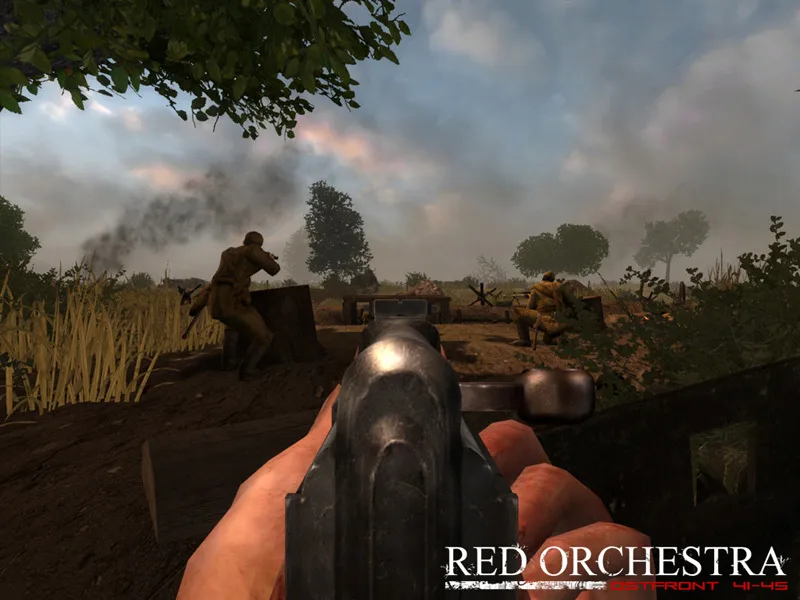
Weapon deployment is its own mechanic: a true deployment system lets a rifle rest on a support, steadying the shot when firing from a fixed position instead of free-standing. Ballistics are modelled realistically for bullets and projectiles, which shapes how firing lanes and cover are used. Deployment, iron sights and ballistics work together: the player finds a support, sets the rifle down, aligns the 3D sights, and fires with the drop and travel of the round accounted for. Voice over IP lets team-mates coordinate strategy while these infantry actions play out across the shared battlefield.
Ballistics and Fragile Cover: Why Bullets Make You Duck
Bullets and projectiles follow realistic ballistic arcs, so a round loses height over distance and can strike cover or pass over it depending on the firing angle. This makes cover meaningful: players duck behind walls, vehicles, or terrain when incoming fire arcs toward them. Because projectiles travel rather than hit instantly, a shooter must judge the distance and the drop, and a target who sees the impact can react by moving to a new position. The result is a firefight where exposure is brief and the ground between combatants matters as much as the sights on the weapon.
Movement supports this cautious rhythm: the advanced player movement system includes diving over obstacles and leaning, letting a soldier break line of sight or peek from behind cover without stepping fully into the open. A custom eight-way animation system drives those actions with highly realistic player animations, so diving and leaning read clearly in first person. Together with ballistics, these mechanics turn ordinary props into fragile protection: a wall stops a round only if the shooter cannot arc over it, and a lean or dive repositions the body before the next shot arrives.
Crewing the Armor: Tanks, Half-Tracks and Long-Range Gunnery
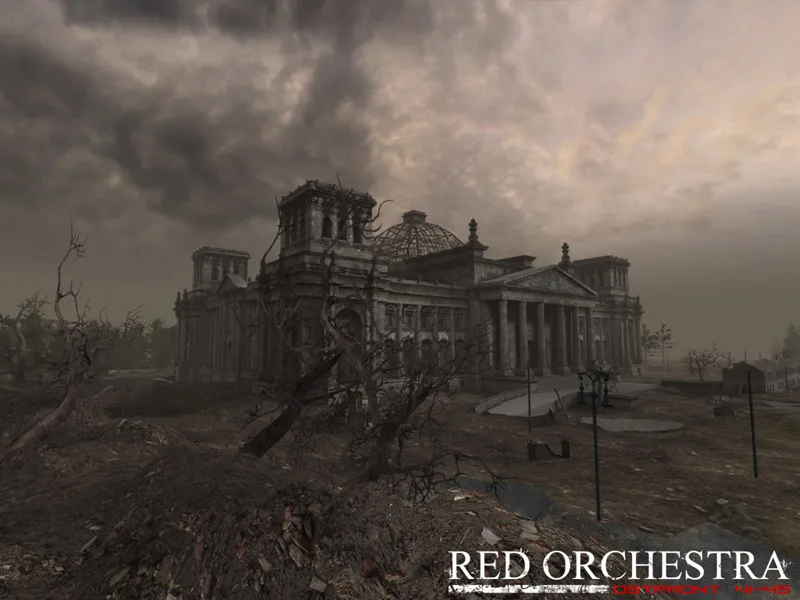
Armored combat is treated as a simulation, built on 16 fully realized vehicles with highly detailed exterior and interior models. The lineup spans half-tracks as well as the most famous German and Soviet heavy tanks, and the Soviet IS-2 carries a massive 122mm cannon. That weaponry sets the scale of the fighting: crews can engage enemy tanks at 800 metres and beyond. For a player, this means identifying a vehicle by its hull or turret, then working the gun at a range where drop and lead matter, all from a first-person view that models the interior as carefully as the outside.
The vehicle actions sit inside the same combined-arms battle as the infantry. A player can crew one of the many armored combat vehicles, from half-tracks to heavy tanks, engaging the enemy with everything in the arsenal, from a bayonet at close quarters up to the 122mm cannon on the Soviet IS-2. If armor alone is not enough, the player finds an officer and a radio to call in artillery strikes. The broader match supports full 50+ player online multiplayer, so armor, infantry weapons and called-in artillery meet in detailed environments.
Calling in the Big Guns: Officers, Radios and Artillery Strikes
Artillery in Red Orchestra is requested rather than carried. A player who needs heavier fire than a personal weapon can provide locates an officer and a radio, then calls in artillery strikes to shake the enemy loose. The game backs this with a historically accurate artillery system, so the strike sits inside the same real-world-data setting as the rest of the battle. Because the officer and radio are the required elements, the action depends on those two pieces being present on the field before any shell lands.
The sound layer around these strikes is distance-based: a dynamic system shapes the battle ambiance according to how far away the fighting is, working alongside authentic immersive sound effects and a 3D positional audio system. Called-in fire therefore arrives as part of a battlefield heard in three dimensions rather than as a flat effect. The artillery action also sits within the wider combined-arms match, where infantry and vehicle combat run together in environments modeled from real-world data, from city centres to deeply rural ground.
Combined Arms and Teamwork: The 50-Player Battlefield
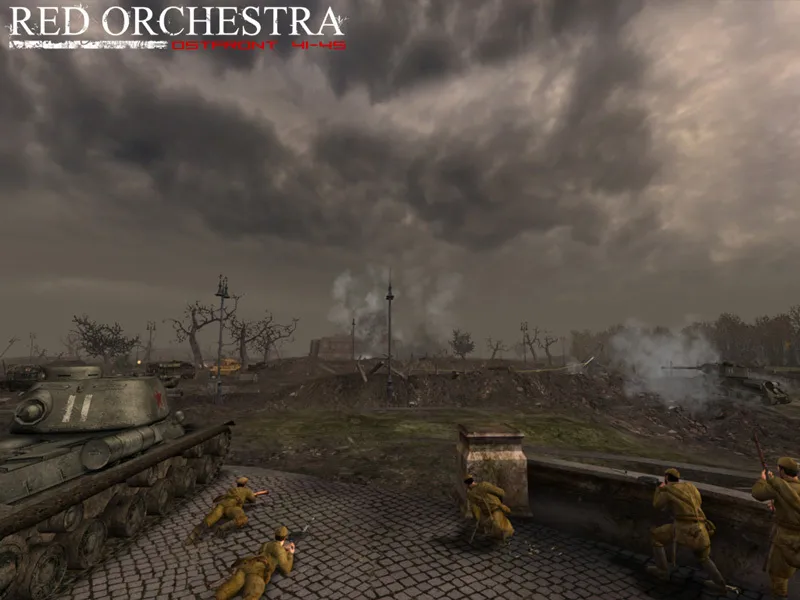
A match in Red Orchestra: Ostfront 41-45 can hold a full 50 or more players online, and the design asks them to share one battlefield rather than split into separate modes. Infantry carry 30 authentic weapons, while crews climb into any of 16 fully realized vehicles modeled inside and out, from half-tracks to the German and Soviet heavies. The Soviet IS-2's 122mm cannon sits at the top of that arsenal, and armored crews can engage enemy tanks at 800 metres and beyond. Called-in artillery sits between those scales: instead of carrying heavy ordnance, a player finds an officer and a radio, then requests a strike to shake the enemy loose.
Because every one of those actions runs inside the same combined-arms fight, communication becomes a practical tool. Voice over IP lets team-mates coordinate strategy while riflemen, tank crews and officers calling in artillery act in the same match. The environments they share are built from real-world data and range from city centres to deeply rural ground. The setting itself is the WWII Russian Front, and the fighting is presented as realistic first-person multiplayer combat on the PC. A strike still depends on an officer and a radio being present on the field before anything lands.
Sources & further reading.
- Red Orchestra: Ostfront 41-45 — official game profile Retrieved Oct 18, 2026
First published .