 THE GAME ARCHIVE
A Judge's Work Is Procedure First
Judge Dredd: Dredd vs. Death is a Windows action game developed and published by Rebellion. What distinguishes its moment-to-moment play is that violence is framed as a legal question before it is a tactical one. The documented loop asks the player to Challenge a perp, offer the chance to surrender, and then arrest the suspect, while a running LawMeter records how well the player is upholding the law. Firing on perps before challenging them, or harming innocent citizens, lowers that meter and, by extension, the end-of-chapter rank.
That frame gives the game two coupled systems to learn. One is procedural: challenge, weaken or disarm, arrest, and keep the LawMeter climbing toward a better rank. The other is the Lawgiver MkIII, which fires six ammunition types from one all-purpose magazine, each draining it at a different rate. Choosing the right round for the target — armour-piercing against metal, incendiary against the undead, ricochet in confined space — is a second layer of decision-making on top of the arrest-first rule.
Walking the Beat: Controls and the Arrest-First Loop
On foot, the default keyboard layout sends the Judge forward and back with W and S, steps him left and right with A and D, jumps with Space, and crouches with Shift. Combat maps to the mouse: the left button fires and the right button performs a melee strike, while the Q key throws a grenade. The E key issues a Challenge, and the F key is the general Action key used for objects, arrests, and requests.
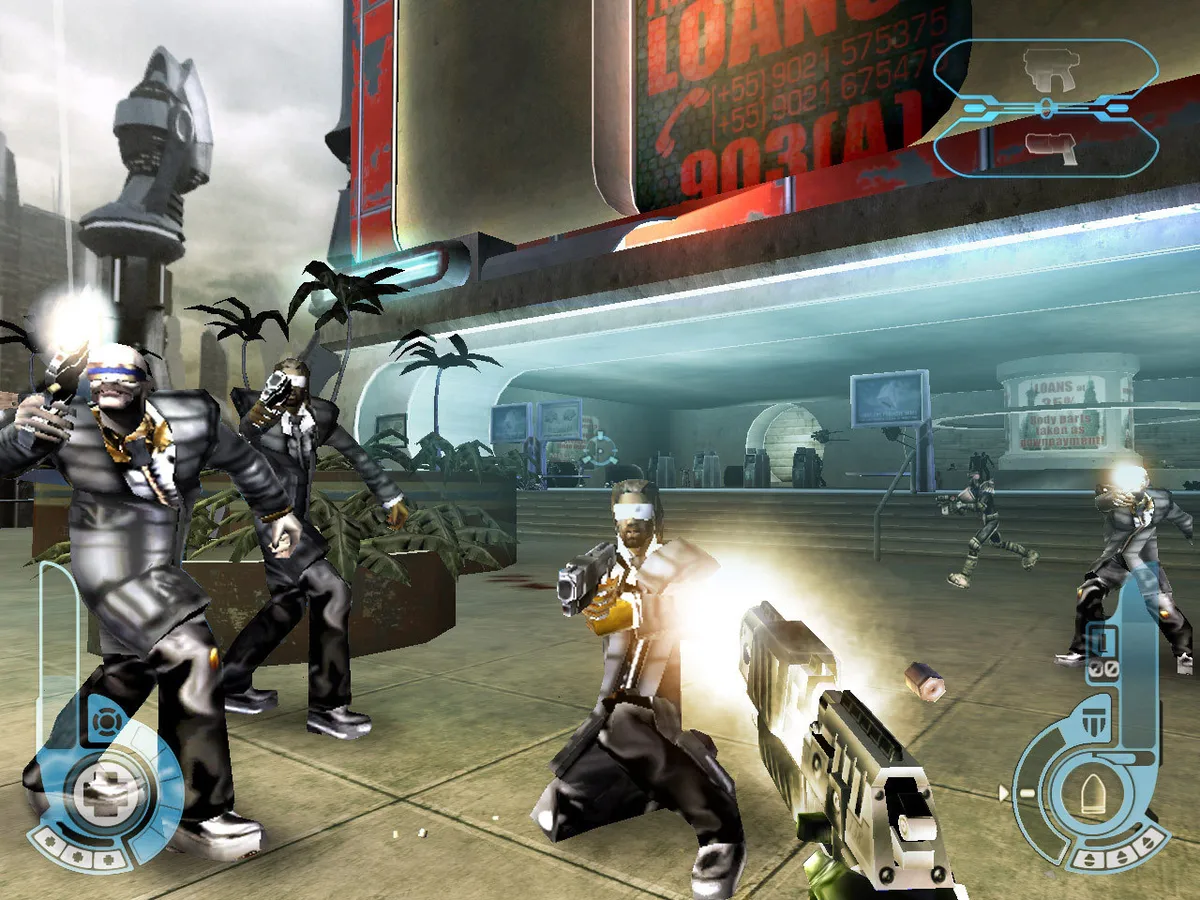
The arrest-first loop begins by walking up to a perp and Challenging them. Unarmed suspects often surrender immediately, though some draw a weapon and fight; armed suspects may give up if surprised from behind or if their morale is worn down enough, and shooting a gun from their hands usually forces a surrender unless they are suicidal and charge bare-handed. Return fire is legal once someone attacks, so the LawMeter holds steady, but harming citizens or firing on perps before challenging them lowers it, while each successful arrest or completed objective raises it.
The LawMeter and the SJS: Policing Your Own Conduct
The LawMeter is the running gauge of how well you are upholding the law as a Judge, and it moves in two directions. Every successful arrest or completed chapter objective pushes it upward, while harming innocent citizens or attacking perpetrators before challenging them sends it down. Firing incendiary ammunition at ordinary citizens draws the Justice Department's disapproval and causes a sharp drop. Very minor offences may not register any increase at all. Because your final rank at the end of a chapter is based partly on your closing LawMeter reading, the manual advises keeping it as high as you can.
Letting the meter bottom out has a named consequence rather than an immediate failure. If your LawMeter sits at zero and you then commit an unlawful act, the Justice Department declares you rogue, and the Special Judicial Squad is dispatched to take you down — turning an enforcement run into a pursuit in which the enforcing agency is the threat. One upside the manual notes for incendiary use: it devastates the morale of any onlookers, which helps when you are heavily outnumbered. Separately, your body armour carries a layer of Nanite technology that gives it limited self-healing; if the armour rating drops, staying out of trouble for a few seconds lets it repair itself.
Ranks, Chapter Unlocks, and Story or Co-op Play
Your end-of-chapter score produces a rank drawn from a five-step ladder: Cadet, Rookie, Street Judge, Senior Judge, and finally Judge Dredd. The top title comes with a condition — any unlawful death on your record during the chapter disqualifies you from the Judge Dredd rating, and you receive the rank directly below it instead. The chapter select screen displays your highest rank for each chapter, so you can revisit earlier stages to try to improve that mark. The multiplayer roster also reacts to the ladder: the higher the rank you earn, the more multiplayer characters become available.
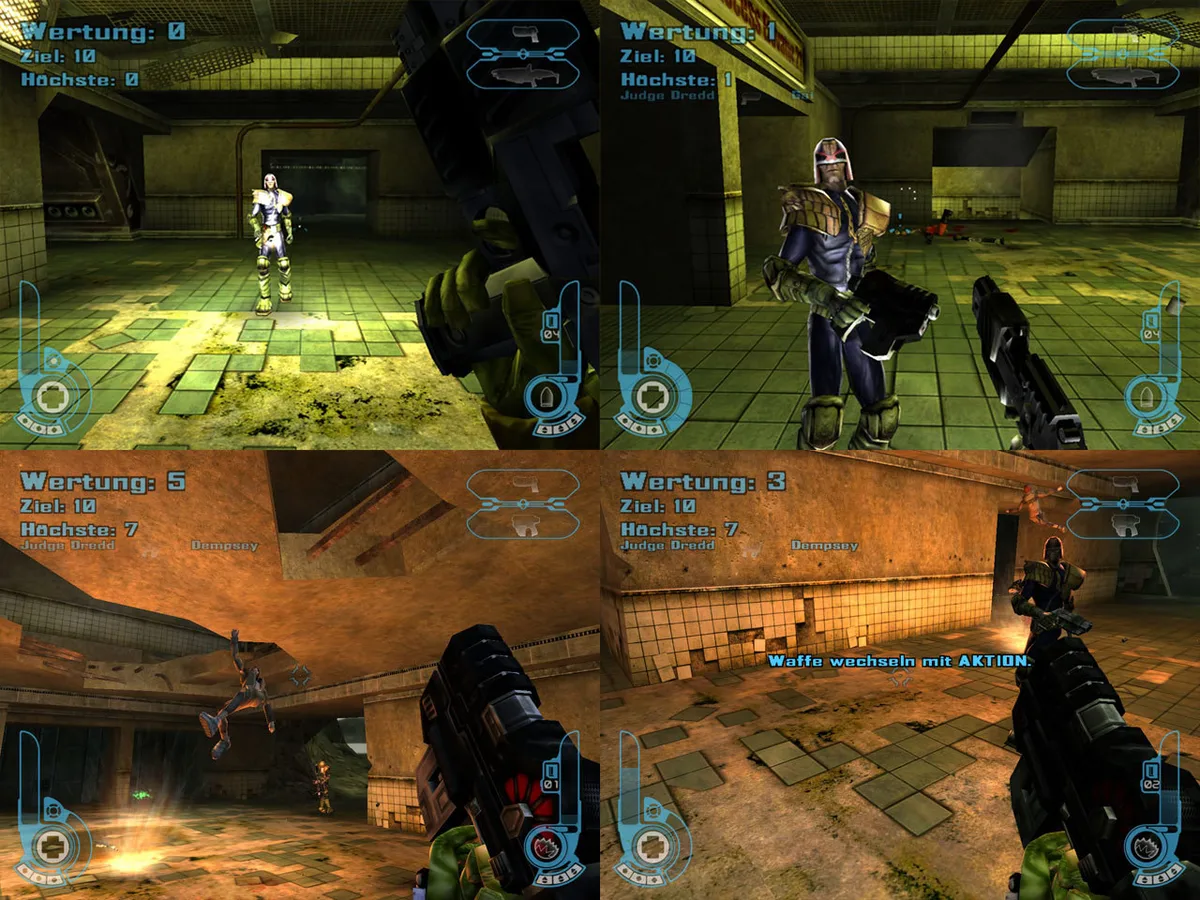
The story chapters form a sequential progression: you advance by unlocking each chapter in turn, and the difficulty setting you pick for a new chapter must be equal to or lower than the setting used in the previous chapter. Co-operative play runs through that same Story mode with a second player. Player 1 controls Judge Dredd in the top half of the screen, while Player 2 controls Judge Rico in the bottom half. The arcade side has its own ties to ranking: outside the games available from the start, further arcade games unlock by earning a high rank in Story mode, and high ranks in arcade games unlock cheats usable in Story mode.
The Lawgiver MkIII and Stumm Gas in Action
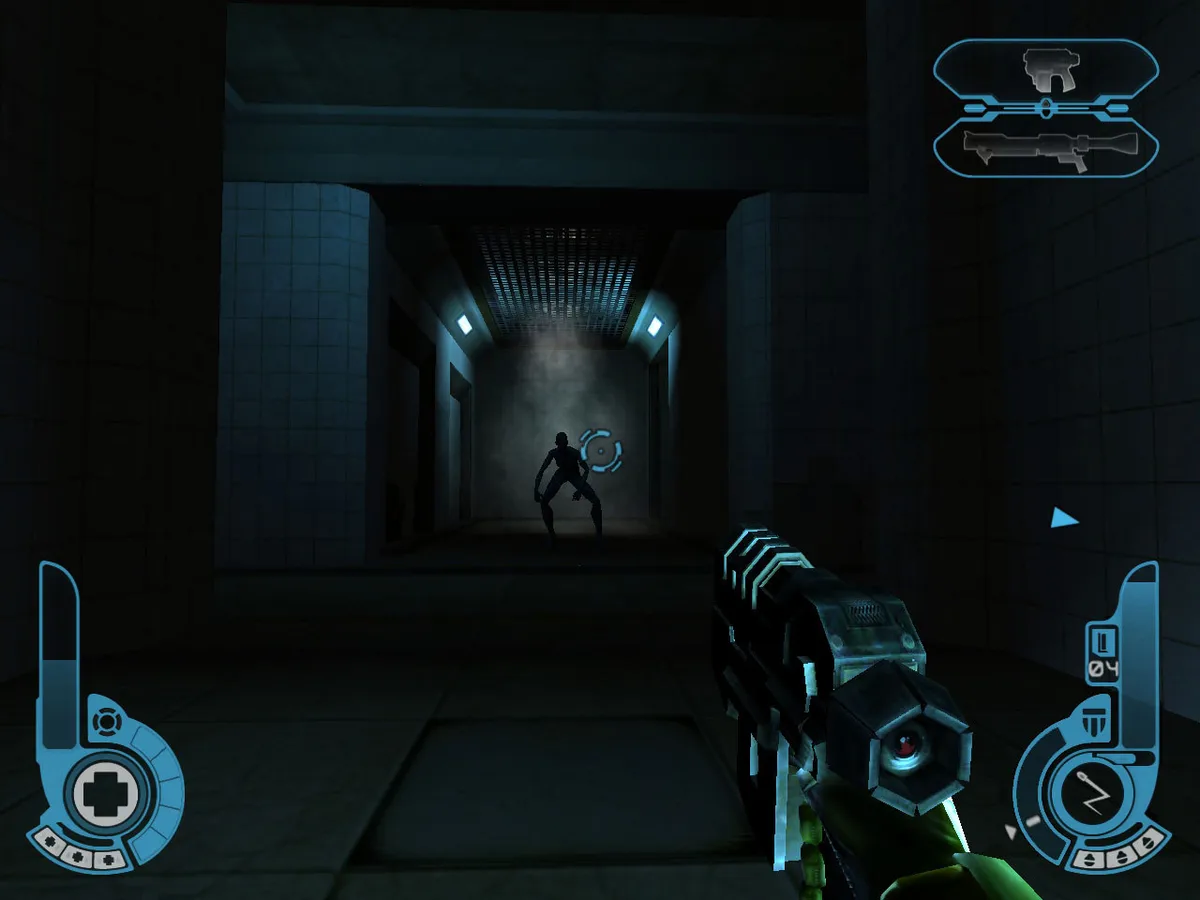
The Lawgiver MkIII is the fixed primary weapon a Street Judge carries, and it cannot be dropped. Its all-purpose magazine feeds six different ammunition types, each consuming the magazine at its own rate. Standard Execution delivers a fast-firing, average-damage bullet at 64 shots per magazine. Armour Piercing gives 32 shots and passes through metal, making it useful against robots, and it can also travel through several perps at once. Ricochet, another 32-shot load, gains damage after striking a surface, which suits confined areas but carries a rebound risk. Incendiary and Hi-Ex each hold only 8 shots; incendiary sets targets alight and works well against vampires and the undead. A secondary weapon can be swapped by walking over a gun and pressing the action key.
Stumm gas grenades choke and incapacitate perps, which simplifies the arrest that follows. The Q key throws a grenade, and the throw distance depends on how long Q is held down, so a brief press drops it close while a longer hold sends it farther. Switching between Lawgiver ammunition modes uses the mouse wheel. These tools sit alongside the arrest-first loop: gas can put a suspect down for a Challenge and formal arrest, while the Lawgiver's specialised rounds let a Judge pick the loading that fits the target, from armour-piercing shots against machines to incendiary rounds against the undead.
Multiplayer Mayhem: 32 Players and Team Modes
Multiplayer in this Windows action game runs over a LAN and supports up to 32 players, with enemy bots and more than 60 selectable characters filling out the roster for larger matches. The manual documents several distinct modes. Deathmatch and Team Deathmatch set players against each other toward a score limit, while Bounty Hunter casts one player as Dredd and everyone else as hunters; Dredd earns points for each perp he takes down, and any player who kills Dredd becomes Dredd in his place. The match ends when someone reaches the score limit or when time expires, with the highest score winning.
Two modes turn on team structure. In Informant, an unarmed informant escorted by a Judge must travel from the Safe House to the Pickup Point; that team wins the round if the informant reaches the base, while the opposing Perps win by killing the informant. Judges versus Perps works like Deathmatch but limits each side's loadout: Judges start with and can only pick up Justice Department weaponry, while Perps and Civilians are restricted to civilian weaponry. Killing a friendly team member costs that team a point.
A Judge's Work Is Procedure First
Judge Dredd: Dredd vs. Death is a Windows action game developed and published by Rebellion. What distinguishes its moment-to-moment play is that violence is framed as a legal question before it is a tactical one. The documented loop asks the player to Challenge a perp, offer the chance to surrender, and then arrest the suspect, while a running LawMeter records how well the player is upholding the law. Firing on perps before challenging them, or harming innocent citizens, lowers that meter and, by extension, the end-of-chapter rank.
That frame gives the game two coupled systems to learn. One is procedural: challenge, weaken or disarm, arrest, and keep the LawMeter climbing toward a better rank. The other is the Lawgiver MkIII, which fires six ammunition types from one all-purpose magazine, each draining it at a different rate. Choosing the right round for the target — armour-piercing against metal, incendiary against the undead, ricochet in confined space — is a second layer of decision-making on top of the arrest-first rule.
Walking the Beat: Controls and the Arrest-First Loop
On foot, the default keyboard layout sends the Judge forward and back with W and S, steps him left and right with A and D, jumps with Space, and crouches with Shift. Combat maps to the mouse: the left button fires and the right button performs a melee strike, while the Q key throws a grenade. The E key issues a Challenge, and the F key is the general Action key used for objects, arrests, and requests.
The arrest-first loop begins by walking up to a perp and Challenging them. Unarmed suspects often surrender immediately, though some draw a weapon and fight; armed suspects may give up if surprised from behind or if their morale is worn down enough, and shooting a gun from their hands usually forces a surrender unless they are suicidal and charge bare-handed. Return fire is legal once someone attacks, so the LawMeter holds steady, but harming citizens or firing on perps before challenging them lowers it, while each successful arrest or completed objective raises it.
The LawMeter and the SJS: Policing Your Own Conduct
The LawMeter is the running gauge of how well you are upholding the law as a Judge, and it moves in two directions. Every successful arrest or completed chapter objective pushes it upward, while harming innocent citizens or attacking perpetrators before challenging them sends it down. Firing incendiary ammunition at ordinary citizens draws the Justice Department's disapproval and causes a sharp drop. Very minor offences may not register any increase at all. Because your final rank at the end of a chapter is based partly on your closing LawMeter reading, the manual advises keeping it as high as you can.
Letting the meter bottom out has a named consequence rather than an immediate failure. If your LawMeter sits at zero and you then commit an unlawful act, the Justice Department declares you rogue, and the Special Judicial Squad is dispatched to take you down — turning an enforcement run into a pursuit in which the enforcing agency is the threat. One upside the manual notes for incendiary use: it devastates the morale of any onlookers, which helps when you are heavily outnumbered. Separately, your body armour carries a layer of Nanite technology that gives it limited self-healing; if the armour rating drops, staying out of trouble for a few seconds lets it repair itself.
Ranks, Chapter Unlocks, and Story or Co-op Play
Your end-of-chapter score produces a rank drawn from a five-step ladder: Cadet, Rookie, Street Judge, Senior Judge, and finally Judge Dredd. The top title comes with a condition — any unlawful death on your record during the chapter disqualifies you from the Judge Dredd rating, and you receive the rank directly below it instead. The chapter select screen displays your highest rank for each chapter, so you can revisit earlier stages to try to improve that mark. The multiplayer roster also reacts to the ladder: the higher the rank you earn, the more multiplayer characters become available.
The story chapters form a sequential progression: you advance by unlocking each chapter in turn, and the difficulty setting you pick for a new chapter must be equal to or lower than the setting used in the previous chapter. Co-operative play runs through that same Story mode with a second player. Player 1 controls Judge Dredd in the top half of the screen, while Player 2 controls Judge Rico in the bottom half. The arcade side has its own ties to ranking: outside the games available from the start, further arcade games unlock by earning a high rank in Story mode, and high ranks in arcade games unlock cheats usable in Story mode.
The Lawgiver MkIII and Stumm Gas in Action
The Lawgiver MkIII is the fixed primary weapon a Street Judge carries, and it cannot be dropped. Its all-purpose magazine feeds six different ammunition types, each consuming the magazine at its own rate. Standard Execution delivers a fast-firing, average-damage bullet at 64 shots per magazine. Armour Piercing gives 32 shots and passes through metal, making it useful against robots, and it can also travel through several perps at once. Ricochet, another 32-shot load, gains damage after striking a surface, which suits confined areas but carries a rebound risk. Incendiary and Hi-Ex each hold only 8 shots; incendiary sets targets alight and works well against vampires and the undead. A secondary weapon can be swapped by walking over a gun and pressing the action key.
Stumm gas grenades choke and incapacitate perps, which simplifies the arrest that follows. The Q key throws a grenade, and the throw distance depends on how long Q is held down, so a brief press drops it close while a longer hold sends it farther. Switching between Lawgiver ammunition modes uses the mouse wheel. These tools sit alongside the arrest-first loop: gas can put a suspect down for a Challenge and formal arrest, while the Lawgiver's specialised rounds let a Judge pick the loading that fits the target, from armour-piercing shots against machines to incendiary rounds against the undead.
Multiplayer Mayhem: 32 Players and Team Modes
Multiplayer in this Windows action game runs over a LAN and supports up to 32 players, with enemy bots and more than 60 selectable characters filling out the roster for larger matches. The manual documents several distinct modes. Deathmatch and Team Deathmatch set players against each other toward a score limit, while Bounty Hunter casts one player as Dredd and everyone else as hunters; Dredd earns points for each perp he takes down, and any player who kills Dredd becomes Dredd in his place. The match ends when someone reaches the score limit or when time expires, with the highest score winning.
Two modes turn on team structure. In Informant, an unarmed informant escorted by a Judge must travel from the Safe House to the Pickup Point; that team wins the round if the informant reaches the base, while the opposing Perps win by killing the informant. Judges versus Perps works like Deathmatch but limits each side's loadout: Judges start with and can only pick up Justice Department weaponry, while Perps and Civilians are restricted to civilian weaponry. Killing a friendly team member costs that team a point.
Sources & further reading.
- Judge Dredd: Dredd vs. Death — official game profile Retrieved Oct 17, 2026
- Judge Dredd: Dredd vs. Death — official game profile — publisher-supplied gameplay manual Retrieved Oct 18, 2026
First published .