 THE GAME ARCHIVE
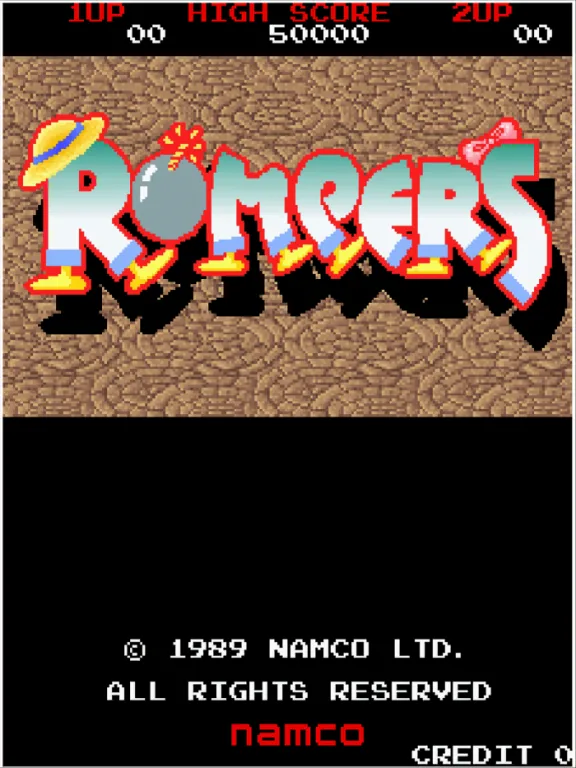
ROMPERS is a Namco arcade action puzzle released in 1989, and its design rests on a small, tightly interlocking set of rules. The player controls a hero named CHAP through maze environments, where three demands sit on top of one another: evade monster attacks, collect all of the keys in the mazes, and knock down the stone walls with all your might to beat the monsters. Each of those verbs is documented for the game, and together they describe a loop in which the maze is simultaneously a collection route, a hazard field and a weapon.
What makes the game more than a maze chase is the way the environment itself is the offensive tool. The publisher description does not describe a separate weapon, projectile or attack command detached from the level layout; it says CHAP knocks down the stone walls to beat the monsters. That single rule turns the walls from simple barriers into something the player has a reason to interact with, because removing one is how a threat is dealt with. The same rule also implies a cost, since the walls that frame the maze are the same structures CHAP brings down.
The Premise: One Hero, One Maze, Three Jobs
The whole premise is stated in a single publisher instruction: control the hero CHAP, evade monster attacks, collect all of the keys in the mazes, and knock down the stone walls with all your might to beat the monsters. Read as a list of jobs, it is unusually compact. There is one controllable character, one collectible type named in the source, one named obstacle to destroy, and one named adversary to avoid or defeat. Everything the player does in ROMPERS hangs off those four elements, and the game's tension comes from the fact that they occupy the same space.
The setting is built from maze environments, and the stone walls are presented as part of that visual identity rather than as an incidental backdrop. That matters for how the player reads the screen: a maze made of destructible stone walls is a space whose shape is not fixed. The publisher describes CHAP as moving through the mazes while the walls remain present as structures to be knocked down. The result is a game whose geography is both the puzzle to solve and the material the hero works with.
ROMPERS belongs to the action puzzle genre, which is the catalog's own classification and fits the description well: the mazes supply the puzzle structure, and the monsters, evasion and wall destruction supply the action. The game was published by Namco and released for the arcade, and the catalog gives the release year as 1989. Those details frame the play described in the publisher text; they do not change the four core elements, which are what the player actually contends with.
The Core Loop: Collect All the Keys
Key collection is the objective that defines progress. The publisher description is explicit that the player is to collect all of the keys in the mazes, not merely a quota of them, which sets the completion condition for a maze at full collection. Every key in a given layout therefore matters, and the player's route through the maze has to reach all of them. The keys are named as the collectible tied to the objective, so there is no ambiguity in the source about what is being gathered.
Because the keys are in the mazes, the collection route is shaped by the maze itself. The maze environments are the level structure, and the stone walls bound the routes between keys. A player hunting the last key is thus working against the layout, and the layout is the thing CHAP can knock down. That makes the search for keys more than a matter of walking a fixed path: the route can be altered, and altering it is tied to the same action used against monsters.
The other half of the loop does not pause while the player collects. Evading monster attacks is stated in the same instruction as the key collection, and the monsters occupy the same mazes as the keys. There is no documented separation into a collection phase and a combat phase; the pressure of the monsters runs alongside the hunt for keys. In practice, that means the player is balancing two goals at once in an enclosed space rather than finishing one task before starting the next.
The documented ordering of the loop is worth stating plainly, because it sets expectations. Gather every key in the maze while avoiding monster attacks, and use full-force wall destruction to beat the monsters. The keys are the objective tied to progression; defeating monsters is the outcome of the destruction action. A player who keeps those two threads distinct while moving through the maze is playing the game the source describes.
Evading Monster Attacks
Evasion is listed as an objective in its own right, alongside key collection. That phrasing tells the player that avoiding monster attacks is not optional housekeeping but part of the stated task. The monsters are the named adversaries in the source, and their attacks are what CHAP is told to evade. The collision system, as far as the documentation goes, is defined in terms of those monster attacks.
The walls complicate evasion in a useful way. Because the stone walls divide the maze and can be knocked down, they are both cover and a material the player might choose to remove. A hero who brings a wall down against a monster is changing the field at the same time as removing a threat. The source does not spell out every tactical consequence of that, but the combination of maze navigation, monster attacks and stone-wall destruction is enough to describe a space where position and structure are always in play.
Evasion also interacts with the collection rule. The keys are spread through the mazes, so the player has to keep moving to collect them, and monster attacks threaten that movement. The source presents both as things the player does while controlling CHAP through the maze. The safe player is the one who can keep collecting keys without letting the monsters close in, and the design states no separate safe zone or alternate objective that would let the player ignore them.
Knocking Down Stone Walls
The one offensive action documented for ROMPERS is knocking down the stone walls. CHAP does it with all his might, and the stated purpose is to beat the monsters. There is no mention of a separate weapon in the source; the destruction action itself is the answer to a monster. That design choice gives every wall in the maze two possible meanings. It can be a barrier that limits the route to a key, or it can be the means by which a monster is defeated.
The phrase 'with all your might' is part of the publisher's own wording, and it frames the action as an exertion rather than a passive tap. The player is told to knock the walls down, and the stated result is beating the monsters. That pairing is the distinctive mechanic of ROMPERS as documented: offense is drawn from the architecture, and the architecture is the same maze the player is navigating to collect keys.
Defeating a monster through wall destruction is about clearing pressure, not about finishing the level. The objective that defines progress remains collecting all of the keys, so the wall action sits inside the key hunt rather than replacing it. A player who knocks down a wall to beat a monster is still obliged to find every remaining key in the maze. That relationship between the two actions is the part of the design most worth holding onto when reading the publisher text.
The maze and the walls work together at the level of navigation as well. The maze environments are where the game takes place, and the stone walls are the prominent structure within them. Because the walls can come down, the space the player moves through is not purely a fixed puzzle; it is a puzzle whose pieces are also the means of attack. The game's identity, as far as the source documents it, is that overlap between navigation, collection and destruction.
How to Approach the Maze
Starting guidance has to stay inside what the source establishes, and the source establishes enough for three practical priorities. First, treat the keys as the finish line: the stated objective is to collect all of them, so the player's route should be planned around finishing the set rather than around wandering. Second, treat monster attacks as a live constraint rather than an afterthought, because evasion is stated right alongside collection. Third, remember that wall destruction is how monsters are beaten, so the walls are not purely scenery to be avoided.
A useful way to read a fresh maze is to ask where the keys are relative to the walls that divide the space. Since the keys are in the mazes and the walls shape the routes between them, the layout itself is the first thing to assess. Once a player knows which walls stand between them and the remaining keys, they can decide whether a monster is worth dealing with by bringing a wall down or whether evasion is the better response in that moment. The source supports both responses as part of play.
Players should also expect the game to keep the two big verbs distinct in their purposes. Evading is about staying out of trouble during the key search, while knocking down a wall is about beating a monster. Mixing them up is easy, because both involve moving through the same maze, but the source assigns them different outcomes. Keeping the key count in mind as the measure of progress helps keep the priority straight while dealing with monsters.
The Arcade Archives Reissue and Current Access
ROMPERS appears in the Arcade Archives series, which describes itself as faithfully reproducing classic arcade game masterpieces and staying true to the originals. That framing matters for reading the modern package: the maze rules, the key collection, the monster evasion and the stone-wall destruction are presented as the original game's content, not as new systems unique to the reissue. The package-specific additions are presentation and settings layers around that reproduced game.
The reissue's settings let the player customize the game, including adjusting the difficulty level. That is a change to how the base game is configured rather than a new mechanic inside the maze; the documented objectives do not change with it. Depending on the title in the series, the package can also recreate the atmosphere of CRT televisions from the past, which is an optional presentation treatment for the reproduced game. Both of these belong to the modern licensed release.
Online rankings are the other documented addition: players can compete for high scores with people from around the world. In a game whose objective is to clear mazes by collecting all the keys, a worldwide score comparison gives the reproduced arcade play an ongoing target beyond a single session. The rankings are described as a feature of the reissue package, and the source does not attach them to the 1989 arcade version.
The original release is a 1989 Namco arcade title, and the reissue is the modern licensed package through which the same game is presented. That distinction is the main edition difference the source supports: same maze rules, different surrounding options. The catalog does not document additional ports, remakes or alternate versions beyond the arcade original and the Arcade Archives release.
Scroll sideways to see the full table →
| Item | Documented detail |
|---|---|
| Title | ROMPERS |
| Release year | 1989 |
| Platform | Arcade |
| Publisher | Namco |
| Genre | Action puzzle |
| Player character | CHAP |
| Objective | Collect all of the keys in the mazes |
| Hazard | Monster attacks |
| Offensive action | Knock down the stone walls with all your might to beat the monsters |
| Modern release | Arcade Archives, with customizable difficulty, optional CRT-style presentation and online rankings |
Sources & further reading.
- ROMPERS — licensed publisher game documentation Retrieved Oct 19, 2026
First published .