 THE GAME ARCHIVE
A Wartime Strategy Game Where Perception Is a Weapon
R.U.S.E. is a real-time strategy game from Eugen Systems, listed on its official store profile with a release year of 2010 and support for Windows. Where most strategy games of its era asked you to win through superior numbers or faster production, R.U.S.E. was designed around a different premise: that the most valuable thing on a battlefield is not a tank, but what your opponent believes about that tank.
That idea runs through the entire game. You command armies drawn from the major powers of the Second World War, but you also command information itself. You can hide your troops, plant false ones, spy on the enemy's intentions, and push units into sudden bursts of aggression — all through a card system that the game treats as its central mechanic rather than a side feature. The result is a strategy game that plays less like a ledger of unit costs and more like a series of gambles.
The Premise: World War II as a Duel of Wits
The single-player campaign casts you as Major Joe Sheridan, following an adventure that runs from the deserts of North Africa to the plains of Western Europe. Each mission is described as combining strategy, storytelling, and plot twists, so the campaign functions as both a tutorial in the game's unusual vocabulary and a narrative frame for it.
Beyond the campaign, the game offers Operations, a set of independent tactical challenges meant to push your skills in extreme situations. There is also Skirmish against AI opponents, which lets you customize matches for practice or for fast, intense battles against what the source describes as reactive and versatile artificial intelligence.
RUSE Cards: The Mechanic That Changes Everything
RUSE are special cards you can activate at any moment to influence enemy perception, reinforce your troops, or gain crucial intelligence. The design intent is explicit: they make every engagement a duel of wits, and they transform bluffing from a psychological side effect of war into a direct, usable tool.
The cards fall into four categories, each addressing a different layer of the information war:
- Reveal Information — decryption and espionage, giving you a clearer picture of what your opponent is actually doing.
- Conceal Information — radio silence and camouflage, denying the enemy that same picture.
- Create Decoys — dummy units and false offensives, manufacturing threats that do not exist.
- Alter Unit Behavior — blitz and terror, changing how your forces fight when the moment calls for it.
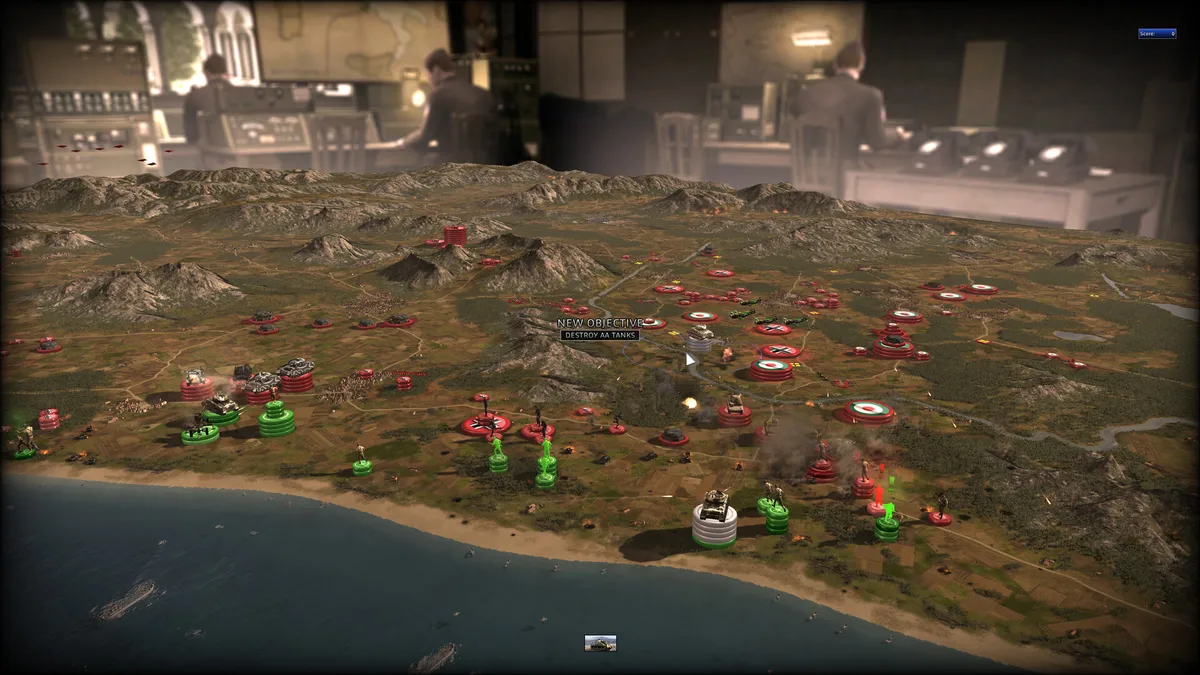
The interesting part is how these categories interact. A decoy is only useful if the enemy has enough information to believe it; camouflage is only valuable if the enemy is actively trying to look. Combining cards lets you orchestrate more complex strategies than any single card allows, which is the real strategic depth the game is chasing.
 View full image ↗
Factions: Six Armies, Six Ways to Play
Each faction in R.U.S.E. embodies a great power of the Second World War and brings its own units, characteristics, and playstyles. Choosing one is described as adopting a different strategic approach, tailored to the way you prefer to think as a commander.
The official faction descriptions sketch distinct identities rather than balanced mirror armies:
- United States — versatility and industrial might
- Germany — quality and firepower
- France — resilience and defense
- United Kingdom — air power and artillery
- USSR — quantity and durability
- Italy — speed and mobility
Read as a set, these identities suggest very different relationships with the RUSE system. A defensive faction wants concealment and decoys to buy time; a fast faction wants blitz behavior to convert mobility into a decisive strike. The source does not spell out those pairings, so treat them as inferences from the stated faction traits rather than documented strategy.
Modes and Victory Conditions
Multiplayer supports 2 to 8 players on varied, customizable maps inspired by World War II theaters of operations. You choose your map, your game mode, and the player distribution, whether teams or free-for-all.
Four modes shape how a match unfolds:
- Classic Mode — all units are available from the start, depending on the chosen era: 1939, 1942, or 1945.
- Total War — a progressive three-phase mode spanning 1939, 1942, and 1945, where new bases and units unlock at each stage.
- Nuclear Mode — a race for the atomic bomb, where the first player to produce and deploy nuclear artillery wins the match.
- Ranked Mode — competition against players worldwide with a global leaderboard to climb.
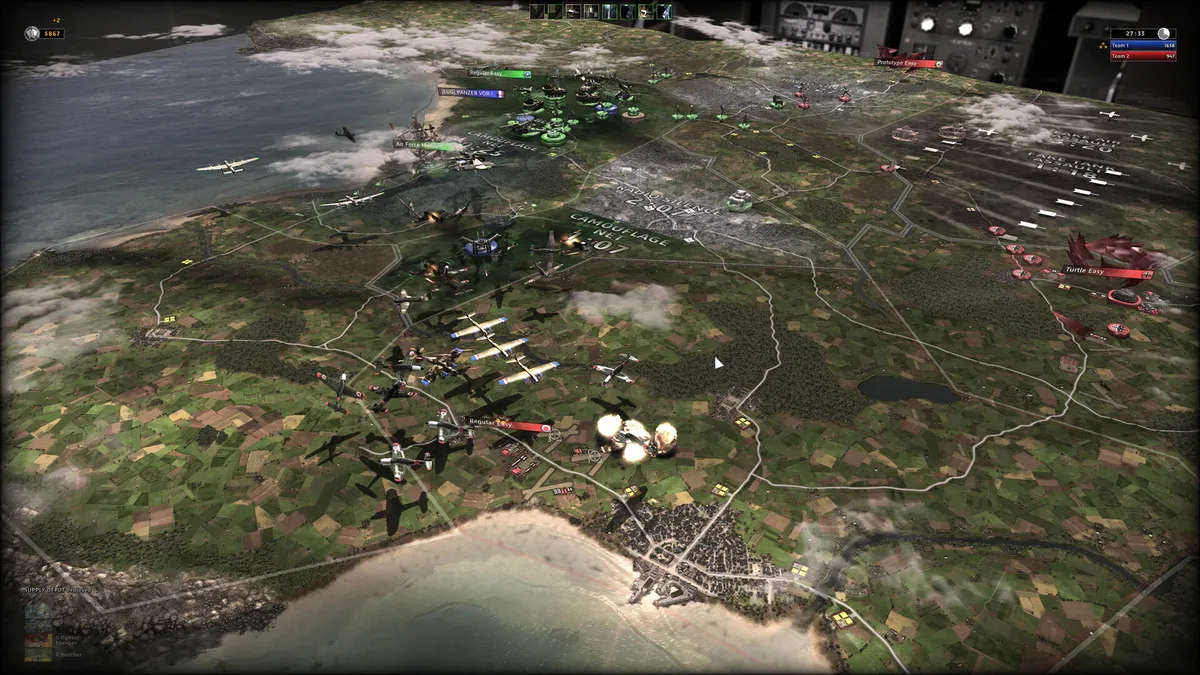
Victory is achieved either by destroying all enemy bases and units or by accumulating more points than your opponent by the end of the time limit. You earn points for every enemy unit destroyed, which rewards tactical play and daring maneuvers and gives losing players a path back into a match.
That dual win condition pairs unusually well with the card system. If points matter as much as elimination, then baiting an opponent into wasting an assault on decoys becomes a scoring strategy, not just a delaying tactic. The source documents the rules that make this possible; it does not describe specific tournament play or balance outcomes.
 View full image ↗
IRISZOOM and the Board-Game View
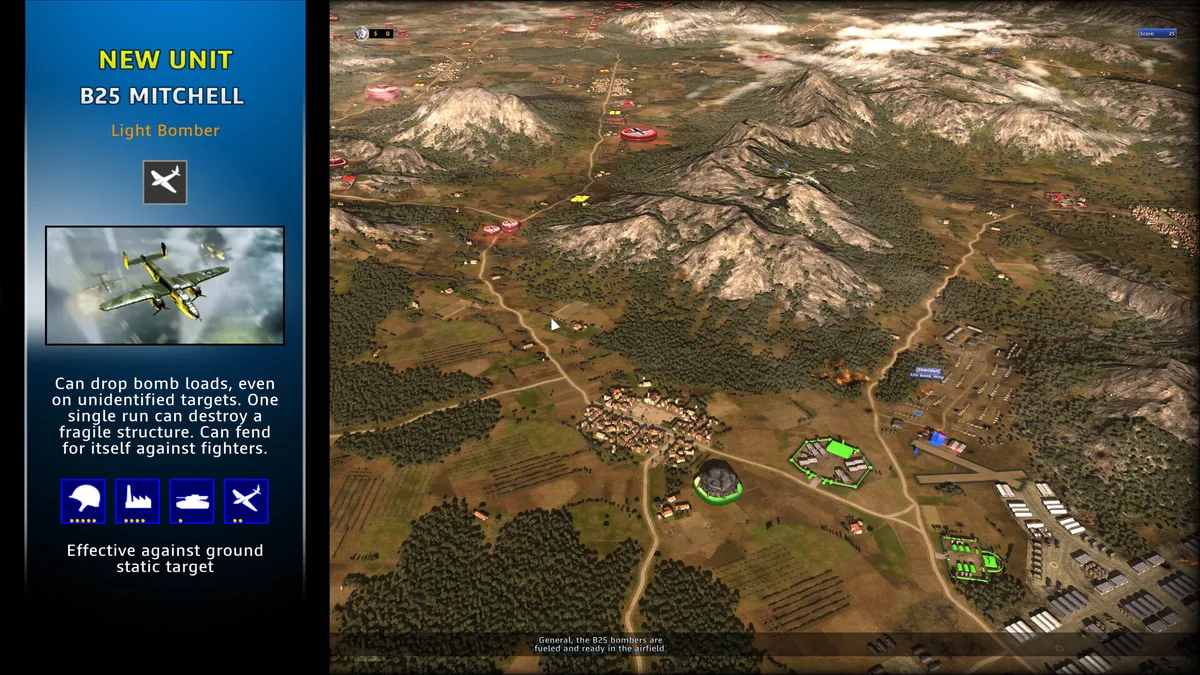
R.U.S.E. uses the IRISZOOM engine, described as exclusive to the game, to give players an unusually wide range of perspective. You can drop down to inspect individual units up close or pull out to a bird's-eye overview that the source compares to a board game.
This is more than a visual flourish. If deception is the core mechanic, then your view of the battlefield is itself part of the design: the zoom range lets the game move between the granular scale where a decoy looks like a real tank and the abstract scale where whole formations read as pieces on a map. The source stops short of describing how the camera affects gameplay directly, so the connection here is interpretive.
The Definitive Edition, Then and Now
The version described in the official listing is the Definitive Edition, which includes all DLCs and Steam Deck support. This matters for anyone approaching R.U.S.E. today: the package is not the bare 2010 release, but a bundle that folds in the extra content and adds a handheld compatibility claim from the store itself.
Keep the release year scoped carefully: 2010 is the year attached to this Steam entry by the source, not a reconstruction of the game's original retail history on other platforms. The listing also documents only Windows among supported platforms.
 View full image ↗
How to Approach the Game
The documented material supports a few sensible starting points without requiring guesswork. The campaign follows Major Joe Sheridan through a structured set of missions, which makes it the natural first stop for anyone learning the game's vocabulary. Operations then offers standalone tactical challenges for players who want pressure without a narrative frame, and Skirmish against AI lets you customize matches and choose among the documented modes.
For mode selection, Classic Mode's all-units-from-the-start rule makes it the least gated option, while Total War's three-phase structure introduces units and bases gradually across 1939, 1942, and 1945. Nuclear Mode is a distinct objective-based race rather than a conventional battle, and Ranked Mode is the competitive track with the global leaderboard attached.
On the card side, the four categories give a clean mental checklist before any engagement: do I need to see something, hide something, fake something, or change how my units behave? The source documents the categories and the ability to combine them, but it does not provide card costs, cooldowns, or timing windows, so those decisions will have to be learned in play.
What the Official Material Does Not Cover
A useful feature has to be honest about its edges. The available documentation does not describe how unit production is tied to bases or resources, how the unlock progression works in mechanical detail beyond Total War's phases, or how the controls handle unit selection and card activation during combat. It also does not describe the specific historical hardware represented by the unit designs. Those are research gaps, not features of the game that were omitted on purpose.
What the documentation does establish is a clear design identity: a real-time strategy game that treats deception as infrastructure, supported by six distinct factions, four modes, and a camera system built for switching between the tactical close-up and the strategic overview. That combination is why R.U.S.E. remains worth revisiting rather than simply cataloguing.
Scroll sideways to see the full table →
| Field | Detail |
|---|---|
| Title | R.U.S.E.™ |
| Release year (this entry) | 2010 |
| Developer | Eugen Systems |
| Publisher | Eugen Systems |
| Genre | Strategy |
| Platform listed | Windows |
| Edition covered | Definitive Edition — includes all DLCs and Steam Deck support |
Scroll sideways to see the full table →
| Mode | Core rule |
|---|---|
| Classic Mode | All units available from the start, based on the chosen era (1939 / 1942 / 1945) |
| Total War | Three progressive phases (1939, 1942, 1945); new bases and units unlock at each stage |
| Nuclear Mode | Race to produce and deploy nuclear artillery; first to do so wins |
| Ranked Mode | Competitive play against worldwide players with a global leaderboard |
Sources & further reading.
- R.U.S.E.™ — official game profile Retrieved Oct 10, 2026
First published .