 THE GAME ARCHIVE
Level-Up Points: Attributes, Skills, and Automatic Boosts
In Sacred Gold, gaining a level is marked by a plus symbol beside the hero's portrait. Clicking that symbol, or pressing the inventory key, opens the Inventory and Character menu, where skill and attribute points can be distributed. A button in the character screen's upper-left corner toggles between the Attributes and Skills displays. The quantities of new attribute and skill points, along with other level-up effects, depend on the hero's current level, so the rewards grow as the character climbs.
The progression table ties skill slots and skill points to level bands. Heroes at levels 1 through 2 have two skills and receive one skill point per level; levels 3 through 5 raise that to three skills and two points. Levels 6 through 11 allow four skills at two points, and levels 12 through 19 allow five skills at three points. Later bands continue the pattern, from six skills at levels 20 through 29 to eight skills at level 50 and beyond. Attribute points stay at one per level throughout, while every attribute also rises automatically by 10 percent of its starting value each level.
Learning Skills and Combat Arts Across a Hero's Career
Skill growth in Sacred Gold is tied directly to the level bands already described. At the start of a career a hero holds two skills, and the table widens the available slots as the character climbs: three skills at levels 3 through 5, four at 6 through 11, five at 12 through 19, six at 20 through 29, and eight at level 50 and beyond. The manual notes that across a hero's career the character can learn up to six additional skills, gained when moving up to levels 3, 6, 12, 20, 30 and 50. Because these skills are described as very powerful, the choice is meant to reflect the character and the preferred tactics.
The roster spreads eight distinct character classes with unique abilities, and their opening skills differ sharply. The Dwarf, Gladiator and Seraphim begin with Weapon Lore, the Daemon and Battle Mage with Magic Lore, the Wood Elf with Agility, and the Vampiress with Vampirism; Constitution appears among the Dwarf's starting options, while the Seraphim also begins with Concentration. Skills alter a hero's properties in different ways and are not shared evenly across classes, so class-specific specializations shape how a build develops. The Daemon illustrates this: some of her skills let her incorporate different elements into her body and shift into another form, a distinct combat transformation.
Mouse Symbols, Quickslots, and Pressing the Attack
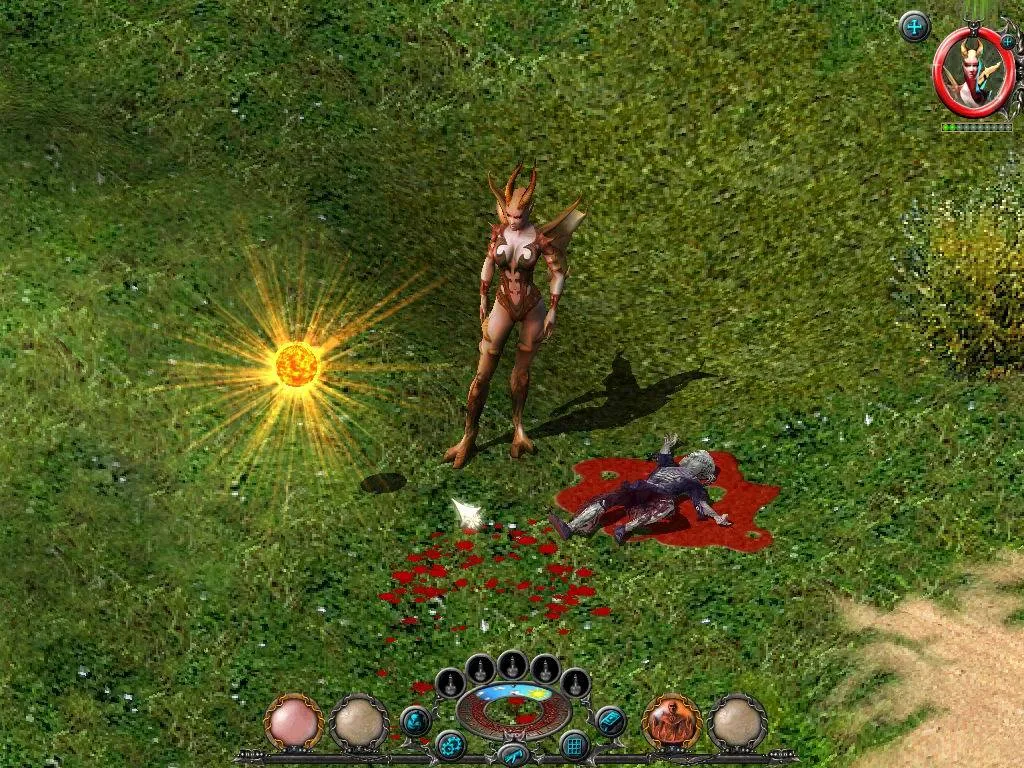
As a hero moves through Ancaria, the mouse cursor changes to signal what a click will do. Over open ground it marks a destination, and the hero runs to that spot. Pointing at an opponent brings up the Fight symbol; a left-click launches an attack with the currently activated weapon. When the attack symbol glows, the selected Combat Art or spell is available, and right-clicking the opponent uses it. Pointing at doors, boxes and pickable items turns the cursor into a hand, while neutral people show a Speech symbol that starts a conversation on a left-click.
Quickslots sit on both sides of the interface and grow with the hero. A career starts with one quickslot per side, and another is added to each side at levels 2, 8, 16 and 30, up to a maximum of five. Keyboard shortcuts mirror the clicks: number keys 1 through 5 switch weapons, while keys 6 through 0 activate special skills such as Combat Arts, spells or combos. A glowing attack symbol confirms that the chosen Combat Art or spell can be cast by right-clicking the opponent.
Parties, Lobbies, and the Eight-Player Frontier
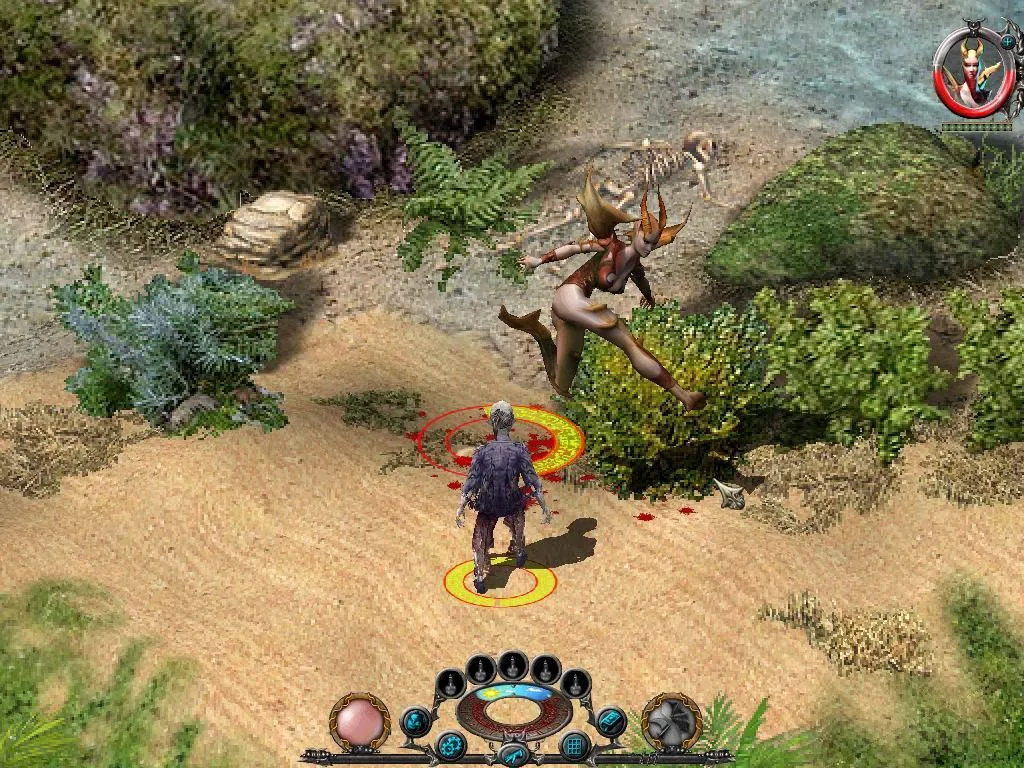
Parties in Sacred Gold hold up to eight players, and each character may belong to only one party. Once assembled, a portrait for every member appears at the top left of the screen, showing that member's current health and character level. The party rules also prevent members from harming one another, whether on purpose or through friendly fire. Experience earned in fights is split equally among the party members, but only while they stay close enough together; members who drift too far apart do not share in that distribution.
Online play runs through a lobby built from chat rooms. Inside a chat room, a player can talk with others and browse active games; clicking a game name and then the Join button enters that session. Setting up a fresh game means selecting a chat room and creating a new game with the properties of the player's choice. Chat rooms differ in who may enter them: some carry minimum or maximum levels, some are chat-only, and others are private or otherwise restricted, so a new game cannot always be started there.
Armor, Weapons, and the Smithing Slot Economy
Weapon and armor property panels in Sacred Gold use the same slot notation. A figure in brackets beside an item's name gives the number of available smithing slots and how many of those slots are already filled, so an upgraded weapon or piece of armor shows both totals at once. Color marks rarity: regular weapons are white, golden weapons are extremely rare, and armor whose name appears in green belongs to a set, with the set's name shown alongside it. The panels also report expected total damage or protection, the item's level, the sell price, and, on weapons, the skill base and damage split into physical, fire, magic and poison with possible bonus points.
Armor entries add two further details: which character can use the piece, and the minimum level required to wear it. Bonuses are graded Bronze, Silver and Gold, and the grade determines how many additional points are added to those bonuses. Reading an item therefore means combining its rarity color, set membership, class restriction, required level, free smithing slots and graded bonuses before keeping or selling it. Both weapons and armor use the same bracket convention for slots, so the two item screens stay consistent with each other.
Ancaria's Open Regions, Weather, and Imported Heroes
Ancaria is built from 16 regions, ranging from forests and mountains to deserts, catacombs and ice-covered landmasses. Villages and towns sit within these detailed landscapes, and the world runs a day/night cycle alongside varying weather systems. Exploration is not gated by progression: more than three quarters of the world is open from the very start, with no unlocks required. The catalog's Steam product date is not the original release year, so it is noted here only as a product-record fact rather than a release claim.
The campaign's structure pairs the open regions with scripted work: over 30 main quests and 200 sub-quests, plus dynamic quests that appear alongside them. Eight heroic characters are available for the journey: Gladiator, Seraphim, Battlemage, Wood Elf, Vampiress, Daemon and Dwarf; existing Sacred players can import their old characters into the Underworld. Around that progression sit hundreds of unique weapons, armors and set items, with artifacts to collect and weapons to forge, while Combat Arts, new skills and customized combo-attacks define how a hero fights.
Sources & further reading.
- Sacred Gold — official game profile Retrieved Oct 18, 2026
- Sacred Gold — official game profile — publisher-supplied gameplay manual Retrieved Oct 18, 2026
First published .