 THE GAME ARCHIVE
Shadow Dancer: The Secret of Shinobi is a one-player action game in SEGA Mega Drive Classics, and its rules ask the player to manage two things at once: a stage list of hostages that must be emptied before the exit counts, and a small stock of scarce tools that cannot be refilled on demand. Ninjutsu comes only once per stage and its type is fixed per stage, Yamato can be knocked out of action for a time, and a Round Boss shrugs off everything except hits to a weak spot. The sections below walk through the documented controls and systems and show how those rules shape stage-by-stage decisions.
Stage Structure and Why the Hostage Count Comes First
The game is built from several rounds, and each round is split into stages. Reaching the exit is not enough by itself: a stage clears only when every hostage has been rescued and you then pass through the exit. That single rule changes the shape of a run. The exit stops being a finish line to sprint toward and becomes the last step after a sweep of the level, so a player who rushes ahead can stand at the door with the stage still unfinished.
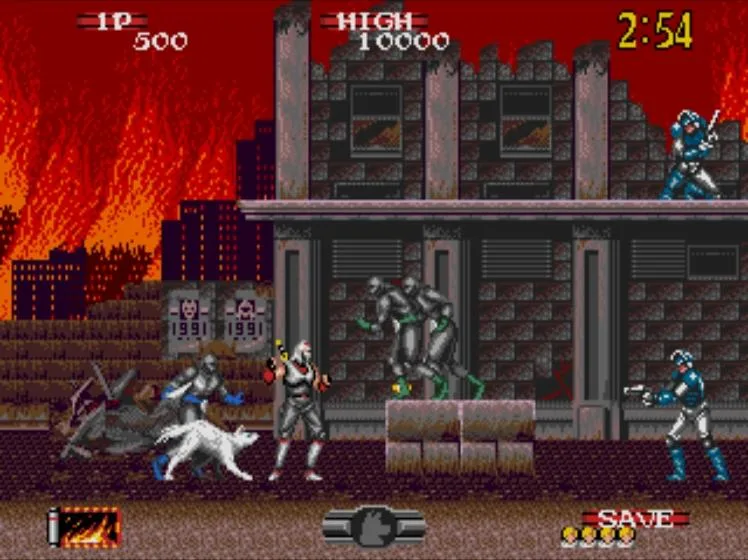
Two on-screen readouts support that sweep. The number of hostages remaining shows how much rescue work is left, and a time remaining counter runs down alongside it; the screen also carries the Dog Gauge, your score, the high score and the ninjutsu indicator. Because the hostage count is visible during play, the player can weigh how far the search still has to go against the clock rather than discovering at the exit that a captive was missed.
Not every hostage is worth the same. Rescuing a certain hostage grants a power-up that strengthens your attacks, which gives that particular captive priority inside the rescue count. The practical consequence is a routing choice: when hostages are spread across a stage, the one that improves offense is worth reaching early, so the boosted attacks are available for every enemy between there and the exit. The power-up also ties the two objectives together — the rescue list is not a chore to clear around the combat, it is where the combat gets stronger.
Default Keyboard Layout, Crouching and Level Jumps
The default keyboard layout maps the emulated pad buttons to specific keys. The directional keys act as the D-button, moving Joe Musashi and the menu cursor, and Enter is Start, which begins the game from the title screen. Among the action buttons, A uses ninjutsu, S attacks and D jumps, while Q and W stand in for the X and Y buttons and E for the Z button. The default mapping is fixed as shipped; the options menu handles game-controller setup, including assigning controller mapping to the A, B, C, X, Y, Z, Start and Mode buttons.
Movement is not confined to a single plane. Holding up or down on the directional keys while pressing jump takes Joe to an upper or lower level, and where it applies the same input carries him over to the other side of a fence and back to the front again. That vertical freedom matters for rescue work: a hostage on a raised walkway or behind a fence is reachable only by using the level-change input rather than by walking straight forward, so the search for captives doubles as practice with the traversal move.
Crouching is handled by holding the directional keys down, and Joe can still attack from that lowered position. The crouch therefore adds a low-profile posture without taking away the offensive option, which keeps the attack button useful in close quarters where standing may be riskier.
Yamato, the Dog Gauge and the Price of Losing Him
Yamato is dispatched through the attack button. Holding Attack fills the Dog Gauge, and once the gauge is completely filled, releasing Attack sends Yamato after a nearby enemy to hold that enemy's movement. The dog's job is to pin an opponent in place rather than to remove it, so the maneuver is a way to freeze a threat while Joe handles something else or repositions. Because the input is held and then released, the player is committing to a charge before the dog is sent.
The companion is not a free, permanent tool. If Yamato is hurt, he turns into a puppy and cannot be used for a given time until he returns to his grown form. Sending him into a crowd is thus a decision with a downside: a badly timed dispatch can take the distraction option away for a stretch. Holding a difficult enemy in place is only worthwhile when the breathing room it buys outweighs the risk of losing the dog.
Combat also has an alternative reward to watch for. Some defeated enemies drop a reptile icon, and walking over it picks the item up for an extra Life. That pickup ties fighting to survival: clearing enemies is not only about making the path safe but also about generating chances for an additional Life when the drop appears.
Sword, Shuriken, Mode Selection and the Once-Per-Stage Ninjutsu
Joe's ordinary offense comes in two ranges. He can attack enemies with the sword at close range or throw shuriken at distant enemies, and that ranged option exists only in Normal mode. If the mode is set to Non-Shuriken, shuriken cannot be thrown at all, so enemies must be attacked from close range. The mode is changed in the options menu, which means the choice of how aggressively to close distance is set up before a stage begins rather than during the fight.
Ninjutsu is a stage-level reserve, not a repeatable attack. Using it destroys all on-screen enemies and inflicts damage on the Round Boss, but it can be used only once per stage, and its type is predetermined for each stage. Since you cannot choose which ninjutsu to bring and cannot use it twice, the decision is one of timing. Spending it to clear a crowded screen has to be weighed against holding it back for the boss at the end of the stage.
The hostage power-up connects to this loadout as the one offensive element that can change during a run. Sword and shuriken define the baseline in Normal mode, the shuriken is removed entirely in Non-Shuriken mode, and ninjutsu is fixed and single-use per stage. Strengthened attacks earned from the right hostage sit on top of that fixed set, which makes the rescue objective and the combat plan two sides of the same stage rather than separate tasks.
Round Bosses, Bonus Stages, Lives and Continuing
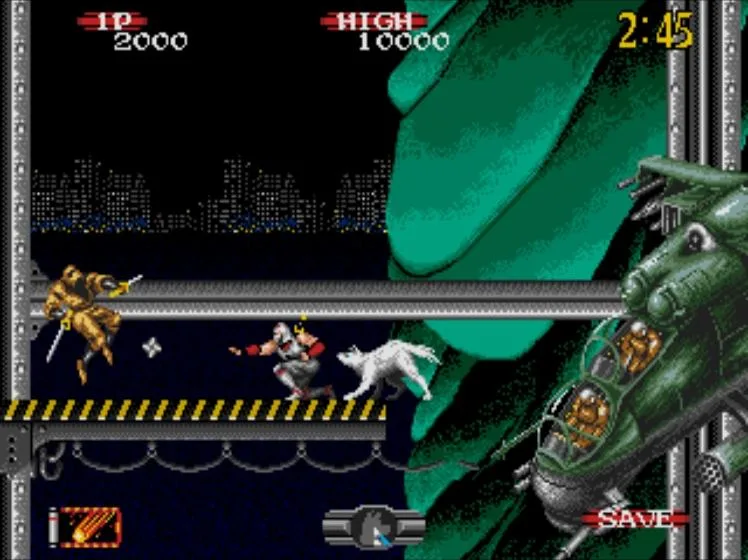
The final stage of each round ends with a Round Boss carrying a health gauge that falls as hits land. Depleting the gauge clears the round, but damage counts only when the boss's weak spot is found and struck. This is where the saved ninjutsu has its second use, since the technique also inflicts damage on the Round Boss. Yamato, however, will not be around during the Boss Battle, so the dog cannot hold the boss the way he holds ordinary enemies.
After the Boss Battle comes a Bonus Stage, where Musashi dives from the top of an old building to defeat as many enemies as he can with his shuriken; depending on performance you earn extra Lives or points. The segment is a shuriken-scoring opportunity inserted between rounds, distinct from the hostage-and-exit objective that governs ordinary stages.
The lives system imposes the stakes for all of this. You lose a Life when hit by an enemy attack or when falling into a bottomless pit, and losing all your Lives ends the game. The number of Lives remaining is displayed before each stage, with the Bonus Stage excepted. If credits remain, selecting Continue restarts from the stage where you left off, provided the selection is made before the continue countdown reaches zero.
Practical Starting Guidance
Begin by learning the default keys before relying on reflexes: directional keys to move, S to attack, D to jump and A for ninjutsu. Crouching with the directional keys down keeps the attack available, and the up-or-down-plus-jump input opens upper and lower levels and the far side of fences. Choose Normal or Non-Shuriken mode in the options menu with range in mind, since Non-Shuriken removes shuriken entirely and forces every enemy to be fought up close.
During a stage, treat the hostage count and timer as a paired objective and hunt the captive that grants the attack power-up early, so the stronger attacks cover the remaining rescue work. Save the single use of ninjutsu with the Round Boss in mind unless a screen becomes crowded enough to justify spending it. Hold and release Attack to send Yamato when pinning one enemy would help, but remember that an injured dog sits out for a while as a puppy.
Against a boss, stop trying to wear down the gauge with incidental hits and look for the weak spot, because only that target reduces the health gauge that clears the round. Keep an eye on the Life count and the pit edges, since a hit or a fall costs a Life and running out ends the game. If a Continue is needed, make the selection promptly, before the countdown ends.
Scroll sideways to see the full table →
| Button | Default Keyboard |
|---|---|
| Directional keys | D-button (move Joe Musashi / cursor) |
| Enter | Start |
| A | Use ninjutsu |
| S | Attack |
| D | Jump |
| Q | X button |
| W | Y button |
| E | Z button |
Scroll sideways to see the full table →
| System | Documented Rule |
|---|---|
| Stage clear | Rescue all hostages, then pass through the exit |
| Ninjutsu | One use per stage, fixed type, destroys on-screen enemies and damages the Round Boss |
| Dog Gauge | Hold Attack to fill; release when full to send Yamato to hold an enemy's movement |
| Yamato penalty | If hurt, becomes a puppy and is unusable for a time |
| Boss | Has a health gauge; only weak-spot hits reduce it; Yamato is absent |
| Bonus Stage | After the Boss Battle; defeat enemies with shuriken for extra Lives or points |
Sources & further reading.
- Shadow Dancer™ — official game profile Retrieved Oct 20, 2026
- Shadow Dancer™ — official game profile — publisher-supplied gameplay manual Retrieved Oct 20, 2026
First published .