 THE GAME ARCHIVE
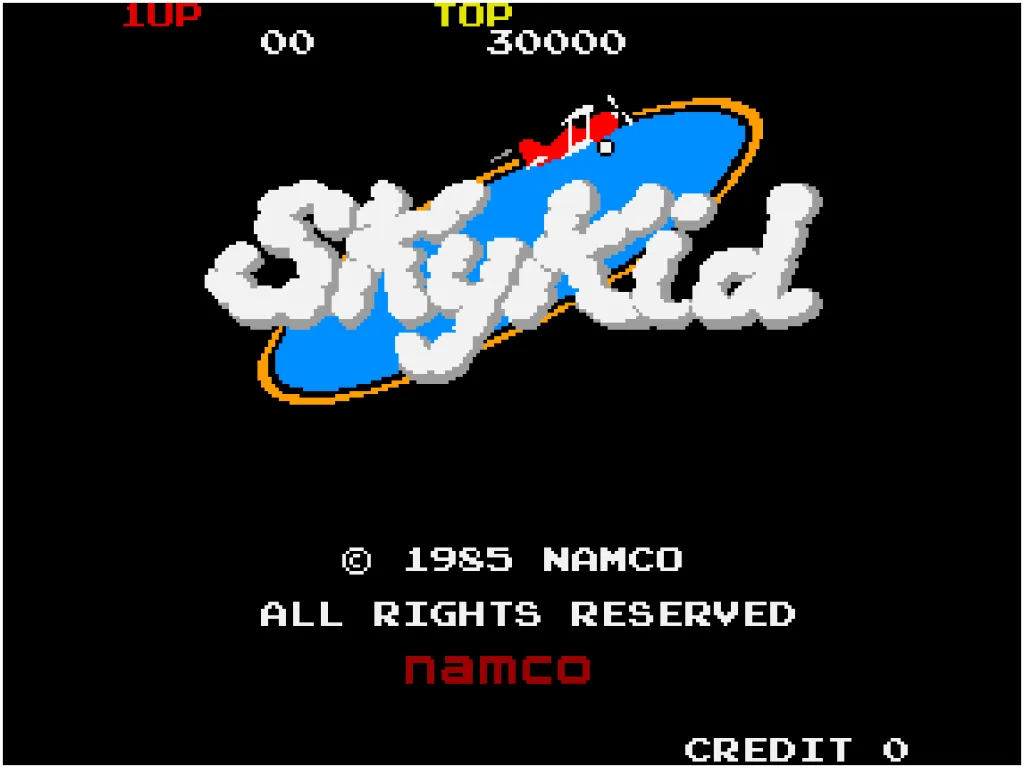
SKY KID is a shooting game released in 1985 for the arcade platform by Namco, and it asks players to fly a plane toward a base while fighting off enemy attacks with two different weapons. The publisher's description of the original arcade game lays out the essentials: players control BARON and MAX, use bombs and machine guns against enemies, fly in loops to dodge incoming attacks, and work their way to the base. Bombs, specifically, are used to defeat massive fortresses and battleships from above, and the game supports two-player simultaneous co-op.
What the Record Establishes
The catalog framework for Sky Kid is narrow and consistent: the title Sky Kid, a 1985 release year, the arcade as the listed platform, Namco as the listed publisher, and shooting as the genre. That combination places the game in the mid-1980s arcade shooting space and is the frame for everything below. The gameplay detail comes from the same licensed publisher documentation, which describes the original arcade game's objective, weapons, dodge mechanic, and co-op support.
The Premise: Two Pilots, One Base
The organizing objective in Sky Kid is navigation toward a base. Players control BARON and MAX, and the documented goal is to fight enemies and make their way to the base. This is a forward-moving mission structure rather than an endless survival setup: the base is the destination, and the flight toward it is where the combat and dodging happen. Enemy attacks occur along that route, which is why evasion is built into the same description as the weapons and the destination.
The two named pilots matter beyond flavor. The publisher says players control BARON and MAX, and that same material says the game supports two-player simultaneous co-op. Read together, the paired names line up with the paired pilot seats: one aircraft per player, both flying the same mission toward the base. The record does not assign separate abilities or distinct weapons to either pilot; the weapons and dodge are described for the flight itself.
Bombs and Machine Guns: Reading the Loadout
Sky Kid's combat is built around two weapons that the documentation treats as complements rather than alternatives. The plane fights enemies with bombs and machine guns. Bombs have an explicit, separate job: defeating massive fortresses and battleships from above. Machine guns are named alongside bombs as the means of fighting enemies, but the record does not state that guns are restricted to aircraft or that bombs are the only way to hurt anything on the ground.
What can be said with confidence is the shape of the decision the loadout creates. The game tells the player that large installations — fortresses and battleships — are bomb targets struck from above. That phrase carries a positional idea: the bombs are described as falling on those targets, which makes the moment of release, relative to the target, the part of the attack a player has to manage. Machine guns sit alongside bombs in the same combat description, so the practical picture is a plane that fights with both while positioning for bombing runs on the big targets. How much damage each weapon does, whether ammunition is limited, and whether guns can also damage the fortresses are not covered by the supplied record.
Loops, Dodging and the Flight to the Base
The documented defensive move is the flying loop. The publisher states that players fly in loops to dodge enemy attacks, which places evasion in the hands of the pilot as an active maneuver rather than an automatic effect. Because that same description also includes pressing on toward the base, the loop is part of how a player keeps the mission going: attacks arrive, the plane loops to avoid them, and the flight toward the destination continues. The record does not describe the loop's timing window, whether it can be interrupted, or how it interacts with firing, so treat it as the named dodge rather than a fully specified system.
Put together, the loop and the two weapons outline a repeating rhythm. Enemies are fought with bombs and machine guns; enemy attacks are answered with loops; the flight continues toward the base; and the large fortresses and battleships are bombed from above when they come up. That is the whole documented gameplay cycle, and it is enough to explain why the game reads as a forward-flying shooter with a dedicated evasion move and a heavy-target bombing role rather than a single-button attacker.
Two-Player Simultaneous Co-Op
Sky Kid supports two-player simultaneous co-op, and the word simultaneous is the meaningful part: both players are in the action at the same time rather than trading turns. With BARON and MAX as the two controlled pilots, the mode fits the mission structure directly — two planes on the same flight toward the base, each able to fight with bombs and machine guns, each able to loop away from enemy attacks, and each able to bomb the massive fortresses and battleships from above.
The documentation describes no split roles. There is no stated rule that one player flies guns while the other flies bombs, and no stated shared life pool, scoring scheme or revive system. What is supported is that the co-op is simultaneous and that both pilots operate under the same documented rules of weapons, loops and the flight to the base. Practical coordination — one plane pressing the guns while the other lines up a bombing run, or covering each other with loops — follows naturally from those shared rules, but the record itself stops at the mode and the mechanics.
The co-op belongs to the original arcade game as published in 1985. The supplied documentation is the licensed publisher material for that arcade title, and it is the scope of this profile: the 1985 Namco arcade shooter, not a home conversion or a later reissue. Statements here should be read against that original release rather than extended to versions the record does not describe.
Source-Backed Starting Advice
New players can take three things straight from the documented rules. First, keep the mission goal in view: the flight is toward the base, so the point of fighting and dodging is to keep the plane moving on that route. Second, treat the loop as a tool rather than a last resort — flying in loops is the described way to dodge enemy attacks, so using it deliberately against incoming fire is the intended response. Third, plan bombing runs for the big targets: fortresses and battleships are defeated with bombs from above, which makes lining the plane up over them a distinct task from ordinary fighting. Everything beyond that — optimum altitude, exact bomb timing, which targets guns can or cannot finish — is outside what the supplied material says.
In co-op, the simplest supported reading is that two planes make the same enemies, the same dodges, and the same bombing targets easier to handle through numbers rather than through assigned roles. Both pilots fly, both can fight with bombs and machine guns, and both can loop. Sharing the airspace means coordinating who takes which fortress or battleship, and spacing bombing runs so the planes are not crowded over the same target, are reasonable extensions of the documented rules, not separate systems the record describes.
Scroll sideways to see the full table →
| Field | Documented detail |
|---|---|
| Title | SKY KID |
| Release year | 1985 |
| Platform | Arcade |
| Publisher | Namco |
| Genre | Shooting |
| Weapons | Bombs and machine guns |
| Bomb targets | Massive fortresses and battleships, from above |
| Dodge mechanic | Flying loops to dodge enemy attacks |
| Objective | Make the way to the base |
| Players | BARON and MAX; two-player simultaneous co-op |
Sources & further reading.
- SKY KID — licensed publisher game documentation Retrieved Oct 18, 2026
First published .