 THE GAME ARCHIVE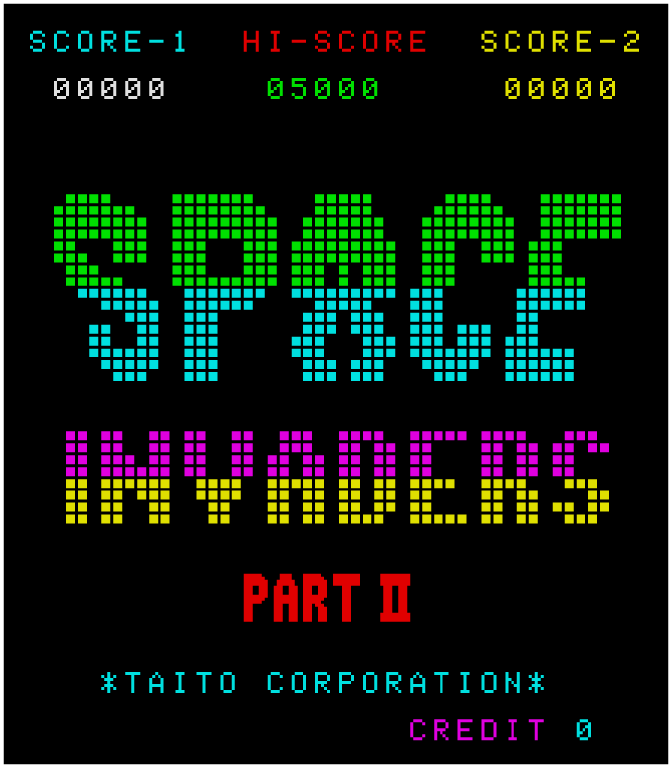
Space Invaders Part II is Taito's 1979 arcade shooting game. Its additions include Invaders that split when shot, reinforcements supplied by UFOs, a 500-point UFO, and the Rainbow Bonus. Taito also identifies name entry as a feature of this release. Those changes give the game two connected areas to explore: the behavior of the enemies and the pursuit of a higher score. The sequel's identity comes from that combination of new threats and scoring features, rather than from a new name alone.
Invaders that split when shot
Taito's original arcade description identifies a new kind of Invader that splits when hit. That makes splitting an enemy behavior attached to shooting, rather than a visual effect mentioned only in the game's presentation. The licensed publisher's account also singles it out as one of the tactics acquired by the returning Invaders. For a reader getting acquainted with Part II, this is one of the concrete rules to recognize: the targets include splitting Invaders, alongside the other additions described for the 1979 game.
UFO reinforcements and the 500-point UFO
The Invaders can receive reinforcements from UFOs. This is another of the new enemy tactics described by the licensed publisher, and Taito's own account lists Invader reinforcements among the sequel's additions. It is useful to distinguish that behavior from splitting: one describes an Invader dividing when shot, while the other concerns additional Invaders arriving as reinforcements. Both belong to the enemy side of the rules, although they are different mechanisms. The description also names a 500-point UFO, adding a specific UFO-related scoring feature to the same set of changes.
How the Rainbow became an official bonus
The Rainbow Bonus has a particular place in Taito's explanation of Part II. A technique called Rainbow had been a bug in the previous game; in this sequel, it became an official part of the specification and awarded a bonus. This is more specific than saying the game simply contains extra points. The change concerns the status of a named technique, moving from a bug in the earlier game to an intentional bonus feature here. The licensed publisher likewise presents the Rainbow Bonus as something to aim for when pursuing a high score.
Name entry and the score
Name entry is another addition highlighted by Taito. Its historical description says Part II is considered the first game in Japanese game history to introduce name entry. That wording is a qualified historical attribution, rather than a claim that every earlier game worldwide lacked the feature. Within this game's collection of additions, name entry belongs alongside the new enemy and bonus systems. It is a distinct feature to recognize when comparing the sequel's documented additions, even though it describes entering a name rather than shooting an Invader or earning the Rainbow Bonus.
Putting the additions together
The publisher frames the Rainbow Bonus around high-score play, while Taito's account supplies the specific additions behind the sequel: splitting Invaders, a 500-point UFO, reinforcements and name entry. The useful distinction is between changes to the opposition and changes to scoring or score-related features. Splitting and reinforcements explain what is new about the Invaders; the Rainbow Bonus and the named UFO score explain some of the scoring additions. Looking at both groups gives a more complete introduction to this arcade game than focusing on either its enemies or its bonus alone.
Original arcade rules and modern reissue options
The licensed publisher page also describes the wider Arcade Archives series. Its series overview discusses conveniences such as save files and rewind, along with difficulty and display settings, control options and ranking modes. Those descriptions provide context for the modern reissue presentation; they are separate from the original arcade game's 1979 additions. When comparing versions, keep the two layers distinct: splitting Invaders, reinforcements and the Rainbow Bonus describe the classic game here, while the series overview describes the modern framework in which classic titles are presented.
Sources & further reading.
- SPACE INVADERS PART II — licensed publisher game documentation Retrieved Oct 16, 2026
- SPACE INVADERS PART II — Taito original arcade documentation Retrieved Oct 16, 2026
First published .