 THE GAME ARCHIVE
Star Trek Online invites players to sit in the captain's chair, command a starship and crew, and explore strange new worlds in a massively multiplayer setting. The official store description frames the game as bringing the Star Trek universe to life on a massive scale: players seek out new life and new civilizations, take on away missions, and fight in space combat. It is a free-to-play online experience that has expanded over time into a large body of story content.
A Galaxy in Turmoil, and the Player at the Center
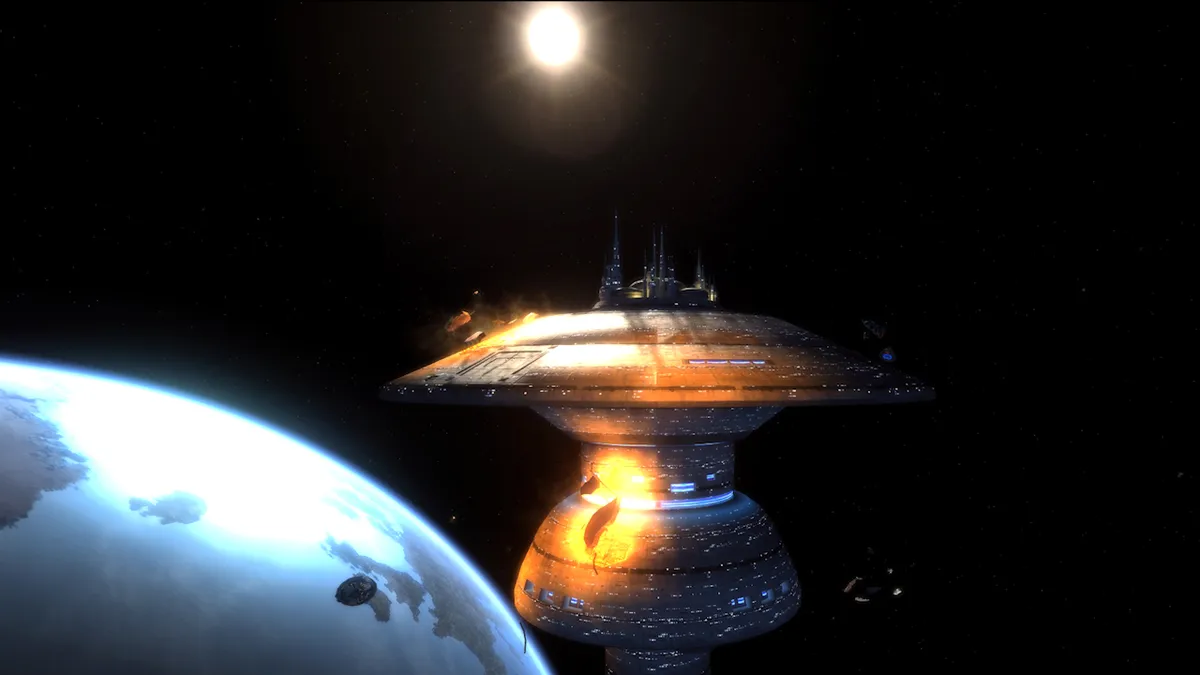
The game's premise is built around a fractured Alpha Quadrant. More than a century has passed since the events of Star Trek: Strange New Worlds, and thirty years since Star Trek: Nemesis. The Romulan Empire has fractured after the destruction of its homeworld; the Federation and Klingon Empire are at war again after decades of peace; and militant Cardassians threaten the recovery of their own people. Meanwhile, ancient powers lurk in the Delta and Gamma Quadrants, waiting for the right moment to strike.
That turmoil is the player's job. The store description explicitly says it is up to the player and their crew to save the galaxy, and that players join forces with Star Trek legends such as Spock, Janeway, Worf, and Tilly, along with over 40 more Star Trek characters played by their original actors. The narrative scale is reinforced by more than 160 episodes across multiple story arcs, giving the captain's-chair fantasy a long, serialized spine.
 View full image ↗
The Core Loop: Command in Space, Lead on the Ground
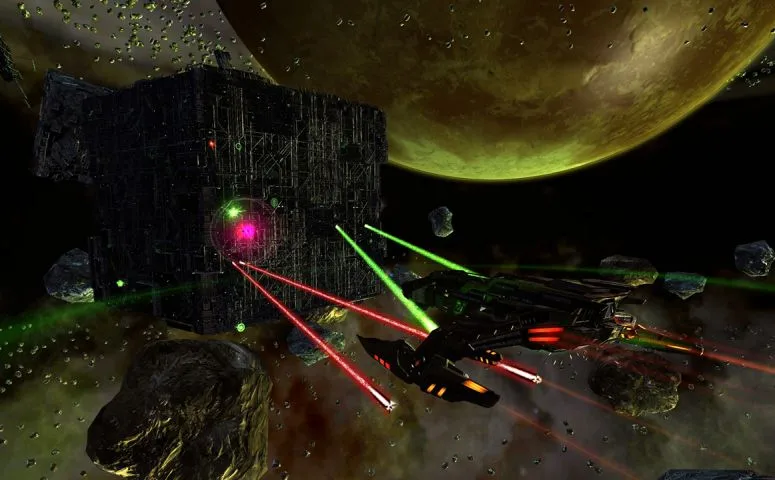
At its most concrete, Star Trek Online alternates between two kinds of play. In space, the player commands their own starship and crew, taking part in epic space battles. On the ground, they lead away teams across unknown worlds on daring away missions. Those two activities — space combat and away missions — are the primary activities described by the official store text, and they form the spine of the game's episode content.
Exploration is the connective tissue between those two modes. The store pitch is to explore strange new worlds and seek out new life and new civilizations, and away missions are described as the ground expression of that idea. In practice, this means the game's episodes move between ship-scale combat and personal-scale encounters with unfamiliar worlds, with the player's customized captain and crew as the constant.
What distinguishes the loop from a generic MMO structure is the way it ties the player's identity to a ship. The player commands their own starship and crew, and the store text repeatedly emphasizes that you are the captain. That framing matters because the persistent object in the game is not just a character but a vessel and its crew, both of which are customizable and both of which carry the player through space battles and away teams alike.
Choosing a Faction Changes More Than the Flag
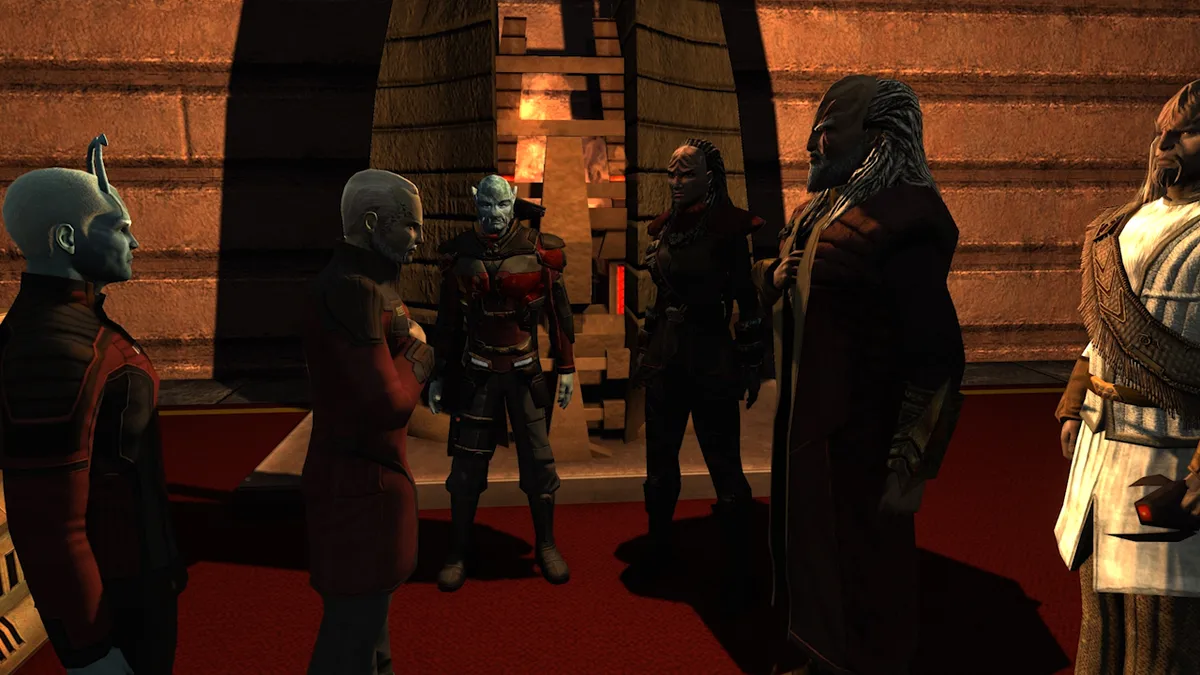
Faction choice is one of the game's clearest structural decisions. Players can defend the Federation, rebuild the Romulan Republic, restore honor to the Klingon Empire, or serve the Dominion in battle. Crucially, each faction features vastly different ships, crew, gear, and play styles. That makes the choice less cosmetic than it might sound: it shapes the tools available and the way the game feels to play.
Faction also feeds narrative. The game is described as story-driven with faction-specific narratives, which means the four paths are not merely alternate starting zones but distinct framing for the player's role in the galaxy's turmoil. A player defending the Federation and a player restoring honor to the Klingon Empire are approaching the same broad conflict from different institutional and personal angles.
 View full image ↗
Customization: Any Species, Hundreds of Ships
Total customization is a central selling point. Players create and customize a captain from any species in the galaxy, or make their own species. They then select from hundreds of ships and find the one that fits their play style. Because ships are tied to faction choice, the customization layer works together with the faction system rather than separately from it.
This pairing of captain identity and ship identity is what makes the customization meaningful in play. The captain is the character the player embodies during away missions, while the ship is the persistent vehicle for space combat. Both are customizable, and both are presented as expressions of the player's own Star Trek experience rather than fixed classes dictated by the game.
Free-to-Play Progression from Ensign to Fleet Admiral
The game's progression is framed around rank: players go from Ensign to Fleet Admiral entirely free-to-play. That is the documented progression path described by the official store text, and it is coupled with the claim that the game is a completely free-to-play online experience. The free-to-play structure is treated as a core design decision rather than a trial version.
Progression is also expressed through content volume: more than 160 episodes across multiple story arcs. That suggests rank advancement is not the only measure of progress; the player is also moving through a long sequence of story material. Faction choice, ship selection, and customization all layer on top of that rank-and-episode structure.
 View full image ↗
Source-Backed Starting Guidance
Because the documented information does not include step-by-step controls or tutorial structure, the most useful starting guidance comes from the game's own framing. A new player should expect to create a captain and choose a faction; each faction offers different ships, crew, gear, and play styles, so that choice is worth making deliberately. After that, the advertised path is to play through episodes that alternate space combat with away missions, moving from Ensign toward Fleet Admiral without paying.
The store text also suggests a play-style mindset rather than a prescribed build. Because there are hundreds of ships and the goal is to find the one that fits the player's own play style, experimentation with ship choice is an intended part of the experience. Likewise, the cast of over 40 Star Trek characters played by their original actors is presented as a reason to move through the episode content rather than skip it.
Design Distinctions and Visual Character
The design distinction that stands out most clearly is the game's commitment to the bridge-crew fantasy. It is not simply an MMO with a Star Trek skin: the player commands a starship and crew, joins forces with canonical legends, and moves between epic space battles and away teams. The scale claimed by the store text is explicit — the Star Trek universe appears for the first time on a truly massive scale — and that scale is expressed through episode count, character count, and ship count.
A second distinction is the way the free-to-play model is presented as expansive rather than restrictive. The store text describes an ever-expanding, completely free-to-play online experience, and pairs that with full rank progression from Ensign to Fleet Admiral at no cost. That combination — a long-running free-to-play MMO with a full command fantasy and a large serialized story — is the game's clearest identity.
Scroll sideways to see the full table →
| Field | Value |
|---|---|
| Title | Star Trek Online |
| Release year (Steam entry) | 2012 |
| Platforms | Windows |
| Developer | Cryptic Studios |
| Publisher | Arc Games |
| Genres | Massively Multiplayer, RPG, Free To Play |
- Core activities: space combat and away missions
- Progression: Ensign to Fleet Admiral, entirely free-to-play
- Faction choice: Federation, Romulan Republic, Klingon Empire, Dominion
- Customization: any species for the captain, hundreds of ships
- Story scale: more than 160 episodes across multiple arcs
- Characters: over 40 Star Trek characters played by original actors
Sources & further reading.
- Star Trek Online — official game profile Retrieved Oct 10, 2026
First published .