 THE GAME ARCHIVE
Star Wars: Knights of the Old Republic places you in a period four thousand years before the Galactic Empire, when hundreds of Jedi Knights have already fallen in battle against the Sith. The Jedi Order's last hope rests on you. The central question the game poses is not merely whether you can win, but how you choose to win: whether you master the Force on a quest to save the Republic or fall to the lure of the dark side.
This profile covers the Windows and macOS edition distributed on Steam. The store entry lists a 2009 release year for that entry, with BioWare as developer and Aspyr credited for the Mac version; it does not document the game's original release history. Details below come from the official store description and metadata, not from hands-on testing.
Premise: A Galaxy That Needs Saving
The framing is deliberately large-scale. You are not a soldier in a single battle but the last hope of the Jedi Order, acting against the ruthless Sith. The store description presents the quest to save the Republic and the temptation of the dark side as the two poles of the experience, and the game is structured around letting you move toward either.
The Steam entry classifies the game as Adventure and RPG, with BioWare as a developer and LucasArts, Aspyr, Disney and Lucasfilm among the listed publishers. It is also explicitly described as a Star Wars role-playing experience featuring unique characters, creatures, vehicles and planets, which sets the tone for the systems discussed below.
Core Gameplay Loop: Power, Path, Party
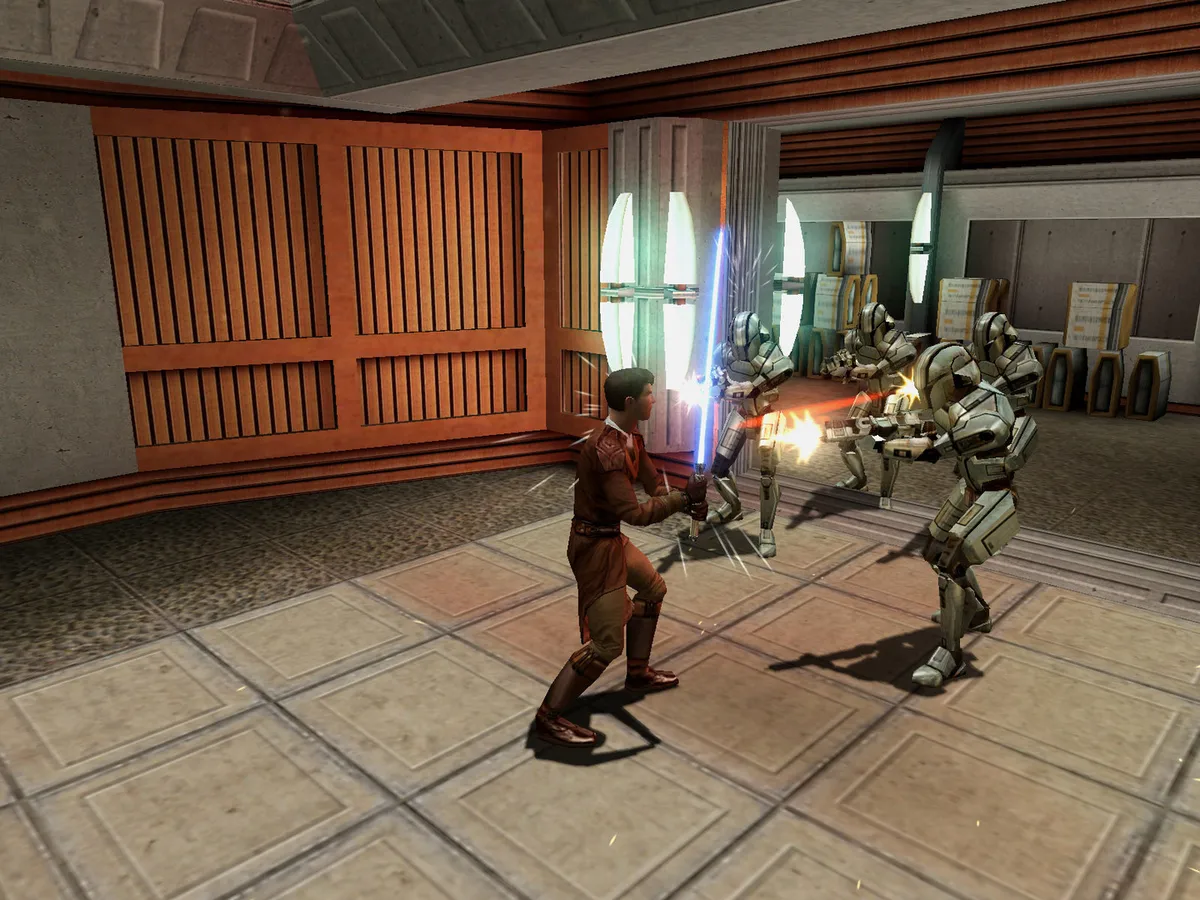
The loop the store description sketches is built around learning the Force. That means acquiring abilities across more than 40 different powers and putting them to use as you travel, fight and make decisions. Building your own lightsaber is presented as a parallel act of self-definition: the weapon and the power set are both things the player assembles and grows.
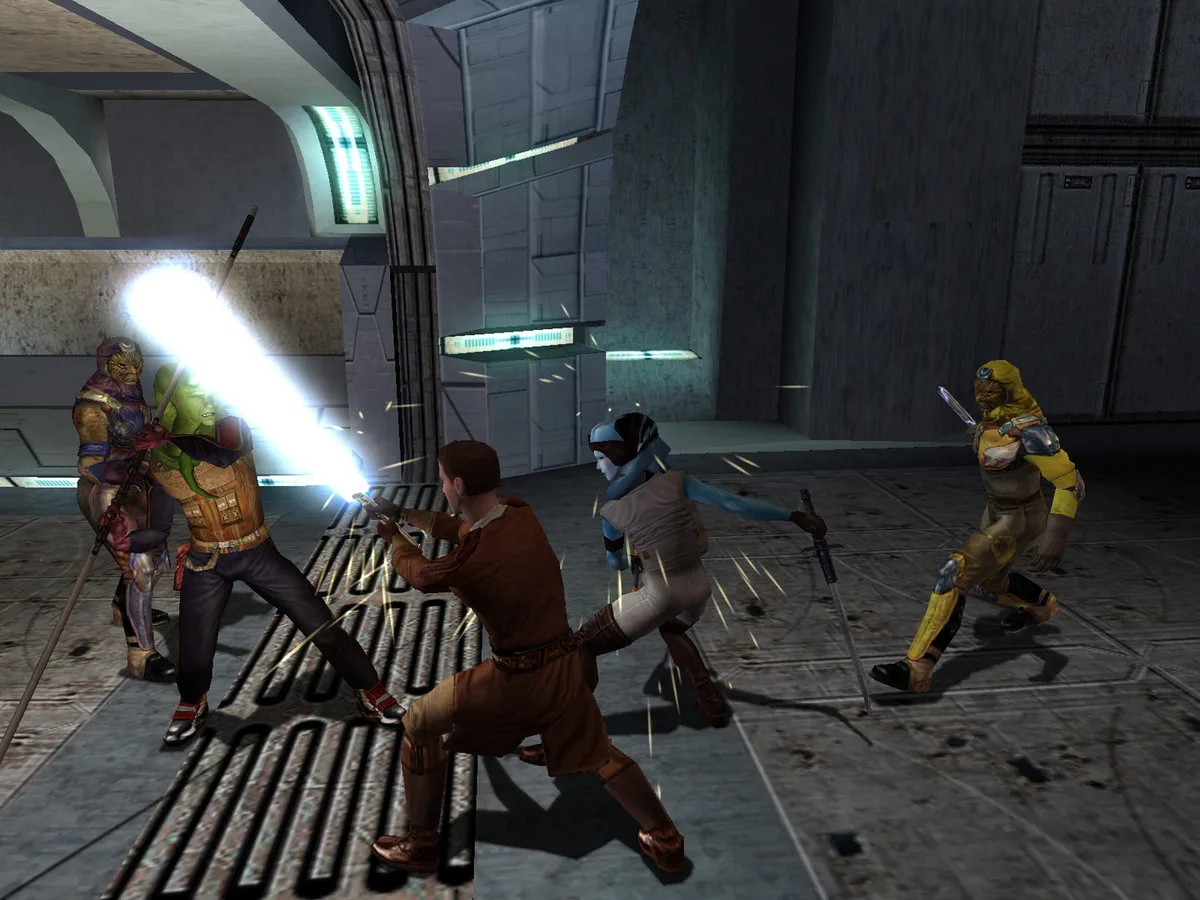
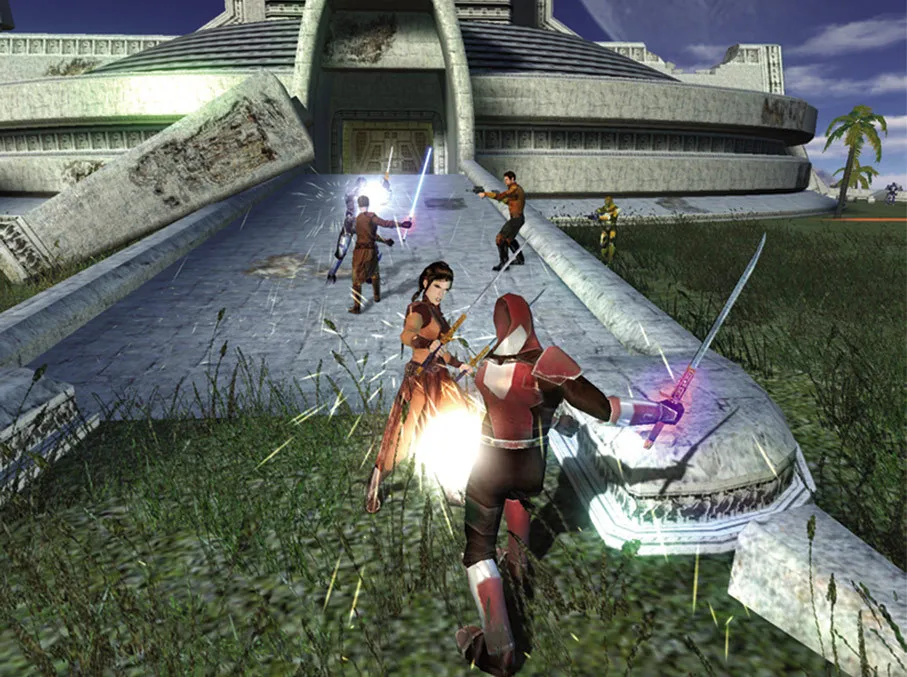
Party choice runs alongside that growth. The description lists nine customizable characters available for your party, including Twi'leks, droids and Wookiees, which makes companion selection a recurring decision rather than a one-time pick. Because the same description ties light-side and dark-side outcomes to what you do, the loop is not only about clearing objectives but about which companions and powers match the path you are taking.
 View full image ↗
Travel and World Structure
Movement across the galaxy is handled with your own starship, the Ebon Hawk. The description specifies travel to eight enormous worlds, and it names Tatooine and the Wookiee homeworld Kashyyyk as examples of popular Star Wars locations you adventure through. That combination of a persistent ship and multiple large destinations suggests a structure where you return to the ship and then choose the next world, rather than following a single linear corridor.
The description also promises unique characters, creatures and vehicles across those worlds, which supports the idea that each destination is meant to feel distinct rather than interchangeable. The eight-world figure is the only world count the source provides.
Progression: Force Training and Branching Choices
Progression appears to be expressed through Force training and through choices that push you toward the light or dark side. The description explicitly asks whether you can master the Force on a quest to save the Republic or whether you will fall to the dark side, which positions mastery and morality as linked tracks. The phrase "Choose Your Path" is used to label that branching structure.
Because more than 40 powers are available and the path is variable, the practical implication is that two players can build noticeably different characters from the same starting point. The source does not describe specific power trees, unlock order, or how individual choices map to specific endings, so those remain open questions rather than established facts.
 View full image ↗
Source-Backed Starting Guidance
The most reliable starting guidance is to treat the game as a role-playing experience with two major axes: what your character can do with the Force and which moral direction you commit to. Since the description ties lightsaber construction and Force powers together, expect the early hours to involve assembling your character's identity, not just selecting a difficulty.
- What the source supports as starting context:
Design Character: A Cast of Nine and a Ship of Your Own
Two design choices stand out in the store description. First, the nine customizable party characters, with named examples in Twi'leks, droids and Wookiees, which signals that companions are meant to be varied both visually and functionally. Second, the Ebon Hawk as a personal starship that carries you among eight worlds, which gives the player a stable home base in a large galaxy.
The emphasis on unique characters, creatures, vehicles and planets suggests the game treats variety as a design goal rather than a backdrop. Whether that variety holds up in play is not something the store text can confirm; that would require direct testing.
 View full image ↗
Edition Note and Provenance
The Mac version has a documented language limitation: it only supports English. The Steam listing identifies Windows and macOS as platforms and credits Aspyr specifically for the Mac version, alongside BioWare for the game. The 2009 date in the catalog is the release year attached to this Steam entry, not a statement about when the game first appeared.
Quick Reference
- Title: Star Wars: Knights of the Old Republic. Listed platforms: Windows, macOS. Listed genres: Adventure, RPG. Listed developers: BioWare, Aspyr (Mac). Steam entry release year: 2009. Force powers described: over 40. Party characters described: nine. Worlds described: eight. Travel vessel: Ebon Hawk.
Sources & further reading.
- STAR WARS™ Knights of the Old Republic™ — official game profile Retrieved Oct 10, 2026
First published .