 THE GAME ARCHIVE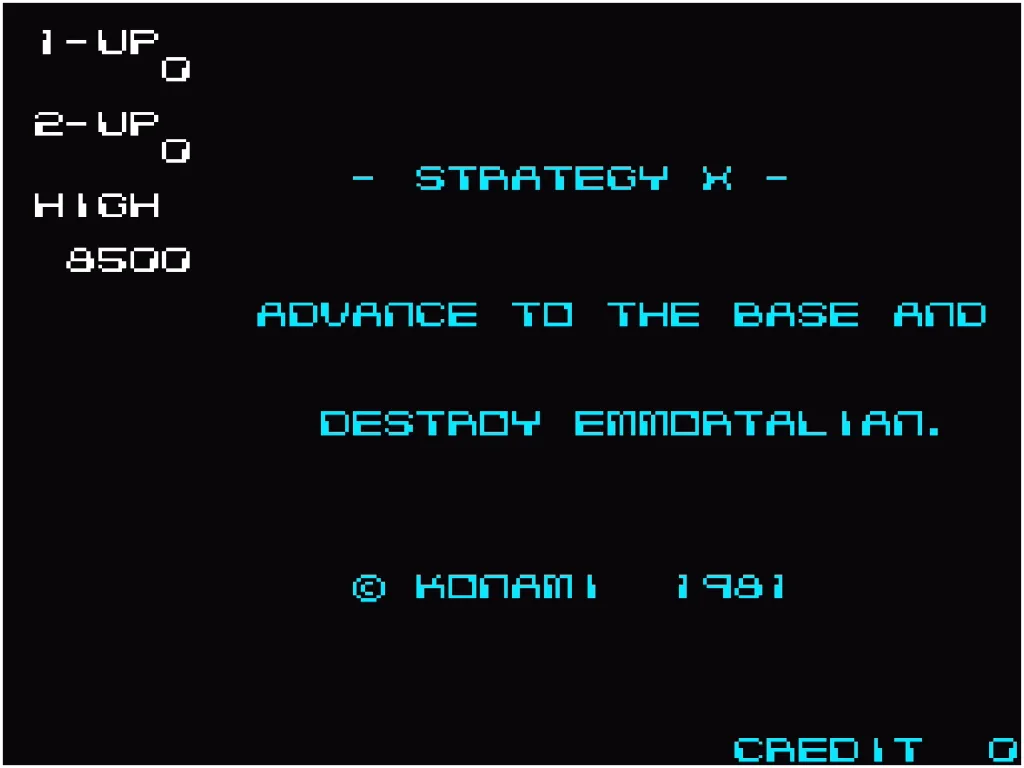
What Strategy X Is
Strategy X is a tank-based shooting game released by Konami in 1981 for arcades. It is a shooting title whose central action is controlling a tank and its artillery fire rather than piloting a conventional ship or character. The publisher documentation describes the player moving the direction of artillery fire left and right. That horizontal aim is the documented control around which every other rule is organized: the player uses it to defeat enemies, and enemy defeats replenish fuel while the player progresses through stages toward the Immortalian waiting at the deepest part.
The Core Loop: Aim, Destroy, Refuel
The documented loop begins with the left-right aim. Moving the direction of artillery fire left and right is how the player lines the tank's guns up with enemies. Firing at a lined-up enemy defeats it, and defeating enemies is the stated objective. Each enemy destroyed then replenishes fuel. Fuel and enemy destruction are therefore not separate systems: the same action that clears opponents also sustains the tank's ability to keep moving through the stage. The practical effect is that the player is always making a positional decision, choosing where along the horizontal line to place the artillery fire so that the next shot both removes a threat and refills the tank.
Because the documentation names only left-right fire direction as the control, the player's decision space is narrow and clear. There is no documented secondary weapon, dodge, or item system to fall back on. The player adjusts the artillery line, fires, and watches whether the result is an enemy defeat and a fuel gain. That single repeated decision is what the game asks the player to master. A missed or poorly placed shot does not defeat an enemy, so it does not replenish fuel, which means the documented rules create a direct link between aim quality and the tank's staying power.
Fuel, Stages, and Progression
The documented progression rule is that the player progresses through the stages. Fuel replenishment is tied to that progress because the tank must keep moving through the stage route, and fuel comes from defeating enemies. The player therefore advances by fighting: the stage is not cleared by waiting or by avoiding contact, but by aiming the artillery fire left and right, defeating enemies, and converting those defeats into fuel. Each stage carries the player deeper toward the final target, so the fuel gauge effectively measures how well the player is performing the core loop rather than functioning as a separate timer or score.
This structure gives the player a clear priority order within each stage. The documented objective is to defeat enemies, so the immediate task is to keep the artillery line on targets. The reward for doing so is fuel, which the documentation lists as replenished rather than acquired through a separate pickup. The player who consistently defeats enemies keeps the tank supplied and keeps the stage route moving. The player who does not defeat enemies does not replenish fuel, which puts continued progress through the stages at risk. The documented rules therefore make combat success the engine of progression.
The Immortalian at the Deepest Part
The endpoint of the documented route is the Immortalian, described as waiting at the deepest part of the game. The stated aim is to destroy it. Reaching that point requires progressing through the stages, which in turn depends on the fuel replenished by defeating enemies. The final objective therefore sits at the end of the same chain the player has been practicing from the first stage: steer the artillery fire left and right, defeat enemies, replenish fuel, and continue deeper. The Immortalian is not presented as a separate mode or a bonus encounter but as the deepest point of the stage progression the player is already following.
The documented objective is specifically to destroy the Immortalian, which gives the run a defined conclusion. Until that happens, the player is still within the loop of enemy defeats and fuel replenishment that the stages require. The evidence does not describe the Immortalian's attack patterns, health, or appearance, so the useful planning information is simply that it waits at the deepest part and that destroying it is the stated aim. The player's preparation for it is the same as preparation for any other documented obstacle: keep the horizontal artillery line accurate enough to defeat enemies and keep the fuel flowing.
What the Documented Controls Mean in Practice
Because the documentation lists left-right fire direction as the control, the player's moment-to-moment decisions are about alignment rather than about choosing between multiple abilities. The artillery fire moves along a horizontal line, and the player adjusts that line until it points at an enemy. The tank-based shooting label supplied by the publisher fits this description: the player is operating a tank's guns, and the guns' direction is steerable left and right. That is the whole documented interface. Advice grounded in the supplied rules therefore starts with patience at the aim control: move the fire direction deliberately, confirm the line before firing, and treat every enemy defeat as a chance to extend the fuel supply.
A second practical point follows from the fuel rule. Since fuel is replenished by defeating enemies and since the player progresses through stages, the most reliable way to keep advancing is to prioritize enemies the artillery line can actually reach. The documentation does not describe fuel draining over time or through any means other than the need to keep progressing, so the safe reading is that every destroyed enemy is a fuel gain and every stage cleared is progress toward the Immortalian. The player does not need to manage a separate resource menu; the shooting itself is the management.
Release and Access: What the Documentation Covers
The catalog documentation identifies Strategy X as a Konami release from 1981 on the arcade platform, with the genre listed as Shooting. Those details place it among early 1980s arcade shooting games and establish the publisher and year of the original arcade title. The gameplay description that accompanies this catalog record is the source for the left-right artillery control, enemy defeats, fuel replenishment, stage progression, and the Immortalian objective. The documentation reviewed for this feature is the licensed publisher material; the evidence pack does not include verified details of modern reissue contents, and it does not describe a version history beyond the original arcade listing.
For the player, the practical upshot of the scoped documentation is that Strategy X can be understood as a compact arcade system: one steerable artillery line, one enemy-defeat rule, one fuel-replenishment reward, one stage route, and one final target. The evidence supplied for this feature does not cover scoring, additional weapons, items, game modes, visual identity, or edition differences, so those topics are left out rather than guessed at. What remains is enough to describe how the documented game plays and what the player is working toward.
What Strategy X Is
Strategy X is a tank-based shooting game released by Konami in 1981 for arcades. It is a shooting title whose central action is controlling a tank and its artillery fire rather than piloting a conventional ship or character. The publisher documentation describes the player moving the direction of artillery fire left and right. That horizontal aim is the documented control around which every other rule is organized: the player uses it to defeat enemies, and enemy defeats replenish fuel while the player progresses through stages toward the Immortalian waiting at the deepest part.
The Core Loop: Aim, Destroy, Refuel
The documented loop begins with the left-right aim. Moving the direction of artillery fire left and right is how the player lines the tank's guns up with enemies. Firing at a lined-up enemy defeats it, and defeating enemies is the stated objective. Each enemy destroyed then replenishes fuel. Fuel and enemy destruction are therefore not separate systems: the same action that clears opponents also sustains the tank's ability to keep moving through the stage. The practical effect is that the player is always making a positional decision, choosing where along the horizontal line to place the artillery fire so that the next shot both removes a threat and refills the tank.
Because the documentation names only left-right fire direction as the control, the player's decision space is narrow and clear. There is no documented secondary weapon, dodge, or item system to fall back on. The player adjusts the artillery line, fires, and watches whether the result is an enemy defeat and a fuel gain. That single repeated decision is what the game asks the player to master. A missed or poorly placed shot does not defeat an enemy, so it does not replenish fuel, which means the documented rules create a direct link between aim quality and the tank's staying power.
Fuel, Stages, and Progression
The documented progression rule is that the player progresses through the stages. Fuel replenishment is tied to that progress because the tank must keep moving through the stage route, and fuel comes from defeating enemies. The player therefore advances by fighting: the stage is not cleared by waiting or by avoiding contact, but by aiming the artillery fire left and right, defeating enemies, and converting those defeats into fuel. Each stage carries the player deeper toward the final target, so the fuel gauge effectively measures how well the player is performing the core loop rather than functioning as a separate timer or score.
This structure gives the player a clear priority order within each stage. The documented objective is to defeat enemies, so the immediate task is to keep the artillery line on targets. The reward for doing so is fuel, which the documentation lists as replenished rather than acquired through a separate pickup. The player who consistently defeats enemies keeps the tank supplied and keeps the stage route moving. The player who does not defeat enemies does not replenish fuel, which puts continued progress through the stages at risk. The documented rules therefore make combat success the engine of progression.
The Immortalian at the Deepest Part
The endpoint of the documented route is the Immortalian, described as waiting at the deepest part of the game. The stated aim is to destroy it. Reaching that point requires progressing through the stages, which in turn depends on the fuel replenished by defeating enemies. The final objective therefore sits at the end of the same chain the player has been practicing from the first stage: steer the artillery fire left and right, defeat enemies, replenish fuel, and continue deeper. The Immortalian is not presented as a separate mode or a bonus encounter but as the deepest point of the stage progression the player is already following.
The documented objective is specifically to destroy the Immortalian, which gives the run a defined conclusion. Until that happens, the player is still within the loop of enemy defeats and fuel replenishment that the stages require. The evidence does not describe the Immortalian's attack patterns, health, or appearance, so the useful planning information is simply that it waits at the deepest part and that destroying it is the stated aim. The player's preparation for it is the same as preparation for any other documented obstacle: keep the horizontal artillery line accurate enough to defeat enemies and keep the fuel flowing.
What the Documented Controls Mean in Practice
Because the documentation lists left-right fire direction as the control, the player's moment-to-moment decisions are about alignment rather than about choosing between multiple abilities. The artillery fire moves along a horizontal line, and the player adjusts that line until it points at an enemy. The tank-based shooting label supplied by the publisher fits this description: the player is operating a tank's guns, and the guns' direction is steerable left and right. That is the whole documented interface. Advice grounded in the supplied rules therefore starts with patience at the aim control: move the fire direction deliberately, confirm the line before firing, and treat every enemy defeat as a chance to extend the fuel supply.
A second practical point follows from the fuel rule. Since fuel is replenished by defeating enemies and since the player progresses through stages, the most reliable way to keep advancing is to prioritize enemies the artillery line can actually reach. The documentation does not describe fuel draining over time or through any means other than the need to keep progressing, so the safe reading is that every destroyed enemy is a fuel gain and every stage cleared is progress toward the Immortalian. The player does not need to manage a separate resource menu; the shooting itself is the management.
Release and Access: What the Documentation Covers
The catalog documentation identifies Strategy X as a Konami release from 1981 on the arcade platform, with the genre listed as Shooting. Those details place it among early 1980s arcade shooting games and establish the publisher and year of the original arcade title. The gameplay description that accompanies this catalog record is the source for the left-right artillery control, enemy defeats, fuel replenishment, stage progression, and the Immortalian objective. The documentation reviewed for this feature is the licensed publisher material; the evidence pack does not include verified details of modern reissue contents, and it does not describe a version history beyond the original arcade listing.
For the player, the practical upshot of the scoped documentation is that Strategy X can be understood as a compact arcade system: one steerable artillery line, one enemy-defeat rule, one fuel-replenishment reward, one stage route, and one final target. The evidence supplied for this feature does not cover scoring, additional weapons, items, game modes, visual identity, or edition differences, so those topics are left out rather than guessed at. What remains is enough to describe how the documented game plays and what the player is working toward.
Sources & further reading.
- STRATEGY X — licensed publisher game documentation Retrieved Oct 16, 2026
First published .