 THE GAME ARCHIVE
Naval Warfare: Cannon Fire, Boarding and Weather
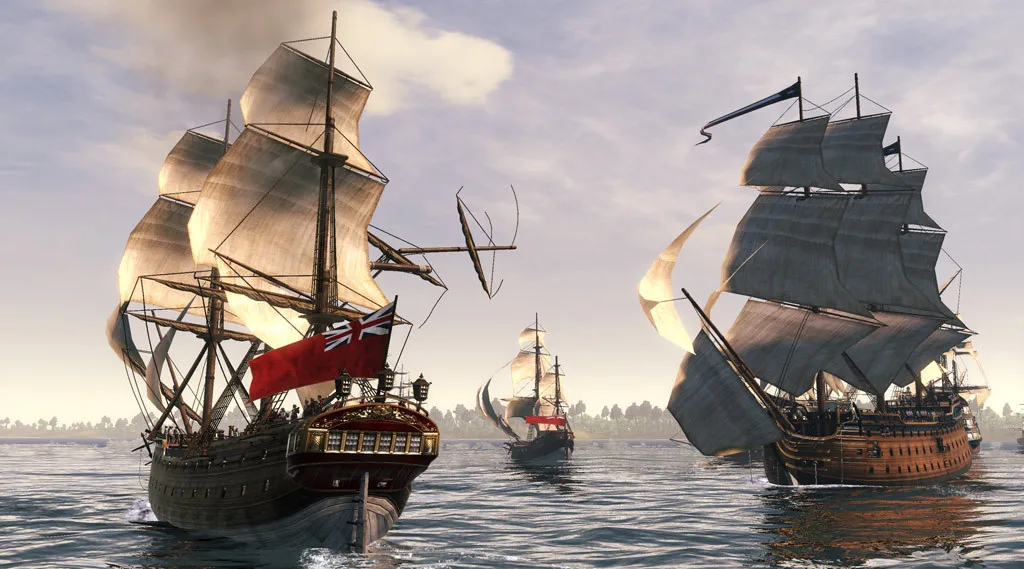
Naval encounters play out in a three-dimensional space where you command either a single ship or a whole fleet across seascapes shaped by water and weather effects. The basic exchange runs through cannon fire first: you pound the opposing vessel at range, then close the distance to grapple it and send your men across for hand-to-hand fighting on the decks. This grapple-and-board step is the documented bridge from gunnery to melee, and it turns a ranged duel into a close-quarters struggle once the ships are locked together.
Fleets do more than fight. An army or an agent moved onto a fleet docked at a shoreline is piped aboard for transport to overseas colonies, and the army or agent tab in the review panel lets you select those units and right-click to disembark at the destination. Placing fleets onto enemy trade routes lets you raid them, and fleets can also block enemy ports, adding an economic dimension to sea control. Crew courage is tracked as morale, raised by training, experience and an inspirational admiral, and lowered by fatigue, enemy fire, flanking or rear attacks, and nearby routing units; flashing banners signal wavering morale before a rout.
Gunpowder on Land: Muskets, Cannon and Siege Tactics
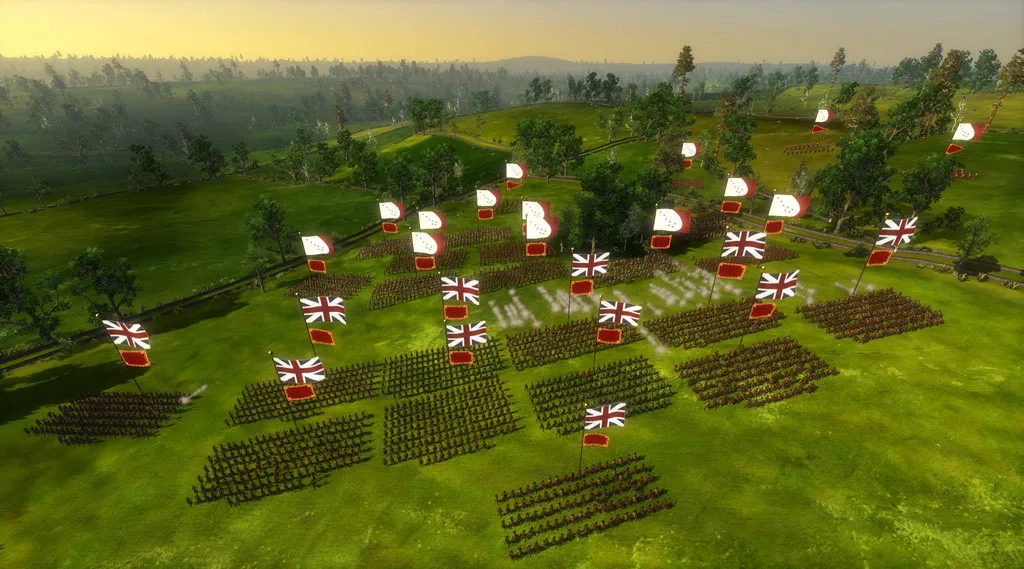
Land battles unfold in real time and mix musket fire, cannon and melee fighting. The growing role of gunpowder pushes you toward new formations and tactics rather than the older melee-only approach, since cannon and musket change how forces must be arranged before contact. On the campaign map, sending an army against a garrisoned town, port or resource building triggers a land battle. If the target sits undefended, the attacking force simply marches in and seizes it without a fight, so capturing these locations expands both territory and resources.
Attacking a fort or fortified city triggers a siege battle, which calls for a different tactical approach. The attacker's aim is to breach the settlement walls and destroy the defenders inside, and the manual documents two methods. For artillery, you concentrate fire with your heaviest guns, select the artillery and right-click a wall section to issue the order. Many infantry units also carry grapnels and rope ladders for reaching the walls. These options give besiegers a choice between pounding a breach open or sending infantry up the fortifications.
Control and Log on the Campaign Map
Campaign-map movement and management run through two input devices working in tandem. The keyboard handles the camera and turn flow: W and the number-pad keys move the view up, S moves it down, A and D strafe left and right, the asterisk or X key raises camera height, the slash or Z key lowers it, Enter ends the turn, and Esc opens the options menu. The mouse handles actors and the interface: left-click selects a character or building, activates buttons and received messages, or selects a unit from its card, while right-click moves the selected piece to a target location. Together, the keyboard steers the view while the mouse issues the orders that drive the campaign forward.
Seizing enemy regions is a stated objective for dominating rival nations, and the campaign map turns that into a direct choice. Ordering an attack on a garrisoned town, port or resource building triggers a land battle; if the target is undefended, the attacking force simply marches in and seizes it without fighting. Either way, capturing these locations expands territory and resources. The pointing controls support the same loop: on the campaign map, left-click selects a character or building and gathers information, while right-click sends the selected piece to the target location, so the move toward a settlement begins with a click on its destination.
Governments, Revolutions and Power in the Capital
Your nation can adopt one of three government types: absolute monarchy, constitutional monarchy, or republic. Each has its own quirks and advantages in how society functions under it, shaping the management of your nation. Revolutions are the mechanism for changing governments; they are essentially rebellions in your nation’s capital region. When a revolution occurs, you choose whether to back the rebels or the state, so even a disastrous situation can still be salvaged. This choice determines whether the government changes and which faction prevails in the capital.
The revolution system ties government change to public order management in the capital region. A rebellion there triggers the revolution, and your decision to support either the rebels or the state resolves it. Backing the state preserves the current government, while backing the rebels likely installs a new one, though the exact conditions and outcomes are not detailed in the supplied claims. Nation leaders no longer appear on the map as generals, so the capital region becomes the focal point for these power struggles. Managing public order there is therefore central to controlling when and how your government changes.
Agents, Research and Trade: The Empire in Motion
Research is tied to universities and similar educational buildings, where each technology you pursue usually grants some of your units a new ability or improves an existing one, or makes new buildings and specialist units available for construction. Gentlemen, a type of agent, can be assigned to aid research efforts. The same agent pool covers scholars, spies and missionaries, and these characters are not recruited like military units: certain buildings in your regions generate them automatically. Active abilities are used by selecting the agent and right-clicking a target character, army or settlement, covering actions such as sabotage, assassination, duels with rivals, research at universities and spreading faith among non-believers.
Some agent abilities run passively instead: a missionary converts a region's religion simply by moving into the target region. Trade follows a parallel structure. The trade tab on the government details panel lists all resources brought to your capital from across your empire and shows how they are exported. Income grows by exploiting resources in your regions, developing trade agreements with rival nations through diplomacy, seizing resource-rich colonies, improving ports and sending merchant fleets to trade theatres.
Campaigns, Merging and Multiplayer
Campaign play comes in two documented forms. The Grand Campaign is turn-based, with each nation taking its turn to move pieces, manage regions and fight battles; it advances one year every two turns, opens in 1700 and runs until the end of 1799 to meet victory conditions, after which play can continue without them. The setup screen lets you pick a nation by its flags and scroll buttons, and each nation carries its own difficulty based on factors such as starting position and military power. The Road to Independence is a story-driven campaign portraying George Washington's rise and the founding of the United States.
Two unit-handling actions use the Review Panel and unit cards. To split a force, select the units on their cards, hold Shift or Ctrl to take more than one, then right-click a destination on the campaign map for the new force. Merging works the other way: units of the same type that have taken casualties can be dragged onto one another in the Review Panel, producing a single stronger unit whose experience is averaged. Multiplayer supports online play and local area network battles with customizable factions, and the main menu also opens player statistics.
Sources & further reading.
- Total War: EMPIRE – Definitive Edition — official game profile Retrieved Oct 20, 2026
- Total War: EMPIRE – Definitive Edition — official game profile — publisher-supplied gameplay manual Retrieved Oct 20, 2026
First published .