 THE GAME ARCHIVE
Homes, Shacks and the Housing Score
If residents are left without a home, they build their own shack from scrap materials, but they dislike living in shacks. The player can instead choose from individual houses, tenements, apartments, luxury houses, rural houses, condominiums, and bunkhouses. Each of these accommodations offers a different degree of satisfaction, and all are preferable to shacks. Better-quality housing raises the housing score, and a building's location also affects how satisfied citizens are. Housing counts among the basic social services the player is advised to establish once a steady stream of revenue is available, alongside a church, a pub, and later a health clinic.
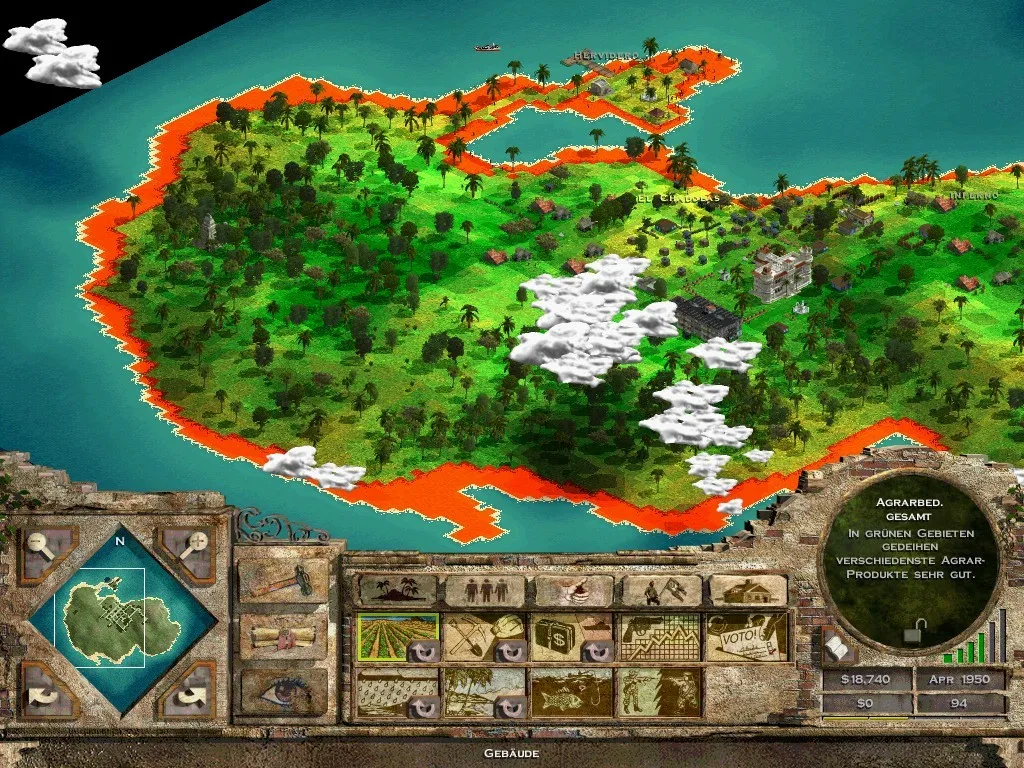
Getting people out of shacks and into better housing is one of the key ways to raise their happiness, and a tenement is suggested as an early upgrade. Placement matters: build near the palace and on flat land where possible, because flat ground needs less grading and the tenement is completed sooner. Pressing G displays a mesh overlay of the land, which helps in choosing a flat site. Pursuing better housing fits the broader social-services step of adding decent housing, a church, a pub, and, when affordable, a health clinic, and a high school can be considered for training workers.
Feeding the Island: Farms, Markets and Starvation
Citizens need food, and the manual lists the places where they can pick up supplies: food-producing farms, ranches, marketplaces, and fisherman's wharves. Restaurants also serve food, but the meal must be eaten on the spot, so they are not the primary food providers for the island's people. When the president fails to supply enough food, the population does not starve all at once; residents are resourceful and used to scavenging from the environment. Even so, some starvation deaths occur, and the survivors quickly become unhappy about this need.
Food is one of the essential services the player manages alongside housing, so allocating resources to farms and markets matters for keeping citizens content and the economy stable. Early on, the manual advises prioritizing income: converting perhaps two farms to profitable cash crops such as tobacco, sugar, coffee, or pineapples, then spending starting money on one or two more cash-generating enterprises. A mine suits nearby mineral deposits, a logging camp suits dense trees, and a ranch suits a large cleared area not planned for other use.
Pubs, Cathedrals, Clinics and Schools
Beyond housing, the manual groups religious, leisure and medical facilities into the social services the player installs once revenue is steady. A church meets basic worship needs, while a cathedral costs more but yields a stronger religious experience and higher religion quality scores. Citizens vary in piety, and for the devout, the absence of an adequate worship building quickly produces unrest. For leisure, pubs, restaurants, gourmet restaurants, sports complexes, casinos, nightclubs and cabarets each supply entertainment, and pricier venues earn better ratings; because tastes differ, a mix of venues covers more residents.
Health care works differently: it is free to citizens, so the player spends on clinics and on hiring doctors without collecting fees, receiving in return a population fit for long, productive work. Hospitals provide better care than clinics. A high school rounds out the set by training workers, and skills themselves come from time on the job, with more intelligent workers learning faster and reaching higher levels. Only the brighter citizens can handle high school and college, so schooling and workplace experience together shape a more capable labor force.
Crime, Tourists and Keeping the Peace
Crime in Tropico rises with population density and with the construction of seedier establishments such as nightclubs and cabarets. The crime level for an island can be checked in Info Mode through a crime overlay, so players can watch where trouble is accumulating. Police stations reduce crime, and tourist areas in particular need well-staffed police to keep visitors safe. The same Info Mode also offers an overlay of overall government control, which reflects the deterrent effect of a strong military presence: armed government soldiers on every street corner make an angry citizen unlikely to act.
Tourism is described as a very profitable industry that also demands a large amount of capital to start. Tourists arrive by yacht or plane and will not come without a hotel to stay in; once checked in, they rove around enjoying the sites until tired enough to return. They have maximum spending limits and expect quality service, and the tourism rating draws on hotels, attractions, crime safety, and environment quality. A strong military also lowers the risk of uprisings and coups, so soldiers stationed everywhere reinforce the sense of government control.
Uprisings, Coups and Rebel Battles at the Palace
When enough citizens grow angry, they may stage an uprising that resolves fairly quickly. Every adult decides either to join the uprising, actively oppose it, or run and hide until it ends. Supporters show loyalty to the government with a flag overhead, while opponents carry a burning flag. Both groups converge on the palace and typically fight each other first; if the opponents beat off most of the supporters, they then attack the palace itself. Enough damage forces the president to flee the island, and even a failed uprising costs a large portion of the labor force.
The president's own military can turn on him in a coup, though the player is not left defenseless: during a coup the soldiers split into those who support the government and those who want it out of power, and the two sides fight while the regime's fate is decided. Rebel forces hiding in the forests present a separate threat. Once brave and numerous enough, they pour out of the trees shooting as they come, then confront the military at the palace in a full-scale battle; soldiers who are less loyal may desert during the fighting, raising the risk of defeat.
Sources & further reading.
- Tropico Reloaded — official game profileRetrieved Oct 30, 2026
- Tropico Reloaded — official game profile — publisher-supplied gameplay manualRetrieved Oct 30, 2026
First published .