 THE GAME ARCHIVE

Defending the Solar System: The Core Loop
The core loop in Unstoppable Gorg is built around defending the solar system from fearsome aliens, and the method of defense is sending satellites into orbit. Rather than placing static towers on a fixed ground map, the player works in orbit, positioning satellites to meet incoming alien threats. That framing places the action in space, with the solar system itself as the territory to protect and orbiting hardware as the defensive units. The gameplay sits within the tower defense mode, so the basic structure is familiar: threats arrive, and the player builds and arranges defenses to stop them.
The game is categorized across the action, casual, indie, and strategy genres, which describes a tower defense title that leans on strategic placement while presenting action-oriented space combat against aliens. The documented rules interact simply: the tower defense mode supplies the build-and-defend frame, the satellite mechanic supplies the units and their orbital placement, and the alien invasion supplies the opposing force the player must stop to defend the solar system. Everything the player does is directed toward that single goal of holding off the aliens by putting satellites into orbit.
Satellites Instead of Towers and Grids
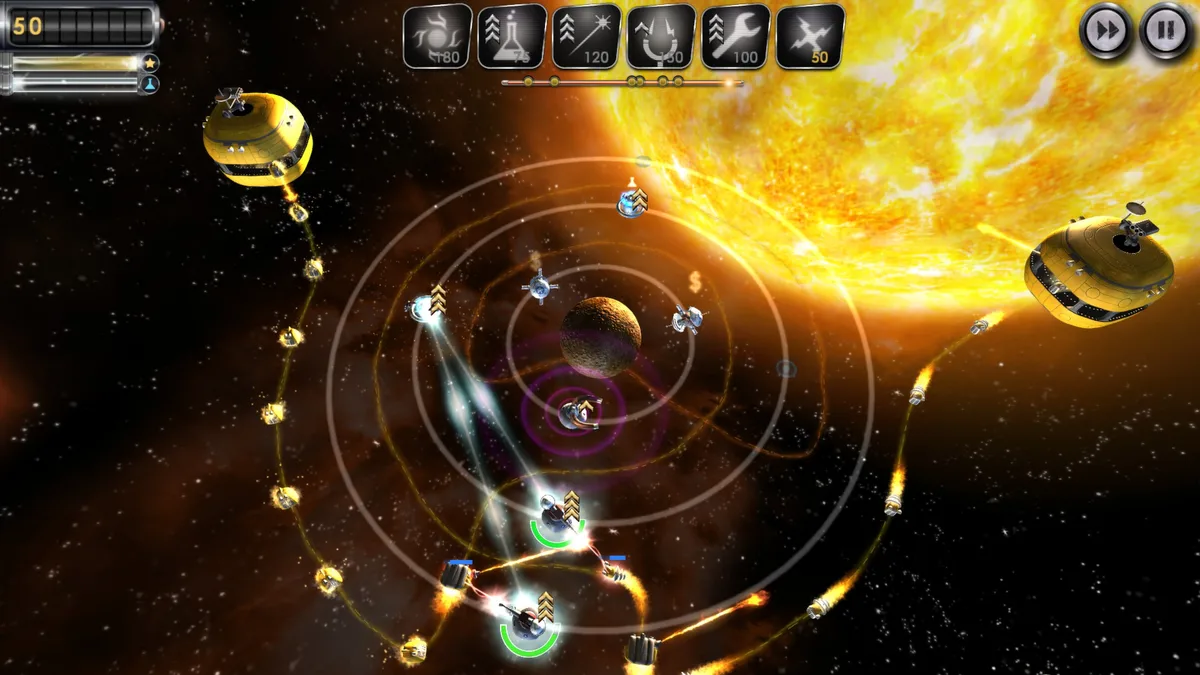
Instead of filling a ground-side grid with conventional defensive structures, Unstoppable Gorg swaps in satellites as the units you deploy. The orbital ring becomes the placement surface: each satellite occupies a position around a planet, moon or space station, and that arrangement is what stands between the solar system and the incoming alien force. The tower defense frame still governs the situation, with waves of threats to answer, but the hardware answering them is orbital rather than anchored to terrain. The opposing side is defined by flying saucers and rubbery aliens pulled from a 1950s science-fiction aesthetic.
The characteristic mechanic follows from that substitution: the orbits themselves can be rotated, so moving a satellite means turning the ring it sits on rather than selecting it and dragging it elsewhere. Because those rings encircle planets, moons and space stations, the repositionable defenses are tied to a celestial body at the center. Rotating an orbit therefore slides satellites around that body, changing which side of it they cover without taking them out of the ring. This is the rule the game sets apart from tower defense layouts where structures stay fixed once built, and it is the interaction the satellite-placement system is built around.
Rotating Orbits to Reposition Your Defense
Once satellites are in orbit, the documented way to move them is to turn the ring itself. Each orbit surrounds a planet, a moon or a space station, and rotating that ring carries the satellites around the celestial body at its center. The action is a rotation of the whole orbit rather than a separate move on a single unit, so a satellite stays on its ring and travels to a different side of the body. The coverage shifts with the ring rather than with an individual placement.
The rules interact through the orbit as the placement surface. Satellites replace traditional towers in a grid layout, and because the rings encircle planets, moons and space stations, repositioning is tied to a celestial body at the center. Turning an orbit therefore changes which side of that body the satellites occupy without pulling them off the ring. That is the departure from tower defense grids where structures stay fixed once built: here the player relocates the orbital hardware by rotating the orbit, and the ring's position around its body sets where the satellites sit.
40+ Levels, Achievements and Leaderboards
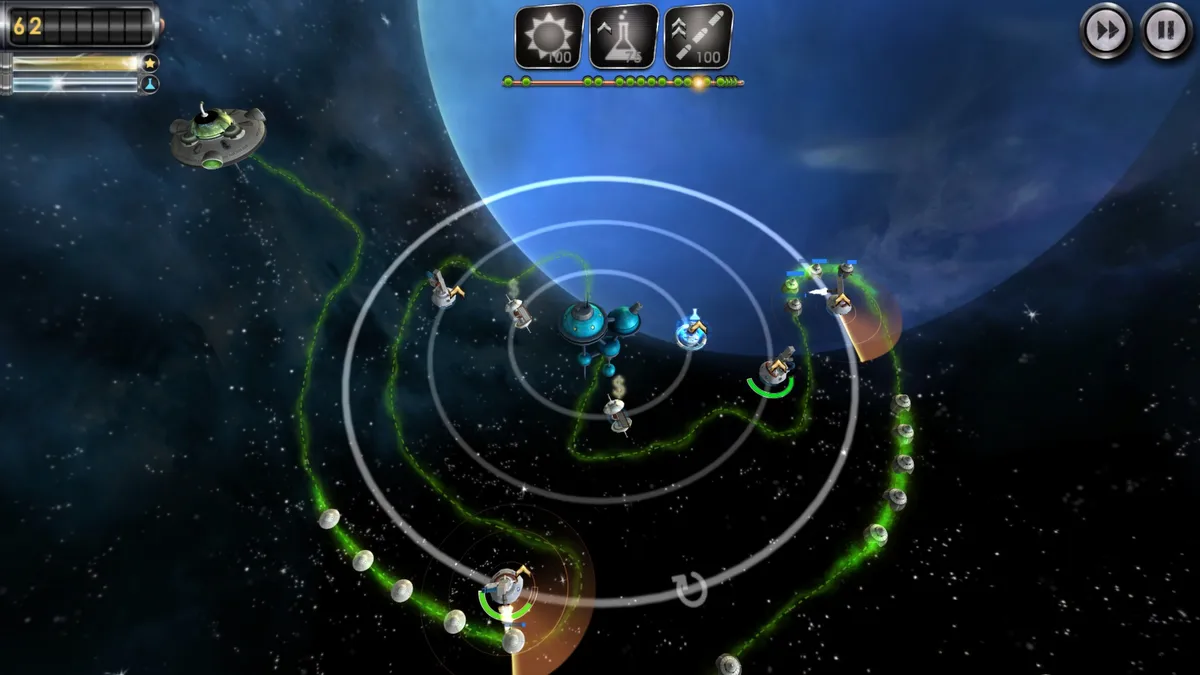
Across the campaign, Unstoppable Gorg offers more than 40 levels of tower defense action, each one asking the player to set up satellite defenses against the alien force. The orbit mechanic carries through that run: satellites sit on rings around planets, moons and space stations, and the player turns those rings to shift coverage against each wave. The level count gives the documented structure of the game a long stretch of encounters in which placement and orbital rotation remain the tools for meeting threats.
Alongside the levels, the game includes Steam achievements to unlock and leaderboards on which players can earn a place. These sit outside the core defensive actions of deploying satellites and rotating orbits, functioning as separate progression and ranking features tied to play. The documented structure is therefore twofold: the level-by-level defense of the solar system, and the achievements and leaderboard placement that accompany it. No further rules for how either is earned are supplied.
1950s Sci-Fi Story Scenes and 3D Look
The look of Unstoppable Gorg draws on the science-fiction films of the 1950s for its story material. Its story scenes were shot on film with physical models, miniatures, and live-action actors, then edited together with genuine archive footage to form a classic science-fiction experience. Filmed miniatures and real performers carry the narrative segments, giving them a period texture rather than a fully computer-generated appearance. That approach ties the story sequences to the era the game's flying saucers and rubbery aliens come from.
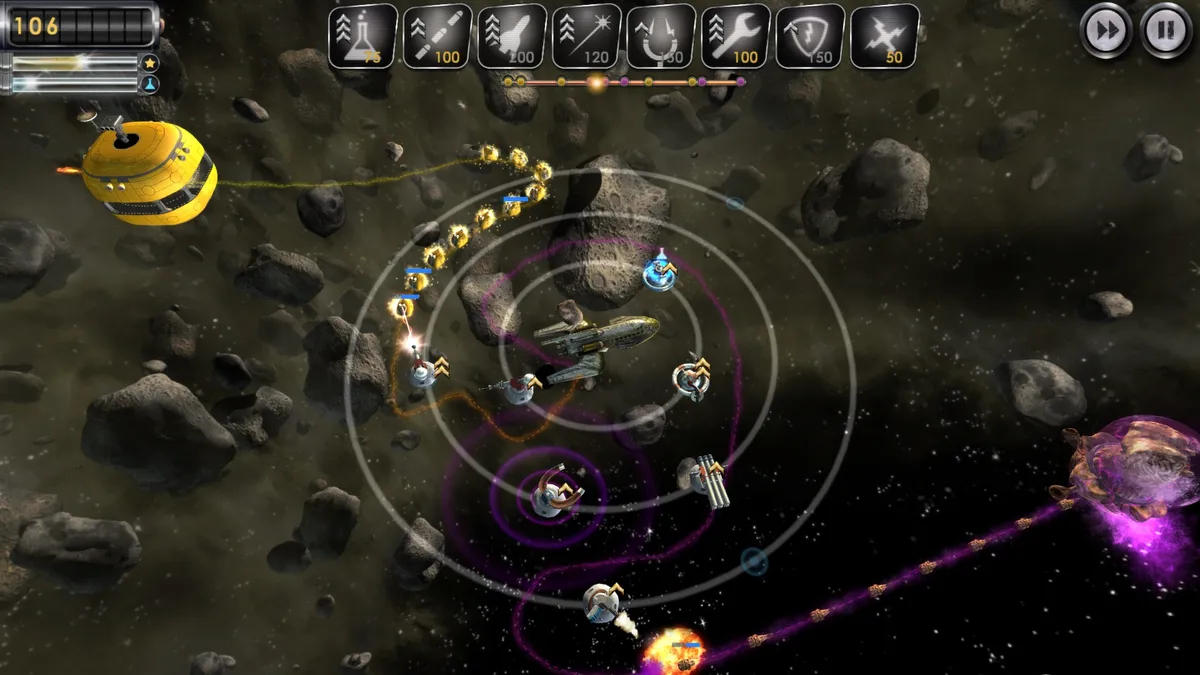
Beyond the story scenes, the game presents three-dimensional graphics and effects, which the documentation describes as adding impact. The filmed model work and archive footage belong to the narrative scenes, while the 3D rendering supplies the visual layer described for play. The two are distinct parts of the presentation: photographed miniatures and actors for the story, and three-dimensional effects elsewhere. Together they support the 1950s-inspired science-fiction identity without the story segments themselves being rendered in 3D.
Release and Platforms
Unstoppable Gorg is documented on Steam for Windows and macOS, with Futuremark listed as both developer and publisher. The Steam product date shown in that record is 2012; this marks the store listing rather than the original launch of the game. No other version information is supplied, so the supported platform picture is limited to those two desktop systems, and nothing is stated about console releases or later ports.
The same Steam record files the game under the action, casual, indie, and strategy genres, alongside the tower defense framework described elsewhere. Futuremark appears again as publisher, matching the developer entry. These catalog facts sit outside the play itself: they identify who made and offered the game, which systems the store lists, and how it is tagged. They do not spell out controls, difficulty settings, or any backup and suspend functions, and none of those should be assumed from the storefront entry.
Sources & further reading.
- Unstoppable Gorg — official game profile Retrieved Oct 19, 2026
First published .