 THE GAME ARCHIVE
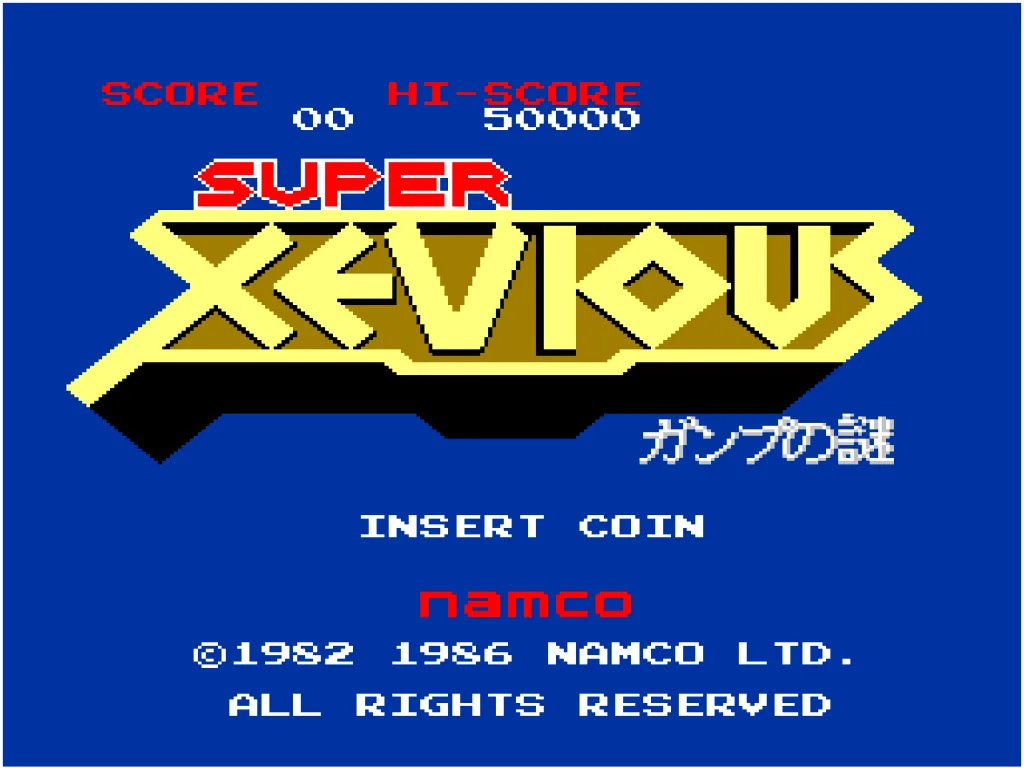
A Shooter Built Around a Puzzle You Have to Find
VS. Super Xevious: Mystery of Gump is a Namco arcade shooter from 1986, and its published description makes the premise unusually specific. You take control of the SOLVALOU, described as a cutting-edge fighter craft, and fight off the XEVIOUS forces to save humanity. But the line that changes how the game reads is the next one: you must solve the secret puzzle in each area to make your way to the enemy fortress where the leader GUMP lies in wait. Puzzle-solving is not a bonus tucked into the corner of this shooter — it is written into the route itself.
That single documented rule reframes the familiar arcade rhythm of fire and dodge. Combat and puzzle-solving are presented as two halves of the same flight rather than two separate modes, and the destination — the enemy fortress and its leader GUMP — sits at the end of that repeated pair of tasks, not merely at the end of a long gauntlet.
The Premise: SOLVALOU, the XEVIOUS Forces and GUMP
The cast is small and clearly drawn. On one side is the SOLVALOU, the fighter craft described as cutting-edge, which the player controls. On the other are the XEVIOUS forces, the enemy the player fights off, and at the top of that enemy structure is GUMP, the leader waiting in the enemy fortress. The stated stakes are the highest the description offers: saving humanity. That framing gives the flight a clear goal and a clear villain, and it makes the fortress the natural endpoint of the journey.
What makes this set-up more than boilerplate is the way the puzzle sits between the player and the leader. GUMP is not reached by out-flying the XEVIOUS forces alone; the description says the secret puzzle in each area is the way to make it to the fortress. So the fight against the enemy and the hunt for each area's secret belong to the same advance. The player is at once a pilot pressing the attack and a solver reading the environment for the hidden condition that opens the next stretch of the journey.
The Core Loop: Fight, Find, Advance
Stripped to its documented bones, the loop is a three-beat cycle. First, you fly the SOLVALOU into an area. Second, you fight the XEVIOUS forces that occupy it. Third, you work out that area's secret puzzle so the route onward opens. Because the description specifies the secret puzzle in each area, this is a repeating structure rather than a one-time trick: the same expectation carries from area to area as you press toward the fortress. That makes the puzzle step a real decision point — the continuation of the run depends on treating it as part of the job rather than an afterthought.
This design adds a reading task on top of the usual shooter demands of movement, targets and survival. The puzzle is described as secret, which implies it is not simply handed to the player as an instruction; it has to be discovered. That is a meaningful shift of focus: the player must balance reacting to threats with searching for what each area hides, and the fortress only comes within reach when both are satisfied.
What the Rules Make the Player Do
The clearest supported mechanic is the area gate. Progression is explicitly tied to solving the secret puzzle in each area before the enemy fortress becomes reachable. In practical terms, that means two separate competencies are demanded of the same player: the combat competence to deal with the XEVIOUS forces, and the observation and logic to uncover what each area is hiding. Neither replaces the other. The published description presents puzzle-solving and combat as steps to the fortress, not as alternatives to one another.
The stated objective — saving humanity — gives these mechanics their purpose. The shooting has stakes, and the puzzles are the means of reaching the enemy leadership rather than abstract brain-teasers. GUMP, waiting in the fortress, is the goal the puzzle-gated route leads toward. Read together, the rules describe a campaign in which each area is a small problem with a hidden answer, and the fortress is the final destination those answers unlock.
It is worth being precise about what the source does and does not pin down. What is documented is the control of the SOLVALOU, the XEVIOUS forces as the enemy, the goal of saving humanity, the secret puzzle required in each area, and the enemy fortress where GUMP waits. The description does not detail how the puzzles are solved, how the ship is steered, how the XEVIOUS forces attack, or how scoring works. Those gaps matter for anyone planning a run, but they do not weaken the one structural rule the publisher does state clearly: the puzzle is the gate, and the fortress is behind it.
Progression: From Area Puzzle to the Fortress
The progression in VS. Super Xevious is built from repeated puzzle clearances. Each area adds its own secret to solve, and each solved secret is a step closer to the enemy fortress. The final beat is the fortress itself, where GUMP waits. The player's advance is therefore measured not only in enemies beaten but in areas understood, and the goal of defeating the enemy leader is the endpoint those understood areas open toward.
Starting Guidance for New Pilots
For a newcomer, the most valuable advice follows directly from the documented rules. Treat each area as two jobs rather than one: fight off the XEVIOUS forces, and solve that area's secret puzzle. The published route ties progress to the puzzle in each area, so it is part of the required work, not an optional extra. Keep the destination in view — the enemy fortress and GUMP are the endpoint, and each area's solved secret is what moves the ship toward them.
Beyond that, the publisher material does not supply specific puzzle solutions, movement inputs or scoring targets, so a guide should not pretend to. The honest starting point is to internalize the two-part expectation and to approach each area's secret as a discovery task. The objective of saving humanity is the frame that makes the run worth completing, and the fortress confrontation with GUMP is the documented finish line the puzzles lead to.
Why the Puzzle Frame Defines the Game
Plenty of arcade shooters ask the player to survive and shoot. What distinguishes this one in its published description is the insistence that a hidden puzzle in every area stands between the player and the end. That choice shapes what the flight rewards: reacting against the XEVIOUS forces, but also the curiosity to find each area's secret. The forward motion toward the fortress and GUMP becomes a record of solved mysteries as much as cleared threats, and the goal of saving humanity gives those solved mysteries their weight.
The result is a 1986 Namco arcade shooter whose published design promise is clear: fly the SOLVALOU, fight the XEVIOUS forces, and solve what each area hides if you want to reach the fortress where GUMP waits. Specifics of inputs, attack patterns and puzzle solutions are not in the supplied material, but the core premise is complete enough to explain what the player is doing and why.
Scroll sideways to see the full table →
| Field | Documented value |
|---|---|
| Title | VS. SUPER XEVIOUS MYSTERY OF GUMP |
| Publisher | Namco |
| Year | 1986 |
| Platform | Arcade |
| Genre | Shooting |
| Player craft | SOLVALOU |
| Enemy | XEVIOUS forces |
| Enemy leader | GUMP, in the enemy fortress |
| Stated objective | Save humanity |
| Progression mechanic | Solve the secret puzzle in each area to reach the fortress |
Sources & further reading.
- VS. SUPER XEVIOUS MYSTERY OF GUMP — licensed publisher game documentation Retrieved Oct 18, 2026
First published .