 THE GAME ARCHIVE
A Semi-Sequel Built for Risky Lines
AaaaaAAaaaAAAaaAAAAaAAAAA!!! for the Awesome is a semi-sequel to Dejobaan's award-winning 2009 title, AaaaaAAaaaAAAaaAAAAaAAAAA!!! -- A Reckless Disregard for Gravity. It carries forward 82 remastered levels from that original and adds 43 brand-new ones that are twice as fast, distributing the new drops around Earth, Luna, and Ganymede behind a new, faster wingsuit. That combination is the whole pitch: familiar stunt-jumping lines remastered, then a faster set of descents that push the same scoring ideas harder.
What makes this installment distinct is not a new genre but a new stance toward the dive. The original took place in an alternate 2011, with BASE jumpers leaping from the skies and performing stunts around the floating buildings of Upper Boston. This semi-sequel picks up six years later: the sport has been outlawed, and the jumper dives as a form of protest. The scope is confirmed for Windows and Linux, developed by Dejobaan Games, LLC and Owlchemy Labs and published by Dejobaan Games, LLC.
The Premise: Outlawed Diving as Peaceful Protest
The fiction reframes every dive. Where the earlier game's stunts read as spectacle around Upper Boston's floating architecture, this one treats jumping itself as defiance: the sport is banned, and the jumper keeps flying as protest. The publisher describes the aims as peaceful, and that framing matters for how the stunts read. Threading turbine blades, taunting colonists, and spraying graffiti are staged as civil disobedience, not combat.
The route then expands outward from Earth. High in the planet's stratosphere the jumper threads a path through the rotating blades of enormous wind turbines. Elsewhere in the solar system the dives call for dodging asteroids above seas of lava, spraying graffiti onto lunar government offices, and flipping off Ganymede colonists. Each location supplies its own hazard or target, so the protest is expressed through the level's flight line rather than through a separate narrative layer.
Close-Contact Scoring: Points for Skimming the Surface
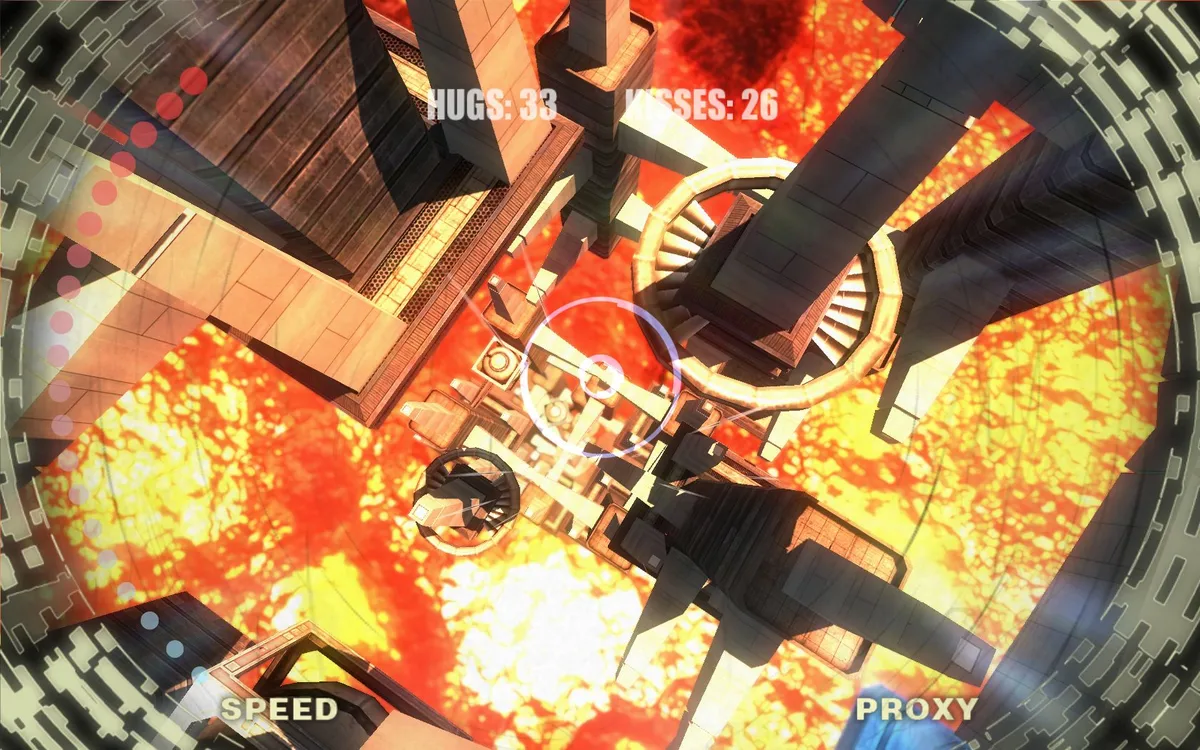
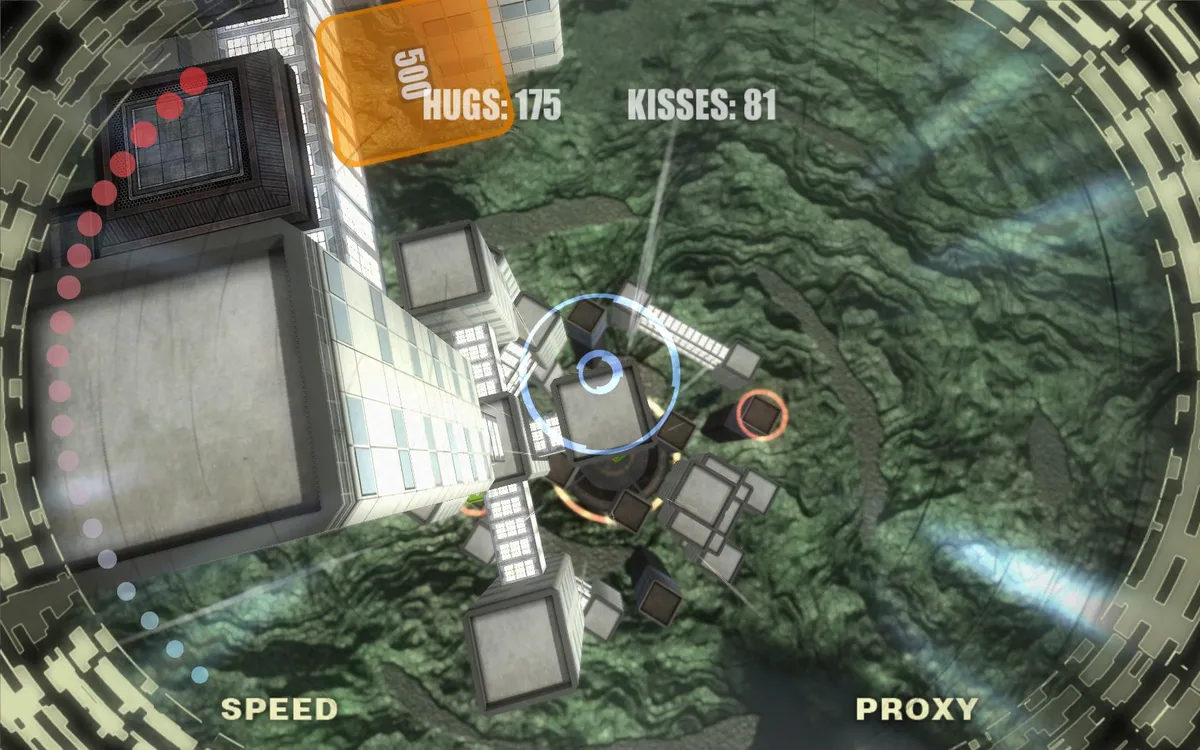
The core scoring loop is proximity. Three named maneuvers award points: hug terrain, kiss concrete, and thread the needle. They share a logic of rewarding risk, but they read as distinct actions rather than one catch-all speed bonus. Hugging terrain means flying close to the ground or built surfaces; kissing concrete means grazing hard structures in the city; threading the needle means passing through tight gaps. Each asks the jumper to choose a line that is closer than is safe.
That gives the player a real decision on every descent: trace the safe center of the gap or shave the edge for points. The faster wingsuit sharpens the tradeoff. With the new suit the jumper dives, and dies, twice as fast, so a line that hugs geometry leaves less time to correct before contact. The scoring system therefore turns level layout into a negotiation between safety margin and visible proximity.
Crowd Gestures: Play to the Audience
The flight path is not the only scoreboard. Giving fans the thumbs-up earns points, and annoying protesters with rude gestures is a second scored action aimed at the crowd. These gestures are audience-facing, not structure-facing: they belong to the spectators rather than to the buildings and obstacles. That means the player also decides how to perform in front of the crowd, splitting attention between reading the line ahead and working the onlookers.
The thumbs-up is the friendly side of that exchange, a way to acknowledge the fans who came out to watch an outlawed dive. The rude gesture is the antagonistic counterpart aimed at protesters demonstrating against the sport. Neither replaces the close-contact moves; instead the two gesture types sit beside them, so a single dive can reward proximity to architecture and engagement with the crowd at the same time.
Wanton Destruction: Bear Hugs, Netting and Invulnerability Plates
A third stream is labeled wanton destruction, fed by three named actions: getting a bear hug, slicing netting, and hitting invulnerability plates. These are obstacle-facing moves rather than crowd gestures or surface skims. The scoring identity of each dive therefore combines close-contact flying, audience gestures, and destruction rewards, giving the player several different sources of points to pursue in any one descent.
Because these moves attach to structures, they push the player toward the same risky parts of the level that the proximity bonuses already do. Slicing netting cuts through netted barriers standing in the flight path, and invulnerability plates are struck to score. Adding the faster wingsuit narrows the window for lining up any of these contacts, so the destruction system reads as a deliberate stress test of how precisely a jumper can commit to the architecture.
Progression: Remastered Levels, New Drops and Checkpoint Rewinds
Progression is split between revived and new material. The 82 remastered levels revisit the original game, while 43 new levels spread around Earth, Luna, and Ganymede are described as twice as fast. That faster second set is where the new wingsuit and its consequences live: diving and dying twice as fast is the design direction the semi-sequel keeps advertising. A player who learns the older lines and then steps into the new drops gets a steeper version of the same proximity game.
The fastest jumps now offer checkpoints, which changes the failure loop. If a jumper smashes against extraterrestrial rock, the game lets the player rewind time and execute the dodge rather than return to the top. That matters on the off-world stages where asteroids patrol above seas of lava. The system keeps the new speed manageable: death still happens twice as fast, but the retry repeats only the dodge that went wrong, letting the player rehearse a precise line instead of relearning the whole descent.
Earth, Luna and Ganymede: How the Locations Shape a Dive
The settings change what the documented objectives ask for. Earth's upper atmosphere is the turbine territory: threading between rotating blades is the hazard. Further out, the asteroid fields above lava seas turn the descent into a dodge. Luna swaps hazard for vandalism as the jumper sprays graffiti onto lunar government offices. Ganymede is where the flip-off gesture aimed at the colonists is staged. In every case the environment carries a task, so the level list is also a list of different protest acts.
The claim of descending through hovering cities over Earth and beyond also identifies the broader visual frame: cityscapes suspended in the sky to dive through and past. The faster wingsuit is what makes those environments read as a speed experience rather than a scenic one. A player choosing a line through turbine blades or between asteroids is judging spacing at a pace that leaves little room to admire the scenery.
Presentation: A Rebuilt Look for the Same Stunt Language
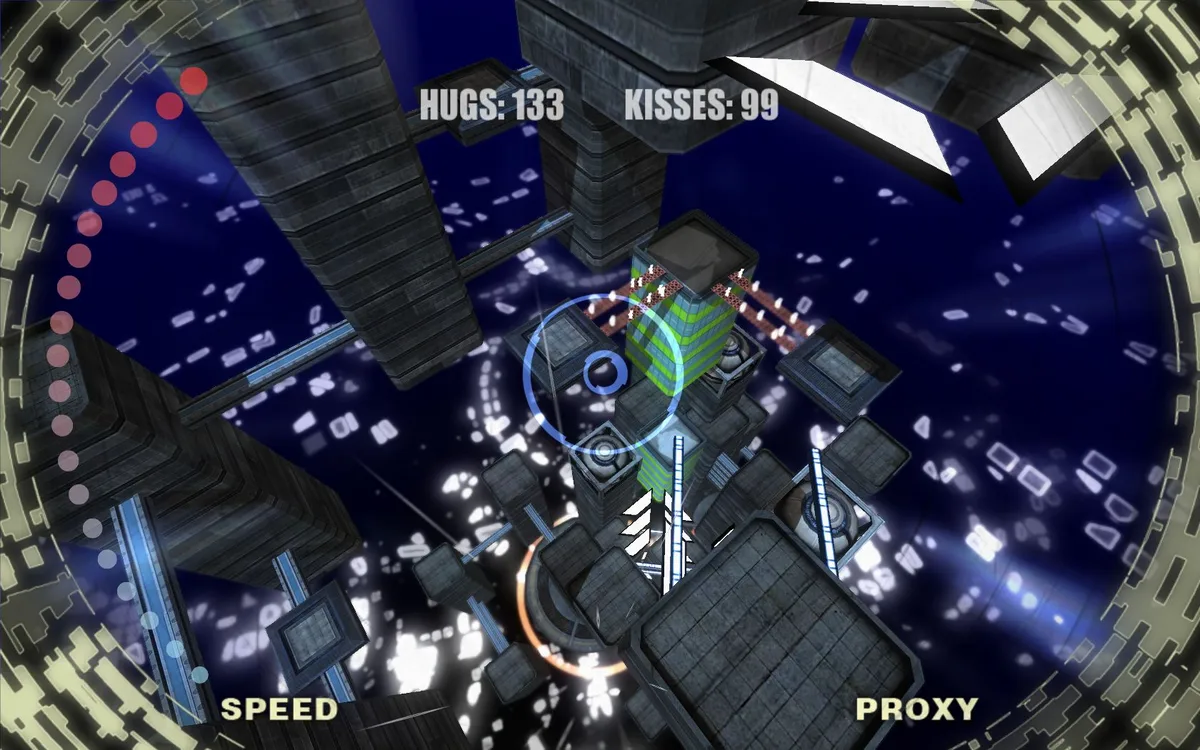
Presentation is part of the edition's identity. The publisher describes the semi-sequel as rebuilt from the ground up, with a new lighting system and shader effects. Those additions sit around the same stunt language rather than replacing it. The game's visual personality is aerial and architectural: floating buildings to skim, huge wind turbines to thread, off-world lava seas and patrolling asteroids to dodge.
Starting Guidance: How to Approach a Dive
Treat each descent as a series of choices rather than a single line. The remastered 82 give a working education in the proximity moves; the 43 new drops are twice as fast, so the safest way into them is to accept checkpoints as a learning tool and use rewinds to perfect individual dodges rather than to restart whole dives. On the asteroid stages, the checkpoint rewind is the documented recovery method after hitting extraterrestrial rock.
Then decide which scoring streams to chase. Close-contact flying rewards skimming terrain, concrete, and tight gaps; crowd gestures reward the thumbs-up and the rude gesture; destruction rewards bear hugs, netting slices, and invulnerability plates. Since these sources are separate, a good early habit is to fly a clean line first and then, on repeat attempts, add the gesture and destruction actions one at a time so the timing of each is understood before the speed forces the issue.
Scroll sideways to see the full table →
| Attribute | Detail |
|---|---|
| Title | AaaaaAAaaaAAAaaAAAAaAAAAA!!! for the Awesome |
| Release year | 2011 |
| Developers | Dejobaan Games, LLC; Owlchemy Labs |
| Publisher | Dejobaan Games, LLC |
| Platforms | Windows, Linux |
| Genres | Action, Indie, Sports |
| Levels | 82 remastered from the original; 43 new levels around Earth, Luna, and Ganymede |
| Core scoring actions | Hug terrain, kiss concrete, thread the needle; thumbs-up and rude gestures; bear hugs, slice netting, invulnerability plates |
Sources & further reading.
- AaaaaAAaaaAAAaaAAAAaAAAAA!!! for the Awesome — official game profile Retrieved Oct 18, 2026
First published .