 THE GAME ARCHIVE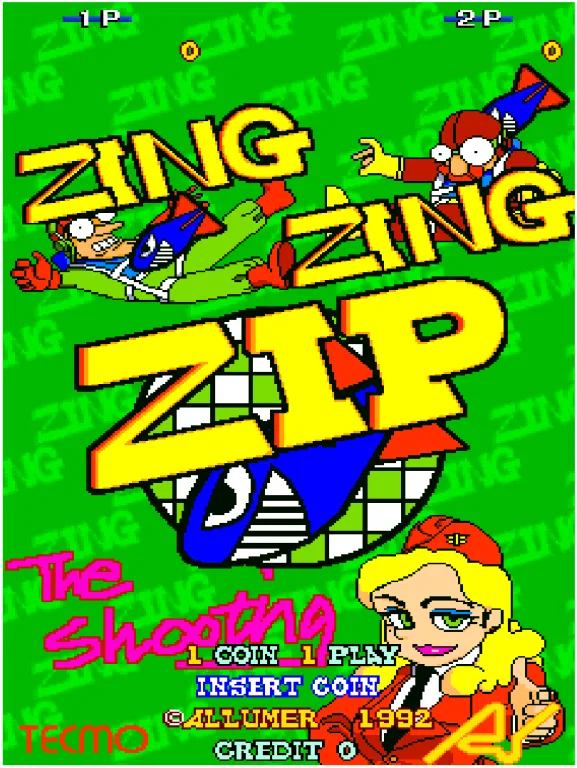
What ZING ZING ZIP Is and How a Run Is Framed
ZING ZING ZIP is a shooter released by ALLUMER in 1992 on the arcade platform. The publisher's documentation presents it as a shooting title, so the action belongs to the gun-based arcade category rather than to puzzle or platform play. Everything known about the game begins from that identity: a player operates an aircraft, fights an enemy force described as the evil empire, and works toward clearing the screen.
The documented aim is twofold: defeat the evil empire and clear the screen. The publisher states that the way to reach the screen-clearing goal is to make full use of various items and rolling special moves. Those two elements, items and the rolling special moves, are the tools the game puts in the pilot's hands, and the documentation treats using them fully, not sparingly, as the intended path through a run.
- Title: ZING ZING ZIP
- Release year: 1992
- Publisher: ALLUMER
- Platform: Arcade
- Genre: Shooting
Two Aircraft, One Trait Each: Choosing a Seat Changes How You Move
The most distinctive rule in ZING ZING ZIP is that the two aircraft are defined by a single movement trait each. The 1P aircraft has fast vertical movement speed. The 2P aircraft has fast horizontal movement speed. The documentation does not describe upgrades, so movement style comes from which aircraft is being operated, not from anything collected mid-run.
That split shapes how each craft approaches the screen. The 1P craft's fast vertical speed makes it the natural choice when the pilot wants to move quickly up and down the playfield. The 2P craft's fast horizontal speed makes it the natural choice when side-to-side travel matters more. Because each aircraft carries only one fast axis, the player is effectively choosing which direction of movement to specialize in whenever a seat is taken.
Both aircraft share the same mission. The documentation states that the 1P or 2P aircraft is operated to defeat the evil empire, and that the screen-clearing aim applies regardless of which craft is flown. Neither aircraft is described as stronger than the other; the difference lies purely in which movement axis is fast.
Rolling Special Moves: Invincibility or Power-Up While Active
The rolling special moves are the centerpiece mechanic. The publisher describes them as moves that make the craft invincible or power it up while activated. The two states are presented together as the outcome of the same family of moves: one leaves the craft invincible for the duration, and the other leaves it powered up.
The practical distinction matters because the two states solve different problems. Invincibility answers the threat of being hit; it covers the craft while the move is active. A power-up answers the need to hit harder or otherwise strengthen the craft. A pilot deciding whether to spend a rolling special move has to weigh protection against offense, and the documentation treats both outcomes as legitimate uses of the mechanic.
The duration clause, while activated, is central. Neither state is described as permanent. The rolling special move changes the craft's condition for the time it is running and then returns the run to normal handling. That timing turns the mechanic into a resource to time rather than a passive upgrade, and the documentation's instruction to make full use of rolling special moves reinforces the idea that they are meant to be used actively.
Items and Special Moves Together: The Documented Route to Clearing the Screen
Items are the second resource. The publisher refers to various items, without naming individual types, so the item catalogue is not documented. What is documented is the instruction attached to them: the screen is cleared by making full use of various items and rolling special moves. Items and special moves appear side by side in that sentence, which makes them partners in the intended strategy rather than separate systems.
The word full is the operative one. The documentation does not say to conserve items or to save rolling special moves for an emergency. It says to use them fully. For the pilot, that points toward a playstyle in which the two resources are kept in circulation: rely on invincibility when a rolling special move's protection is the useful state, rely on the power-up when offense is the useful state, and fold items into the same effort so that both tools carry the run toward the screen-clearing goal.
The enemy is described as the evil empire, and defeating it is named as the objective alongside clearing the screen. The documentation gives no detail on enemy types, formations, bosses, or stage structure, so those elements cannot be described. The supported rules cover what the player must do: operate the aircraft, use items and rolling special moves, and press toward defeating the evil empire and clearing the screen.
Starting Guidance Drawn From the Documented Rules
Choose the aircraft by the movement you trust. If quick travel up and down the playfield is what the situation demands, the 1P aircraft with fast vertical movement speed is the documented fit. If quick side-to-side travel is the priority, the 2P aircraft with fast horizontal movement speed is. Because each craft carries only one fast axis, the seat decision is the first tactical choice in any run.
Then use the tools early and often. The publisher directs players to make full use of various items and rolling special moves to clear the screen, and to defeat the evil empire. That instruction is the closest the documentation comes to advice, and it is straightforward: treat items and rolling special moves as the core of the effort, not as backups, and lean on invincibility or the power-up as the situation calls for.
The Modern Reissue: Difficulty Settings, CRT Look, and Online Rankings
ZING ZING ZIP also appears in a modern licensed reissue, and that context needs to be kept separate from the 1992 arcade original. The reissue is described as faithfully reproducing classic arcade games and staying true to the original. It adds customizable game settings, including the ability to adjust the difficulty level to suit the player. Those options belong to the reissue, not to the original cabinet.
Depending on the title, the reissue can also recreate the nostalgic atmosphere of CRT televisions from the arcade era. The documentation qualifies this as title-dependent, so it is a possible feature of the reissue package rather than a guarantee for every game. The reissue also supports competing for high scores with players from all around the world through online rankings, again as part of the modern package rather than the original release.
Sources & further reading.
- ZING ZING ZIP — licensed publisher game documentation Retrieved Oct 17, 2026
First published .