 THE GAME ARCHIVE
Running, Jumping, and Mouse-driven Actions
Huitzilo moves through the side-scrolling stages using the left and right arrow keys or the A and D keys for running. Pressing the up arrow or W key makes him jump, while the down arrow or S key lets him crouch and pick up items. A separate traversal action appears when flashing stars surround Huitzilo; pressing up at that moment performs a wall jump, letting him spring off the wall rather than simply jumping upward. These keyboard inputs handle locomotion and crouching, while the mouse is reserved for other abilities.
With the mouse, Huitzilo attacks with his spear or holds the button to charge a stronger strike. The same mouse-driven input also manipulates spiritual energy by dragging and dropping energy cells. Beyond combat and energy handling, the pointer is used to talk to characters and to enter doors and caverns. Together, these mouse actions cover the game's interaction layer: striking enemies, moving energy from one place to another, starting conversations, and passing into interior locations.
Spear Combat and Ancestral Techniques
Huitzilo's spear combat centers on a charge-and-release rhythm. Holding the attack button charges the spear; right after releasing that charge, rapid clicks on the attack button again produce powerful combo attacks. The timing matters because the combos follow the charged strike rather than replacing it. The mouse button is the same input used for the attack itself, so the charged hit and the follow-up burst of clicks form a single sequence the player builds through holding, releasing, then clicking quickly.
Ancestral techniques add two more spear options that use different inputs. The down attack lets Huitzilo strike enemies by pressing the down key while he is in the air, tying the technique to airborne positioning. The whirlwind attack strikes in all directions at once and is triggered by right-clicking rapidly and alternately on both sides of Huitzilo. The game notes that Huitzilo can learn several new techniques during play, so these listed ancestral skills are part of a set he acquires rather than the entirety of his spear repertoire.
Spell Selection and Spiritual Energy Cells
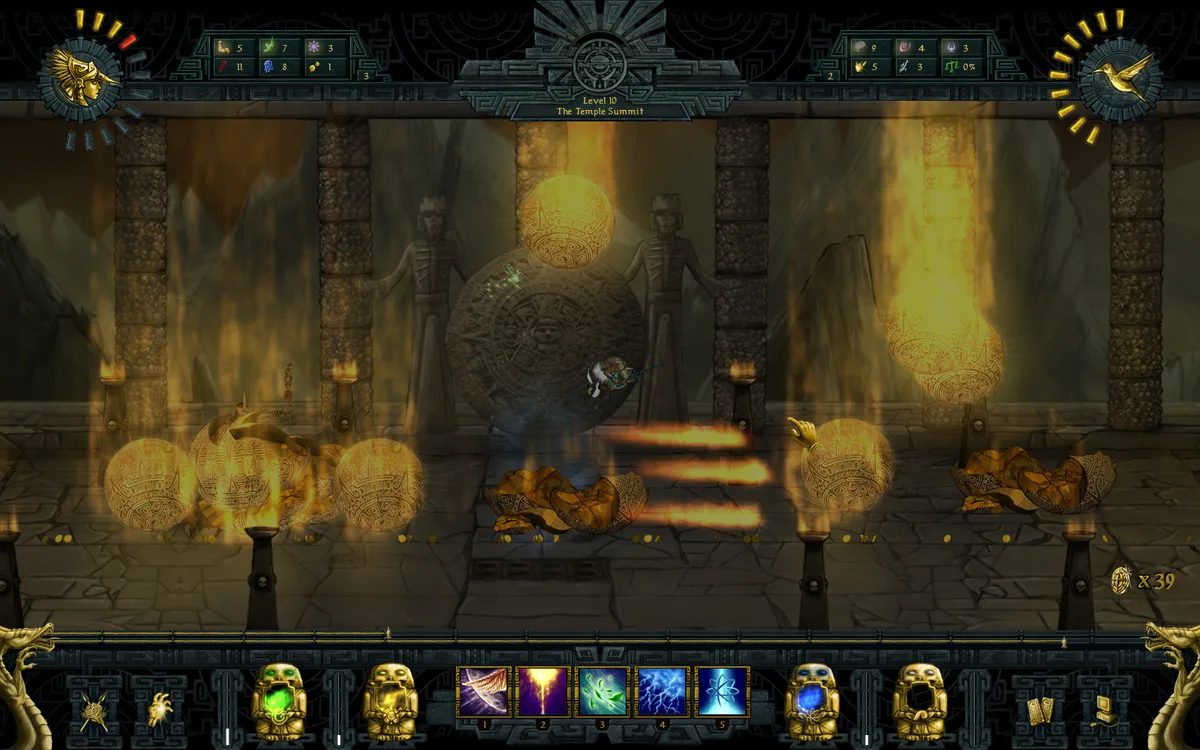
Spellcasting is a two-step process tied to the number row and the pointer. Pressing keys one through five, or clicking the spell icon, selects one of the available spells; after that, clicking the intended target with the mouse casts it. This separates choosing a spell from aiming it, so the same five-key range and icon cover selection while the mouse handles delivery. Ayohpa's divine energy, shown in the upper-right yellow meter, limits this casting: when its cells are all empty, she can no longer cast spells until it is replenished.
Energy cells are physical objects handled by drag and drop, and what they do depends on where they land. Four types of energy can be placed into statues, and each statue holds only one specific type; stored energy stays there until dragged back out. Dropping a vital cell on Huitzilo or his upper-left health meter heals him, while a divine cell dropped on Ayohpa or her divine meter raises her divine energy. A pure cell dropped on Ayohpa unlocks the Pure Shield spell, and an elemental cell dropped on Huitzilo activates the Elemental skill.
Vital and Divine Meters, Levels, and Extra Lives
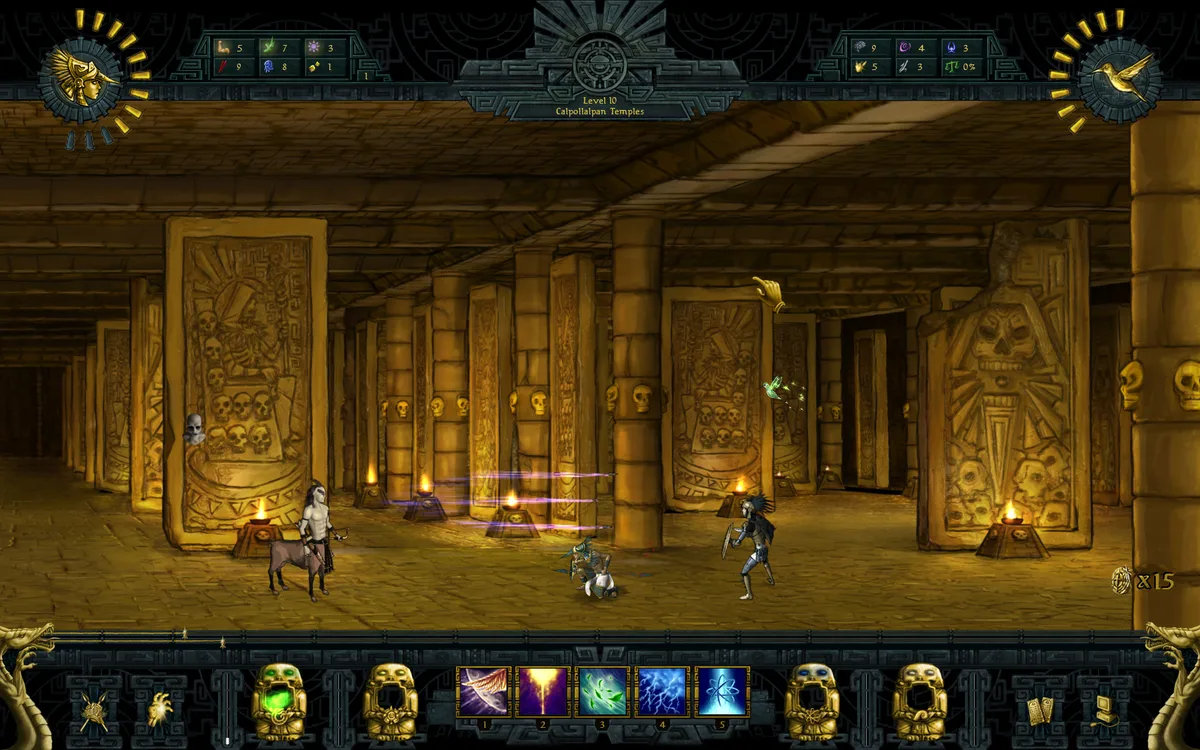
Huitzilo's vital energy appears as a yellow meter in the upper-left corner of the screen, and the game ends once every cell in that meter is empty. Ayohpa's divine energy occupies a matching yellow meter in the upper-right, and it governs her spellcasting: as long as at least one cell remains, she can cast, but when the meter is fully drained she cannot cast spells at all until it is refilled. These two meters set the stakes of play, since running out of vital energy finishes the run while an empty divine meter temporarily removes Ayohpa's spells from the pair's options.
Defeating foes earns experience points for both Huitzilo and Ayohpa. When they reach a new level, the player may add one point to an attribute and one point to a skill; for attributes, a plus sign appears above the upgradeable ones after each new level, and clicking it adds the point. The two characters share a set of twelve attributes, which equipment and potions can also modify. Extra lives come from divine favors, and lives are restored whenever the player returns to the world map, so progress there replenishes that stock.
Phonogram Quest, Shops, and Side-quests
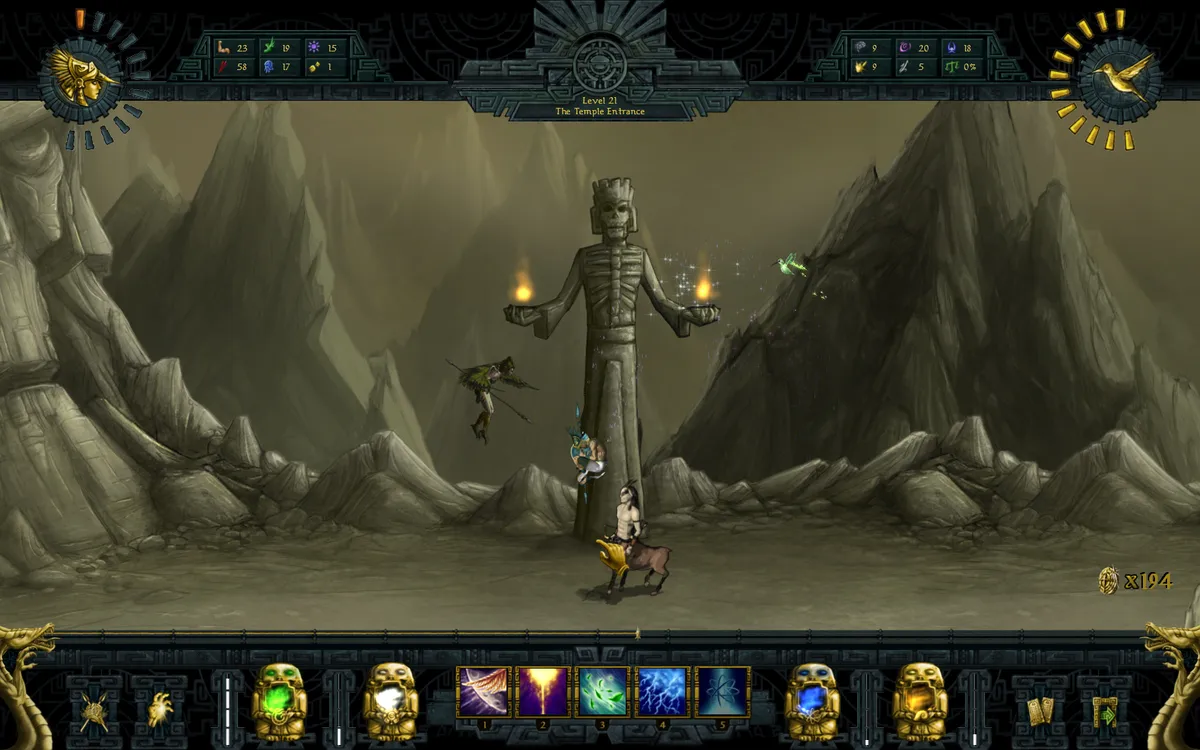
The campaign's central objective is to reunite seven phonograms, a task framed as saving Huitzilo's people from the wrath of the Aztec Gods. Alongside that main thread, the game offers optional side-quests, and completing these yields valuable items and gold. That gold feeds directly into the shop system: players visit shops to buy and sell potions, rings, piercings, and skills that aid them in their travels. The world supporting these activities spans twenty-one unique and detailed levels, each with grand, richly detailed backdrops and fluid character animations.
The side-quest and shop loop connects to character growth: shops stock potions, rings, piercings, and skills, and the gold earned from optional quests pays for them. Potions and equipment also modify the shared twelve attributes described elsewhere, so purchases can feed back into the same stat pool that level-ups expand. The twenty-one levels provide the stages where quests, shops, and combat encounters sit against detailed backdrops. The seven phonograms remain the narrative spine running through these varied locations.
Huitzilo, Ayohpa, and World-map Lives
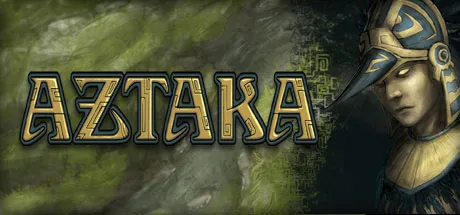
Huitzilo is the player's character, the heir of the Sun God who is skilled in both combat and magic, and he is joined by his faithful companion Ayohpa, a hummingbird trapped in that form by a magical curse. The pair works together to overcome the obstacles in their path, combining fighting prowess with spiritual magic. The catalog presents this as a single-player action role-playing side-scroller set inside a war between the Gods and Mankind, with the two characters operating as one unit through the stages rather than as separate controllable figures.
Extra lives are tied to divine favors: each divine favor grants an additional life, and the stock is restored each time the player goes back to the world map. That restoration turns the world map into a refill point for lives rather than a purely navigational screen, since returning there resets the count regardless of how many were spent in the stages. The rule is explicit about both the source of lives and their replenishment, so the world map functions as the place where the extra-life supply is renewed between excursions.
Sources & further reading.
- Aztaka — official game profile Retrieved Oct 21, 2026
- Aztaka — official game profile — publisher-supplied gameplay manual Retrieved Oct 21, 2026
First published .