 THE GAME ARCHIVE

Three Ways to Win: Laps, Wreckage, or a Pedestrian Purge
Every level hands you three separate finish conditions rather than one. You can complete all the laps of the race course like a conventional racing game, wreck every opponent vehicle until none are left, or kill every pedestrian in the area. The setting shifts between cities, mines and desert towns, with computer-controlled competitors sharing the roads and locals wandering the streets at their own risk. Your car doubles as the weapon throughout, and scattered power-ups add varied effects to the chase. Whichever condition you satisfy first ends the level and counts as a win.
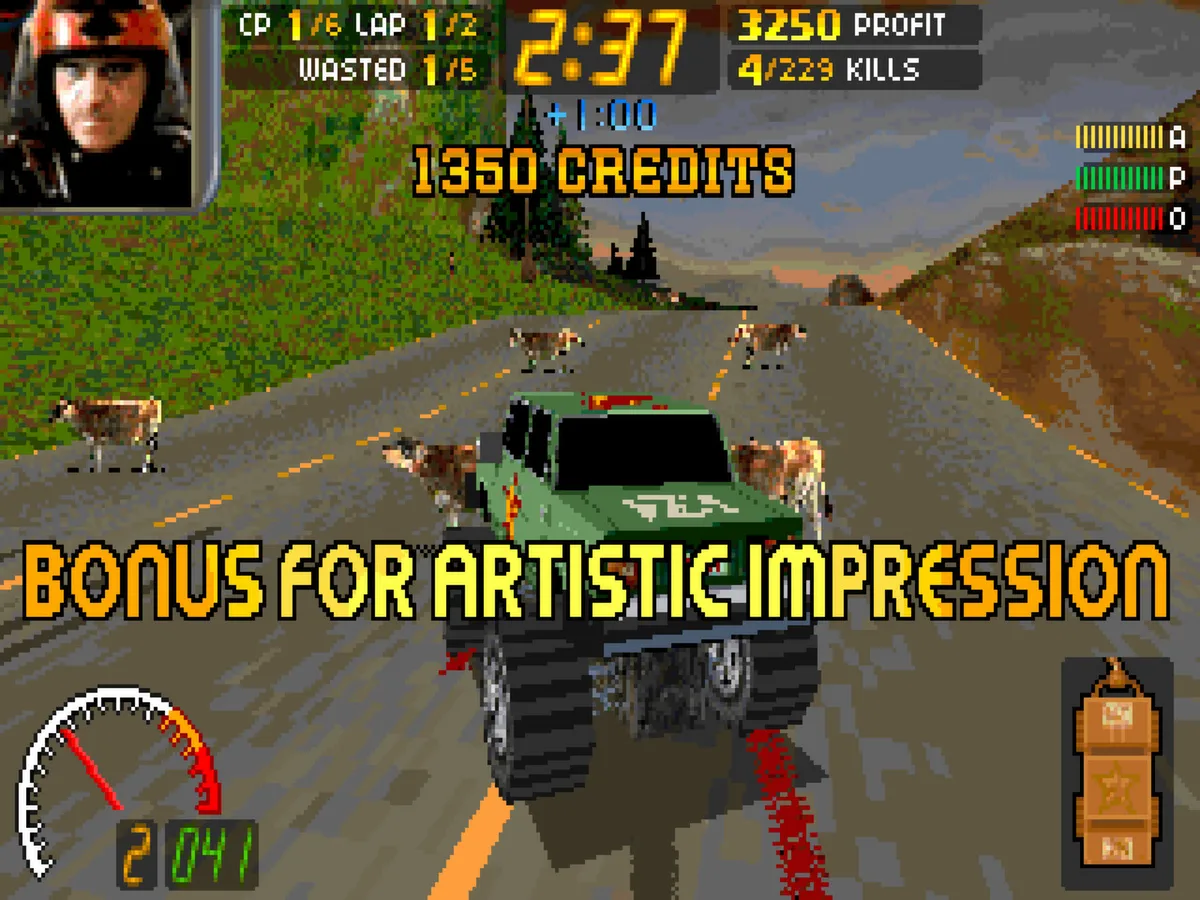
The pedestrian route rewards style as much as body count. Hitting other cars and splatting pedestrians adds time to the timer and earns credits, and doing it in imaginative, novel ways brings extra bonuses, so the manual urges you to invent new and humorous methods of pulping pedestrians. When ramming opponents, it advises keeping your foot down all the way until impact, since timid contact is not rewarded. Wrecking every opponent or killing every pedestrian also finishes the race outright and pays a juicy bonus on top.
The Clock Is the Only Real Loser: Time, Checkpoints, and Credits
Each level runs on a countdown clock, and that clock is fed in several distinct ways rather than by racing alone. Passing through a checkpoint adds time, as does collecting a power-up, damaging or destroying a competitor's car, or running over a pedestrian. The game separates time gain from payment: the same destructive acts that buy you more seconds also award Credits. This means the timer and your wallet draw from one shared pool of activity, and a clean lap done without incident leaves both thinner than a messy run through traffic and bodies.
Style bonuses sit on top of the basic rewards, so how you dispatch opponents and pedestrians matters alongside the raw count. Credits then have a practical destination: they pay for instant repairs or for recovering the car, including after falling into a chasm. Between races the same currency is spent in the Parts Shop, where Armour, Power and Offense stats can be upgraded, and where you may switch to a different car if others have been obtained. Checkpoints, power-ups, wrecked rivals and flattened pedestrians therefore convert into both survival time and long-term car strength.
From Rank 99 to Number 1: Earning Your Way Up the Ladder
The ranking ladder begins at 99th place, and the stated goal is to climb all the way to number 1, at which point the game opens itself up further. Rank advances by earning enough credits within a single race, judged on what you earn rather than on careful saving, so a messy high-scoring run can move you up even if you spend freely afterward. The career structure wraps this climb in 36 levels spread across 11 environments, ranging from cities to mines and desert towns, with computer-controlled opponents to race and wreck on each map.
Credits earned on the road are spent between races in the Parts Shop, where the car can be upgraded across Armour, Power and Offense categories using credits accumulated in previous races. Armour governs how much damage your car takes from impacts with opponents and the environment, making it the defensive counterpart to the offensive and speed-oriented stats. The same mode also holds 30 playable cars that are unlocked by racing and wrecking opponents, and once others have been obtained you may switch to a different vehicle. Climbing the ranks therefore pairs a credit grind with a steadily expanding garage and a stronger build.
Keep It Running: Damage, Repairs, Recovery, and the Cops
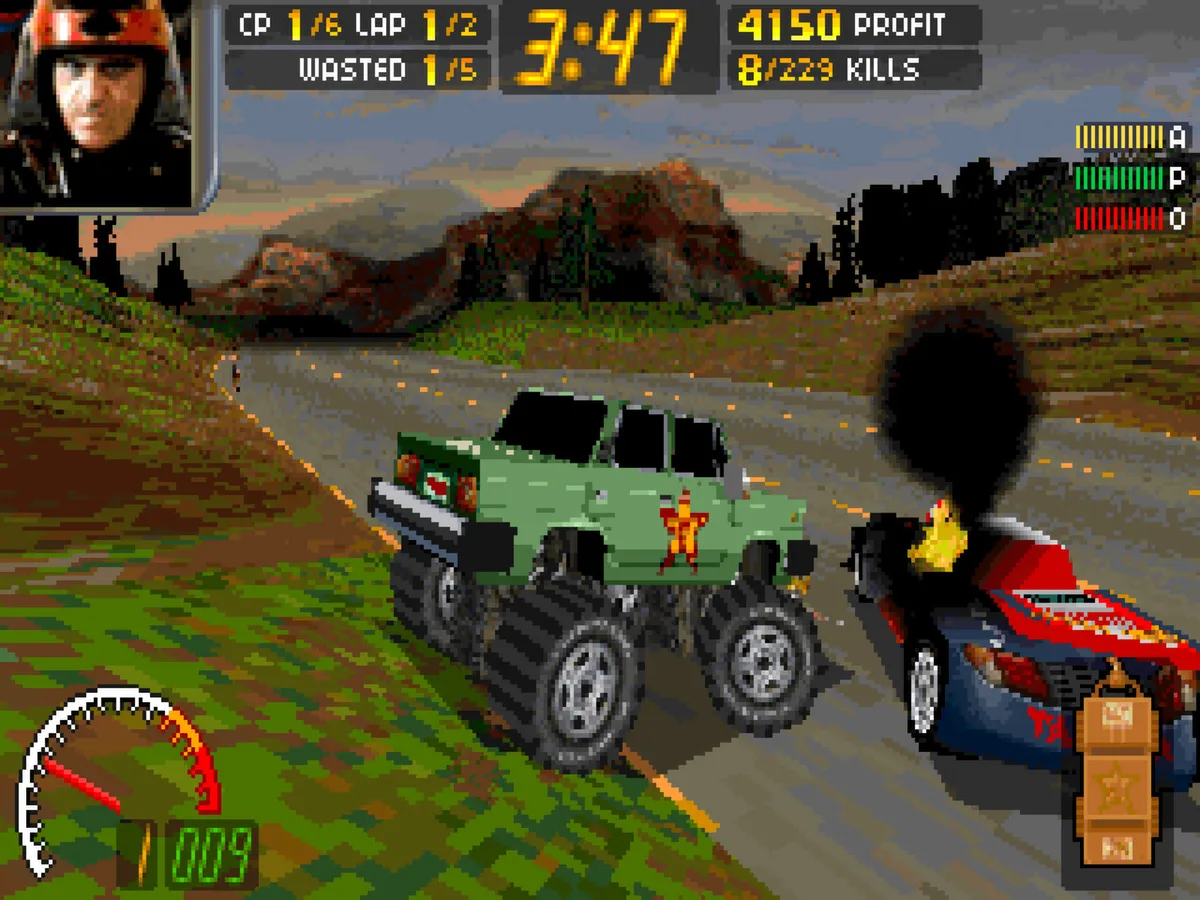
Collisions with opponents, lampposts and the hard ground at the bottom of sheer drops bend your car's systems, and a status screen reports their condition as they slide toward malfunction or outright failure. Waiting until the race ends repairs the car fully and for free, but you need not wait that long. Holding the repair key, usually Backspace, mends the car continuously while the race runs: the longer you hold it, the more damage is undone, and the larger the bill in Credits. Double-clicking the key triggers a full repair for speed.
Landing on the roof or side of the car strands it until you press Insert, which recovers the vehicle at a cost and lets you continue; if the key slips your memory, the Escape menu carries a Recover Vehicle and Continue entry that does the same. Falling down a chasm is likewise undone by spending Credits on recovery. Some levels also hold heavily armored Cop Cars: provoke them and their sirens sound as they hound you. They can be attacked and destroyed, yet they never count as opponents for the finish conditions.
Over 40 Power-Ups, Some of Them Downright Silly
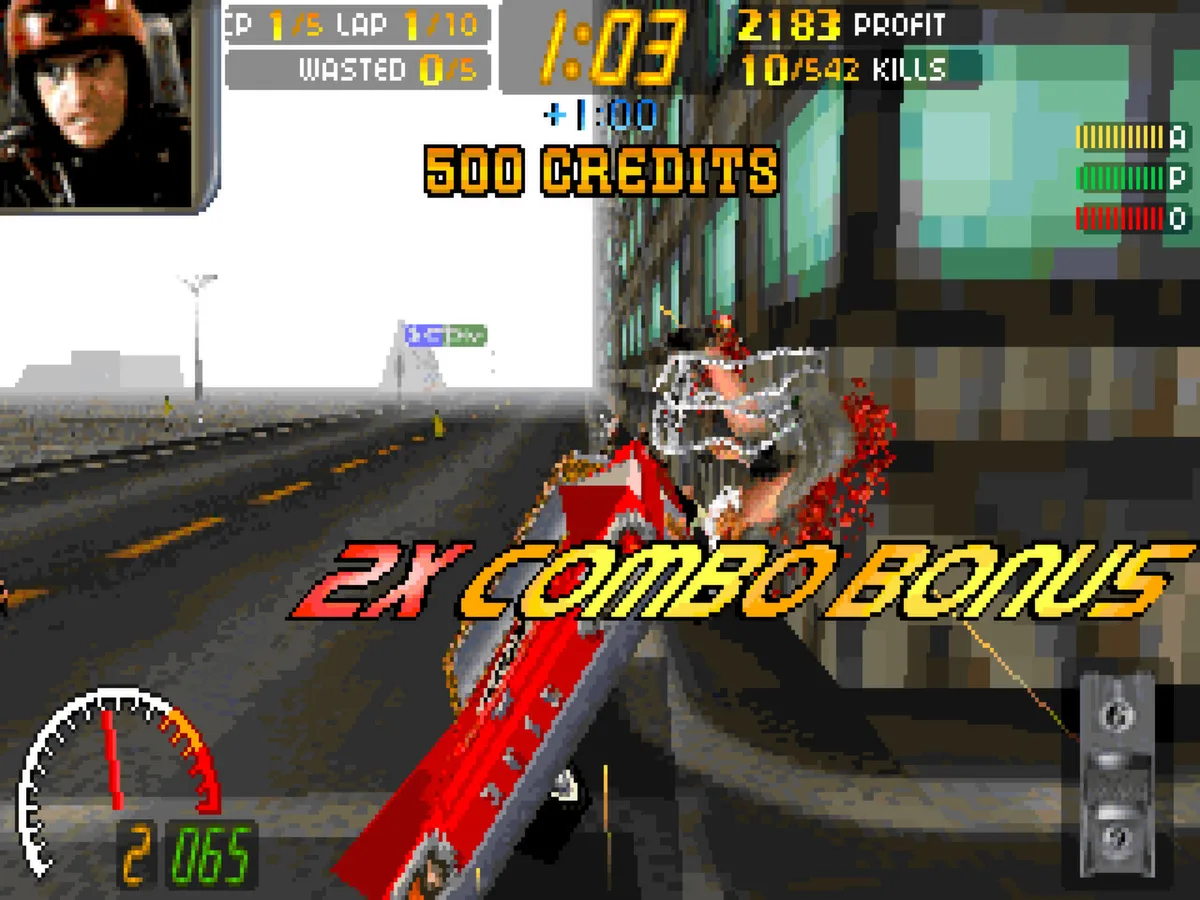
Races scatter more than 40 power-ups across the course, and the manual sorts them into a broad spread rather than one tidy family. The useful end includes invulnerability, which removes damage from impacts with walls or other cars, turbo boost, and an underwater ability that lets you drive beneath the surface with relative ease. Others tilt toward disruption: a freeze effect coasts opponents to a halt until it expires, and a separate version does the same to cops, leaving them unable to fight back while you line up a shove toward a sheer drop. There are bonus points and bonus time, an impact magnifier that raises the damage you deal, instant repair, and a rare freeze for the timer itself. A handful work against you.
Duration separates the effects as much as their purpose does. A few last the entire race, but most expire after a limited window, usually 30 seconds, so a frozen opponent or a burst of turbo closes on its own schedule. The interface keeps that schedule visible: icons down the left-hand side of the screen list which power-ups are currently active, and any timed effect shows a countdown beside its icon. The collection is deliberately uneven in character, with the manual admitting that a few entries function as power-downs and many are simply silly.
Open Roads and Local Bloodsport: Free Exploration, Replays, and Six-Player Networks
The track layouts in this game are not corridors with a required line. Open world design gives complete freedom to explore, and hidden bonus areas wait off the obvious route; no mandatory race paths or checkpoints force you along a single course. The player vehicle faces several computer-controlled competitors across locations that include cities, mines and desert towns. Those opponents are not neutral traffic: they carry distinct personalities, and ramming one can provoke it into seeing red and coming after you instead of continuing its own line.
At any point during a race you can press the numeric keypad Enter key to open action replay mode. This plays back a tape of the race's events so you can watch your antics again, and the length of that tape depends mainly on available memory; the feature is absent from the 8 megabyte version. Multiplayer goes local: you can challenge up to five friends, six players in all, across seven different network games, selected from the main menu. Hosting requires the game CD in the drive, while joining players can install from the host's CD first.
Sources & further reading.
- Carmageddon Max Pack — official game profileRetrieved Oct 30, 2026
- Carmageddon Max Pack — official game profile — publisher-supplied gameplay manualRetrieved Oct 30, 2026
First published .