 THE GAME ARCHIVE
Columns III keeps the falling-jewel puzzle familiar but makes the cleared jewels do double duty: they are also ammunition. Three or more matching jewels disappear when lined up vertically, horizontally or diagonally, and letting the stack reach the top of the screen loses the game. What separates this entry from a pure score chase is the attack economy layered over that rule. Clearing jewels banks points, and points are spent to bury an opponent under Crush Bars, while Magic Stones and Flashing Stones add ways to attack, disrupt or reclaim space.
Falling Jewels and the Match-Three Core
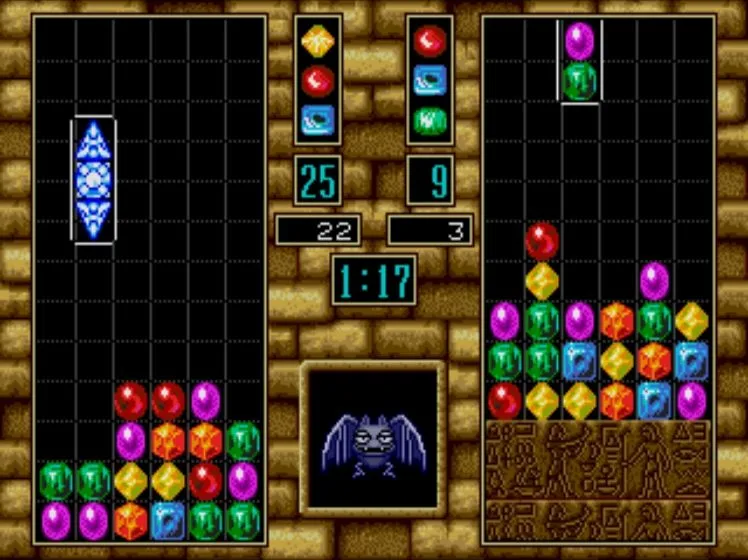
Jewel blocks descend from the top of the screen. The player moves the falling set left or right and can drop it faster; the Rearrange input changes the order of the blocks of jewels rather than sliding them sideways. Because matches count in three directions, placement is always a judgment about whether a spot sets up a vertical, horizontal or diagonal line. Running underneath that judgment is the core risk: if the jewels pile to the top of the playfield, the game is lost, so every drop trades match-building against keeping the stack off the ceiling.
A small Next window beside the playfield displays the set of jewels that will appear next, though its location varies by mode. That preview is the planning instrument for the whole loop: once the upcoming colors are visible, the player can set up combinations for pieces that have not landed yet instead of reacting only to the current set.
Points, Crush Bars and the Attack Decision
A player scores a point for each jewel made to disappear, and the tally caps at 30 points. Once the total exceeds 10 points, the player can attack by dumping a Crush Bar into the opponent's field. A Crush Bar is a row of indestructible blocks that piles up from the bottom of that field, and each row spent reduces the attacker's points by 10. Any jewels falling in the opponent's field are also broken up by the attack.
That pricing creates the central decision. A modest clear above the 10-point threshold can buy one bar, while a clear near the 30-point cap can bank enough for several. The player must also choose when to fire, since holding points delays pressure while the rival keeps building matches, and each Crush Bar dumped consumes part of the bank the attacker might want later. Because bars pile from the bottom, they raise the starting floor of the victim's playfield and shrink the usable space above, though play can later reverse them through specific stones and items.
Magic Stones and Flashing Stones
During play, Magic Stones appear alongside the falling jewels, and the effect depends on which stone is arranged at the bottom. A regular triangle stone dumps two rows of Crush Bars into the opponent's field. A square stone eliminates the jewel it lands on together with any other jewels of the same color in the user's own field. An inverted triangle stone instead removes three rows of Crush Bars that an opponent has dumped onto the player's side, making it the direct answer to offensive triangle play.
Flashing Stones appear when a player eliminates many jewels at once or makes a chain of three or more. Eliminating one while it is flashing triggers a timed Poison effect against the opponent: left-right controls reversed, falling jewels that cannot be rearranged, all of the opponent's stones including those in the Next window turned black and white, the screen flipped top to bottom, or a blank Next window. Separately, a stacked-up stone may suddenly begin to glow; eliminating it produces a Super Flashing effect such as clearing all jewels and rows in the field, dumping five rows, speeding up the opponent's drops, or blocking the opponent's Magic Stones and Flashing Stones for the rest of the game.
These systems make chaining more than a scoring flourish. A large clear both banks points toward Crush Bars and opens the possibility of a Flashing Stone, and the Inverted Triangle gives a defending player a documented way to reclaim vertical space without waiting for a favorable color. The Super Flashing effects spread across offense and denial: the speed-up and special-jewel block are separate documented outcomes alongside row dumps and full clears, so the value of reaching a glowing stone depends on which effect surfaces.
Modes, Matches and Rule Tweaks
The main menu offers three choices. 1P Mode selects a difficulty level and follows a story. 1-on-1 Mode pits two players against each other. Test Mode plays the game's sounds and tests controllers. The head-to-head mode is set as best of 3, 5 or 7, and its Settings screen allows changes such as giving a handicap to a player.
Those settings reshape the duel rather than merely decorating it. Layers sets how many Crush Bars are already stacked for a player at the start of the match, so a handicapped side begins with less room before any jewel falls. Colours sets the number of jewel colors; a smaller number means combinations are easier to make. Control reassigns the Attack and Cycle buttons, and Stage selects among five configurations of background and jewel styles, changing presentation while leaving the match rules intact.
Items, Continues and Recovery
Items change the arithmetic of a losing position. The Hourglass lets a player continue once after losing a game. The Heavy Weight eliminates all of the Crush Bars in the player's own field, and the Magic Bell eliminates all jewels in the player's field, giving two different ways to survive a crowded stack: remove the indestructible floor or clear the removable cargo. Item use beyond the Hourglass is restricted to single-player mode. There, if a player holds other items, pressing START opens the Item Window; the cursor selects an item and the Attack input uses it, while choosing exit or pressing START again closes the window without spending anything. The Hourglass is a separate continue item outside that window.
Progression in single-player also has a documented shape. A new item can be earned after winning each match, with matches structured as best of three games, so the item pool starts narrow and widens only through winning. Because items are a single-player resource, tournament-style head-to-head play stays focused on falling jewels, Crush Bars, Magic Stones and Flashing Stones rather than pre-match loadouts.
Screen Design and Readable Information
The manual notes that the arrangement of the screen and the information displayed vary with the mode in play, so the layout is not a fixed template players can memorize once. The Next window remains the constant planning aid across that variation, showing the upcoming set of jewels. Status windows and previews therefore do real work in a duel: they are where the cost of a move is judged before the piece is committed.
Starting Guidance
Start by learning the attack threshold in practice. Clear jewels deliberately until the tally crosses 10 points, then pick a moment to spend 10 of them on a Crush Bar rather than dumping immediately every time. Read the Next window before locking a set into a column, since it is the only advance information about what is coming. Stockpile toward the 30-point cap when you want the option of several bars, but remember that the points stay banked only until you spend them, and that a rival with an Inverted Triangle can erase three rows of your work. For new head-to-head players, Layers is the most direct handicap dial at the Settings screen, since it changes how many Crush Bars each side starts with; Colours adjusts how easy combinations are to build.
Edition Scope and Access
This profile describes Columns III as documented in its official store description and publisher-supplied manual. The catalog entry lists the game with a 2010 release and compatibility for Windows, macOS and Linux, developed and published by SEGA. Readers looking for the original console version should treat the manual's Mega Drive control labels (D-button, A/B/C buttons) as the source vocabulary; the same store page maps those labels onto keyboard and controller setups.
Scroll sideways to see the full table →
| Item or Stone | Supported effect |
|---|---|
| Crush Bar | Row of indestructible blocks dumped into the opponent's field, piling from the bottom; each row costs 10 of the attacker's points |
| Magic Stone (regular triangle) | Dumps two rows of Crush Bars into the opponent's field |
| Magic Stone (square) | Eliminates the jewel it lands on and other jewels of the same color in the user's field |
| Magic Stone (inverted triangle) | Removes three rows of Crush Bars dumped onto the player's side |
| Flashing Stone (Poison) | Timed disruption such as reversed left-right controls, no rearrangement, monochrome stones, screen flip or blank Next window |
| Super Flashing Stone | Effects such as All Clear, Dump 5 Rows, Speed Up or Special Jewels Block |
| Hourglass | Continue the game once after losing |
| Heavy Weight | Eliminates all Crush Bars in the player's field |
| Magic Bell | Eliminates all jewels in the player's field |
Sources & further reading.
- Columns™ III — official game profile Retrieved Oct 20, 2026
- Columns™ III — official game profile — publisher-supplied gameplay manual Retrieved Oct 20, 2026
First published .