 THE GAME ARCHIVE

Laying Track Through Tunnels and Overpasses
In Railroad Tycoon 3, track laying extends beyond flat ground: you can build tunnels through hills and overpasses across other routes, letting a line pass through or over obstructions instead of going around them. The manual also treats grade as a trade-off against cost, so the path you choose involves deciding how much to spend on earthworks and structures versus a cheaper, perhaps more circuitous, alignment.
These rules interact directly: a tunnel or overpass is a concrete way to cross terrain or another track, while the grade-versus-cost consideration shapes where such structures are worth placing. Because the same track-laying system covers both ordinary track and these special crossings, every tunnel or overpass is part of the same cost-and-alignment decision rather than a separate mode.
Locomotives, Cargo and Train Profit
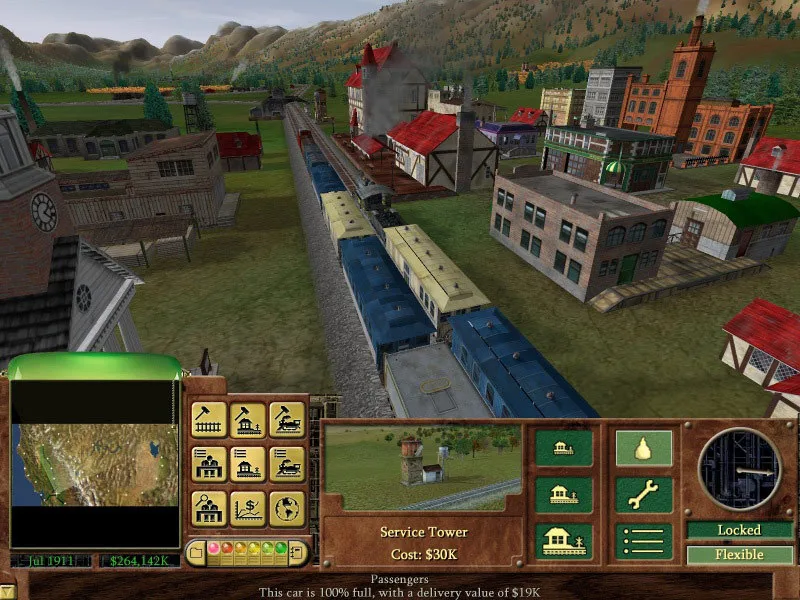
Railroad Tycoon 3 offers a roster of more than 40 locomotives, spanning early steam engines through modern bullet trains, and the economy runs on a choice of over 35 cargo types. Trains can haul up to 8 cars along their routes, a capacity that supports more profitable trips than a shorter consist would. The profit from moving freight generally equals the difference between the cargo's price at its origin and its price at the destination. Delivering three full loads of coal from a mine priced at $30 to a city priced at $50 yields roughly $20,000 per load, or about $60,000 total.
Timeliness modifies that profit, and the cargo determines how much it matters. Perishable goods such as milk and produce spoil quickly, so a slow delivery erodes the margin while the train rolls toward its destination; assigning fast locomotives to these loads protects the return. Bulk cargoes like coal, iron and lumber behave differently: speedy delivery is not very important, and because these goods carry lower prices and thinner margins, a slow but efficient train can carry them while the operator accepts a slower trip. The practical result is that locomotive choice should follow the cargo rather than the other way around.
Industries, Cities and the Stock Market
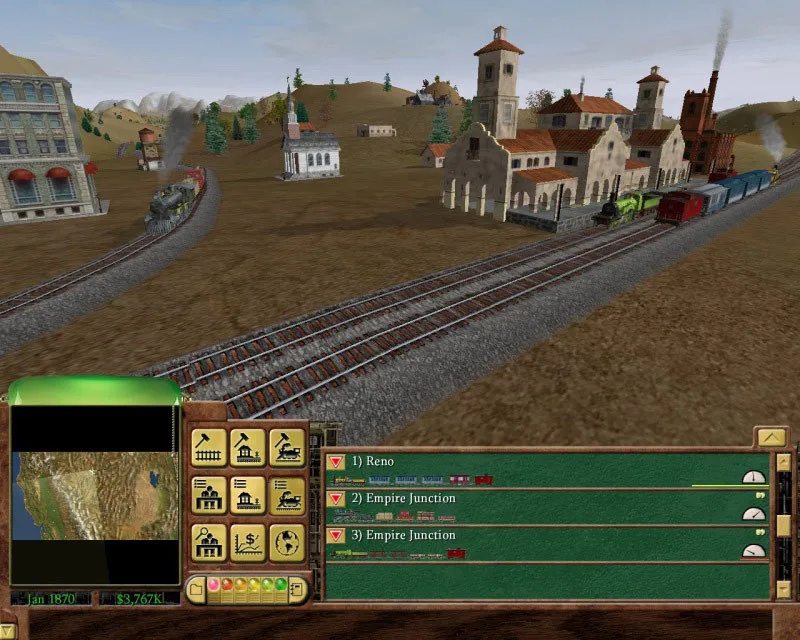
Beyond laying track, the company side of Railroad Tycoon 3 lets you buy any industry already on the map and construct your own. Profitable factories can be upgraded with a single click, provided you have the cash, and each upgrade enlarges the facility and raises its production output. Resources and goods can also move on their own without your railroad, though more slowly than they would by train, and passengers no longer simply let you haul them anywhere. Company profits can go into buying up profitable industries or buying back stock so the share price rises, while bonds issued from the Company Detail panel supply expansion capital.
Cities reward early arrivals through the station and city age rule: the first railroad to reach a new city can charge a premium of up to 15 percent extra profit on each load in and out, a bonus that disappears by the fourth year after the station is built, after which profits slide toward a maximum 10 percent penalty. Cities needing rail service may also offer incentives to the first company connecting them, though the manual leaves it to you whether that is a golden opportunity or a money pit. The stock market adds buying on margin and short selling, with hostile takeovers as another weapon.
Campaigns, Sandbox and Multiplayer
Single-player structure splits into three entry points. The campaign strings together 16 scenarios set in locations around the world, designed to grow harder as you advance; the manual recommends playing them consecutively but allows skipping scenarios or taking them out of order. A separate scenario list holds 25 stand-alone challenges that ask you to recreate railroading feats from history. Sandbox is the third option: all financial aspects are switched off, leaving track building and train operation, and it also permits map modifications that normal play does not allow.
Competitive play runs over a LAN, supported by an online chat and matchmaking service for finding opponents. Beyond playing, the manual points to an extensive editor for building new scenarios to share with friends, and it notes that reloaded scenarios do not play the same way twice because a new economy reshapes each run. Saved games are organized by type: the load screen for stand-alone scenarios lists only those saves, not campaigns or sandbox games.
Sources & further reading.
- Railroad Tycoon 3 — official game profile Retrieved Oct 20, 2026
- Railroad Tycoon 3 — official game profile — publisher-supplied gameplay manual Retrieved Oct 20, 2026
First published .