 THE GAME ARCHIVE
Doubutsu no Mori gives players a village in which to choose their own activities. Nintendo’s description begins with everyday possibilities: talking to neighbors, shopping and writing letters. Its other gameplay pages expand that outline into a shared town, visits to friends’ villages, ways to earn money and activities that players can organize for themselves. These details describe the Japanese Nintendo 64 game. They provide a useful introduction to how time, communication and collecting fit together, with concrete examples drawn from the original publisher’s pages.
Return to a village that keeps its own time
The village follows the passage of real-world time through morning, day and night. Seasons also change the colors of trees and the surrounding scenery. Time continues to matter between play sessions: Nintendo says a villager may have written a letter or moved while the player was away. Returning to the game can therefore mean finding a development that happened during an absence. The publisher’s explanation gives the village an ongoing rhythm alongside the activities chosen during a session. Talking, shopping and correspondence take place within that changing setting, while the seasonal appearance gives another visible indication of the time passing in the village.
Share one town through separate sessions
Up to four players can live in one village, with play taking place in turns rather than simultaneously. Nintendo’s shared-village page describes visiting another player’s empty home and forming an opinion about its decoration, then carrying that conversation into letters. The bulletin board provides another common place for communication. Letters can also be sent to the animal residents, who may reply when they feel like it. These exchanges give the shared town a social life across separate sessions. A player can leave something for another resident to encounter later, whether it is a message, a room to look around or a clue for an activity that the players have arranged.
Visit a friend’s village with a Controller Pak
Nintendo describes using the Controller Pak to visit a friend’s village on another cartridge. The residents and the shape of the land differ between cartridges, so a visit can bring a different group of neighbors and a different place to explore. The village page suggests looking at bulletin-board posts and letters that the animals show you to learn about the other player’s life there. Its examples also describe a town shaped by planting or cutting trees, growing flowers and leaving items around. Visiting lets those choices become part of the encounter: the appearance of a friend’s town can give you something to discuss after returning to your own game.
Earn money for the house and its furniture
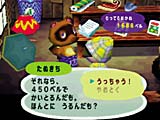
The publisher’s money-making page describes arriving in the village with a debt and spending money to expand the house or obtain furniture. It proposes a player-organized contest over about a real-world week to see who can save the most. Fishing is one documented way to earn that money. With a fishing rod, players can look for fish in rivers and ponds and sell catches at the village shop. Nintendo gives fish worth 120 Bells and 200 Bells as examples, showing that the sale value depends on the catch. This connects an activity out in the village to the money needed for home improvements and other purchases.
Grow fruit, excavate fossils and trade turnips
Fruit is another source of income. Nintendo says burying fruit may produce a fruit-bearing tree, and suggests bringing fruit from a different village because the local shop values varieties that are not native to your own town. Fossils offer a different choice: the page mentions amber and ammonites as room decorations while also describing selling valuable finds. Its turnip example uses the actual vegetable as an in-game trading item. Players buy from the turnip seller and follow changing daily prices. Together, these examples give several distinct activities to pursue around the village: developing fruit-growing opportunities, excavating objects to keep or sell, and watching a changing price for a purchased item.
Make a treasure hunt and explore the bundled extras
The publisher suggests making a treasure hunt by taking a favorite item to a friend’s town, burying it and posting a clue on that town’s bulletin board. The residents can then compete to find it, using the village’s ordinary items and communication tools for a player-created activity. Nintendo also describes bonuses supplied with the Controller Pak bundle: access to two Famicom games selected from several prepared titles, music and a letter from supervisor Shigeru Miyamoto. The page says similar game and music items may be obtainable through play, while excluding that letter from the possibility. These are documented parts of the bundle and its in-game content.
Sources & further reading.
- Doubutsu no Mori — Nintendo gameplay documentation Retrieved Oct 16, 2026
- Doubutsu no Mori — Nintendo gameplay documentation Retrieved Oct 16, 2026
- Doubutsu no Mori — Nintendo gameplay documentation Retrieved Oct 16, 2026
First published .