 THE GAME ARCHIVE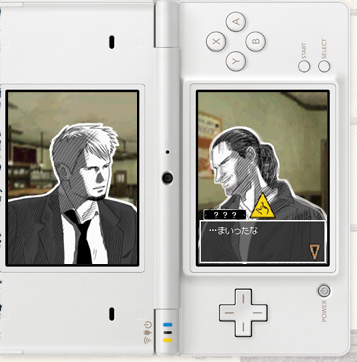
Last Window places former detective Kyle Hyde in an old apartment building that is approaching demolition. A strange request sends him looking for Red Star, something connected to an incident hidden in the building’s past. As he investigates the residents and their secrets, that search begins to overlap with the mystery of his father’s death. Nintendo presents the investigation through conversations, searches of the apartment and problems solved with information and acquired tools. These connected activities give the player several ways to follow the story, while the companion novel records the completed chapters in another form.
Conversations have consequences
Talking to characters is a way to draw out information from people who are keeping secrets. Nintendo’s conversation page emphasizes the other person’s psychological state and the flow of the exchange: there are moments when Kyle needs to press a question further. His attitude matters as much as his persistence. A response that makes the other character uncomfortable can lead them to close their heart, and that can produce a game over. The page illustrates the tension with a mysterious man who is tailing the protagonist, asking whether a battle of wits can bring out the truth. The documented challenge is to pursue information while reading the person being questioned, rather than treating every conversation as an automatic delivery of answers.
Move, examine, then change the viewpoint
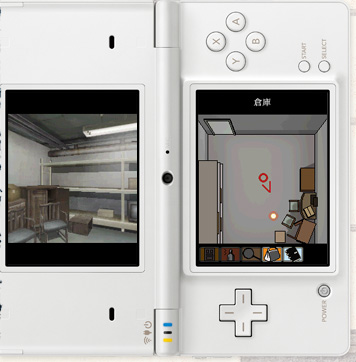
Exploration uses the touchscreen. Touch the direction in which you want Kyle to move, then investigate locations that attract your attention. Objects placed in the environment can be touched for a closer examination. A missing tape recorder provides Nintendo’s example of why a room deserves attention: a resident has lost it somewhere in the apartment, leaving the question of whether it was stolen or whether something else happened. When a location needs a more detailed look, the viewpoint can be changed, potentially revealing a new discovery. Movement, initial inspection and a different viewing angle are therefore distinct parts of the same search. The publisher describes these actions without supplying a complete solution to the tape-recorder mystery.
Use information, tools and handwritten notes
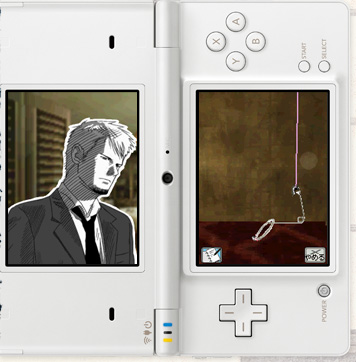
The puzzle page describes problems that require both gathered information and tools obtained during the story. Its example shows something shining in a gap between furniture and asks how it can be retrieved using the tools available in that room. The example makes an important part of the puzzle design concrete: observing the problem and considering the objects at hand belong together. Nintendo also says the game uses various functions of the DS system, without naming a particular hardware action for this example. For information that needs to be remembered, the stylus can be used to make handwritten notes. This gives the player a documented way to retain details encountered during the investigation while continuing to look for a solution.
Completed chapters become a novel
Last Window includes a novel inside the software itself. Completing a chapter of the game adds that finished chapter to the novel, so the written account grows alongside story progress. Nintendo describes detailed scenery and the characters’ psychological states being presented in novel form, allowing completed events to be followed from a new perspective. The account also responds to the player’s actions. The publisher gives a vending-machine choice as one example of a decision that changes the written description, and says that puzzle-solving methods and whether particular events were experienced can affect the text as well. Reading the novel therefore offers an additional account of the investigation shaped by the route taken through those documented choices and events.
Choose whether to open the interview notes
At the end of each novel chapter is a sealed section of interview notes concerning Kyle Hyde. Opening that section is the player’s choice. Nintendo says it may contain hints useful when the next chapter becomes difficult, which gives these notes a practical role alongside the novel’s retelling of completed events. Their placement also links them to progress: they appear with the chapter that has just been added to the written account. The published description promises the option to consult them and the possibility of a useful hint; it does not provide a complete walkthrough or a guaranteed answer to every puzzle. The player can decide how much of that optional material to read while continuing the story.
Sources & further reading.
- Last Window: The Secret of Cape West — Nintendo gameplay documentation Retrieved Oct 16, 2026
- Last Window: The Secret of Cape West — Nintendo gameplay documentation Retrieved Oct 16, 2026
- Last Window: The Secret of Cape West — Nintendo gameplay documentation Retrieved Oct 16, 2026
- Last Window: The Secret of Cape West — Nintendo gameplay documentation Retrieved Oct 16, 2026
- Last Window: The Secret of Cape West — Nintendo gameplay documentation Retrieved Oct 16, 2026
First published .