 THE GAME ARCHIVE
Dungeon Defenders, listed on Steam as a 2011 release from Chromatic Games, describes itself as a Tower Defense Action-RPG in which players defend the land of Etheria from an Ancient Evil. The pitch is a hybrid: you choose a hero from four classes, build defensive towers and traps between waves, and then jump into the fight yourself. That combination of strategic placement and direct combat is the design spine the official store description builds everything else around.
Premise: Defend Etheria With Heroes and Defenses
The store description frames the game as a fight to save Etheria from an Ancient Evil. Players create a hero from one of four distinct classes, then face wave after wave of enemies by summoning defenses and participating directly in combat. The defensive objective is usually a crystal or castle to protect, and the enemy pressure scales into large waves and boss encounters.
Genre labeling on the Steam listing places the game across Action, Indie, RPG, and Strategy, which matches the hybrid pitch: it is not purely a tower defense game, and it is not purely a loot-driven action-RPG. The two halves are meant to feed each other, since experience from kills and cleared waves can be spent on both character power and defense capability.
The Core Loop: Build, Fight, Loot, Upgrade
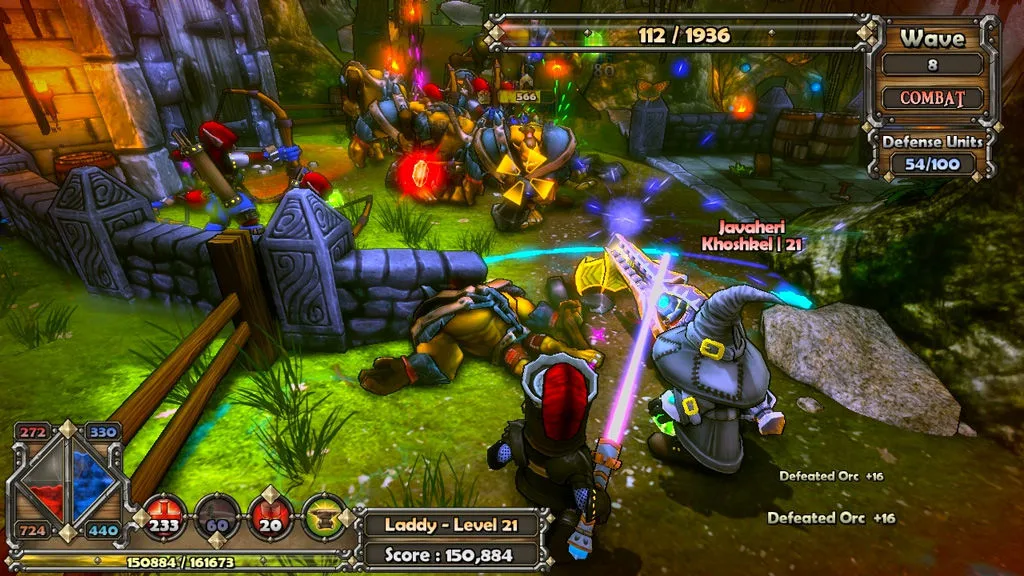
A typical session moves through recognizable phases. Before and during a wave you assemble your defenses strategically, choosing where towers go and how they cover the approach to your objective. During the wave you also participate directly in action-packed combat rather than standing back and watching your towers work. Between waves you collect money and items dropped by defeated foes, then spend or reinvest them.
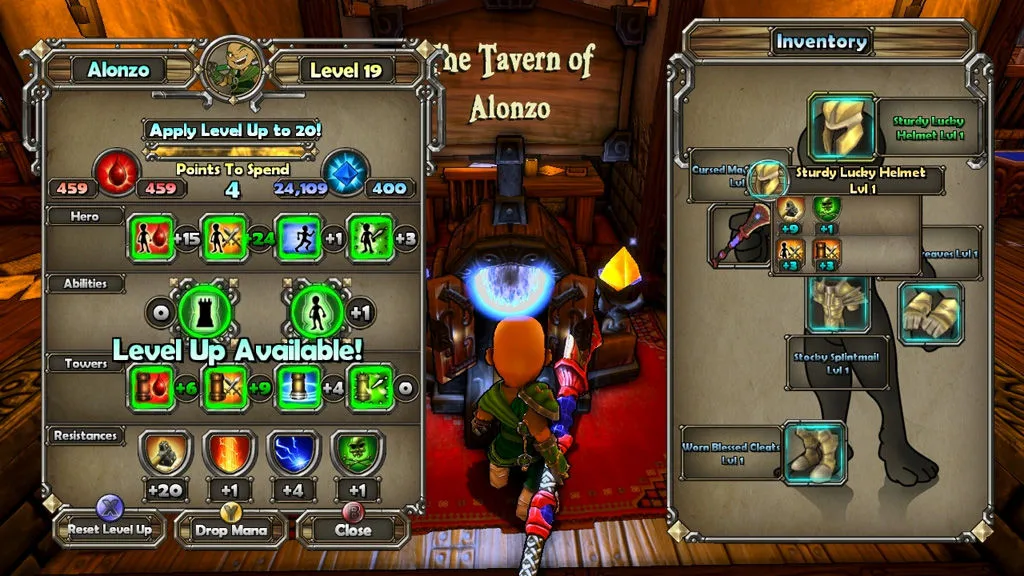
Kills and completed waves generate experience points that can be used to upgrade characters, skills, equipment, and towers on a per-statistic basis, so the numbers you are chasing are granular rather than a single character level. The store description explicitly names Hit Points, Attack Rate, and Damage as examples of stats you can choose to enhance. Excess currency can be stored in a Mana Bank and later spent on equipment improvements or trades with other players.
Class choice shapes how that loop actually feels. Each of the four classes has a different skill tree, its own set of towers, and even different basic attacks. The Huntress is presented as a stealth option who can turn invisible and plant traps behind enemy lines, while the Squire is a more direct brawler who blocks off choke points and fights foes head-on. Those two examples make the design intent clear: your hero's contribution to defense is not generic.
 View full image ↗
Mechanics and Systems
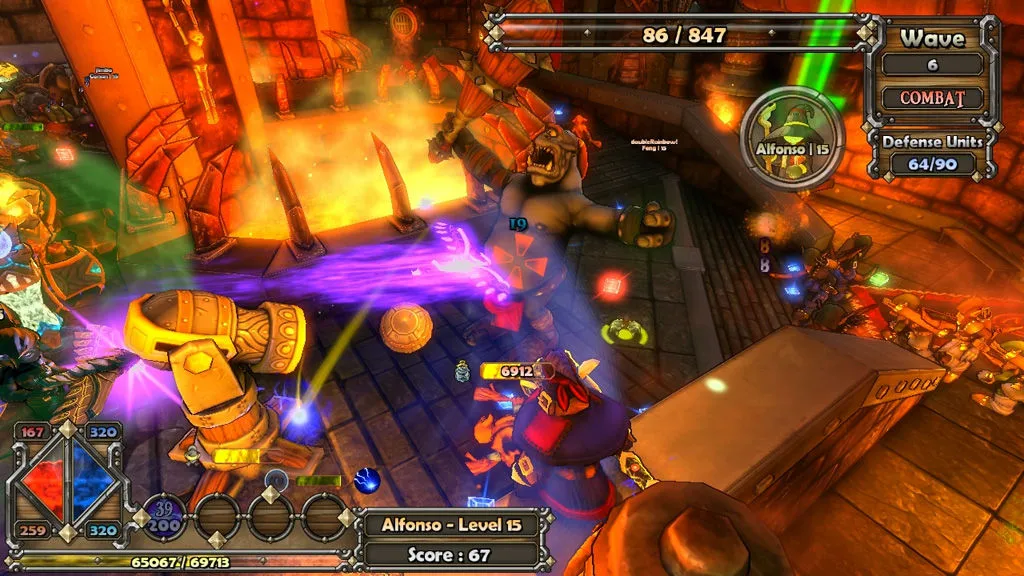
Defense placement and direct combat are both first-class systems. The description calls for strategically assembling defenses and then participating in battle, which means the player's attention is split between tower coverage and hands-on fighting. Class skills reinforce the split: the same class that plants traps can also engage enemies directly, so stealth and aggression are not mutually exclusive roles assigned to different players.
Enemy variety is described as running from big Orcs swinging axes, to Dark Elves who strike from the shadows, to kamikaze goblins. Over 100 simultaneous enemies may attempt to break through defenses, and gigantic Boss Monsters appear as major threats. The designer's intent is that only effective defensive strategies, teamwork, and strong characters overcome these waves, which ties enemy pressure directly to co-op coordination.
Support systems wrap around the combat. Defeated foes drop money and items that can be traded or stored for later use in an Item Box. A secure trading system is documented for exchanging weapons, armor, and pets online, with the description emphasizing the value placed on trust between players. Pets can be leveled up, customized to match a play style, and traded online, each with distinct behaviors.
Stat tracking is treated as a feature rather than a sideshow. Every shot taken, kill made, and defense built is logged and recorded, with charts and graphs presented at the end of each session for team analysis and level-by-level review. Achievements are visible in the player's Adventurer's Tavern, and the highest scores for each hero are ranked on worldwide leaderboards.
Modes, Progression, and Mission Variety
Co-op is the headline mode: four-player online and local splitscreen support, with local and online players able to mix and drop in or out so the game stays full. Classes are explicitly framed as supporting each other's strengths and weaknesses, which suggests team composition matters. For players who prefer competition, a PvP Deathmatch mode is also documented.
Progression runs through four difficulty modes plus the wave-based mission types. Challenge maps and survival missions are framed as optional or advanced routes to more experience and better treasure, alongside the normal difficulty ladder. To collect all the loot and reach the highest levels, the description says, you must take your character through all four difficulty modes and those extra mission types.
Mission variety changes the objective, not just the scenery. Each level is described as having a different visual setting, layout, enemy types, traps, and surprises, and some are not static defense scenarios. Some maps require mobile defenses while guarding a crystal that warps around the map, and others invert the usual role by having you attack enemy encampments. That variety is the game's best argument against tower defense as a one-note loop.
 View full image ↗
Source-Backed Starting Guidance
Anything more specific than the official description would be speculation, so the starting advice here stays close to the documented systems. The description's own logic points to a few reasonable priorities: pick a class whose towers and basic attack match how you want to play, expect to mix defense construction with direct fighting rather than picking one, and treat the four difficulty modes as the structured path toward better loot and higher character levels.
Because upgrades are per-statistic, experience allocation is a real decision each time, and the Mana Bank exists specifically to handle overflow currency that would otherwise sit idle. Pets are a second growth track that can be leveled and customized, and they can be traded, so they are both a combat tool and an economic one. The store description does not document exact stat costs, optimal tower layouts, or specific level routes, so players looking for detailed build advice should consult community resources rather than treating this feature as a walkthrough.
Distinguishing Design
The clearest thing Dungeon Defenders does differently from a pure tower defense game is insist that you fight. Towers and defenses matter, but so does the hero holding a weapon, and progression feeds both. The four-class structure, with a different skill tree, tower set, and basic attacks per class, means a four-player group can field genuinely different answers to the same wave rather than four copies of the same defender.
Two more design decisions stand out. First, the flexibility of co-op: online and local splitscreen players can mix, and leave/join is allowed at any time. Second, a free development kit is included, using existing game assets to create and edit new missions, with those user-created levels shared via Steam Workshop. That combination of drop-in co-op and open modding gives the game a long tail beyond its launch content.
 View full image ↗
Edition Notes and Current Official Access
The Steam listing documents a Windows release and includes Steam-exclusive content: a Portal gun and TF2 familiars. This feature is scoped to that Steam entry and its 2011 listing year; it does not attempt to reconstruct the game's full release history across other platforms, later ports, or remasters. Likewise, no claims here about current compatibility, server population, or online feature status are sourced, so none are made.
Fact Table
- Game: Dungeon Defenders
- Developer / Publisher: Chromatic Games
- Steam listing year: 2011
- Platform (Steam listing): Windows
- Genres: Action, Indie, RPG, Strategy
- Co-op: 4-player online and local splitscreen, with drop-in/drop-out
- Competitive: PvP Deathmatch
- Classes: Four distinct classes, each with its own skill tree, towers, and basic attacks
- Difficulty modes: Four
- Modding: Free development kit; user-created missions shared via Steam Workshop
Sources & further reading.
- Dungeon Defenders — official game profile Retrieved Oct 10, 2026
First published .