 THE GAME ARCHIVE
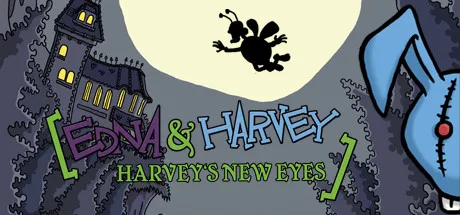
A shy schoolgirl, a missing friend, a world drawn by hand
Edna & Harvey: Harvey's New Eyes is a Daedalic Entertainment point-and-click adventure, released in 2012 and published for Windows, macOS and Linux. Its player character is Lilli, a young girl at a convent school described as apparently the best-behaved little girl in the world: she carries out every task diligently, no matter how unfair, with resentment and childlike disobedience buried beneath a seemingly impenetrable shell of sweetness. The game's driving situation is that her best friend Edna disappears under mysterious circumstances, and Lilli has to rise above her own limits to get her friend back and confront her subconscious fears.
What the player does is familiar genre work, deliberately so: the store description sells "classic point-and-click adventure gameplay like in the good old days." You move Lilli through a drawn world, click on what she finds, solve the problems blocking her route, and read and listen through long stretches of conversation. The supporting pitch is equally clear: bizarre characters and wacky humor, challenging puzzles, hours of dialogue and 53 locations, all rendered in unique cartoon graphics completely drawn by hand in 2D and implemented in Full-HD.
The core loop: click, talk, solve, move on
Harvey's New Eyes runs on point-and-click mechanics, so the basic verb of play is directing Lilli's attention rather than steering her through action sequences. The puzzle layer is what the source calls a core element of gameplay: challenging puzzles are not optional filler but the central activity. Solving them is a key part of progression — the store description pairs challenging puzzles, hours of dialogue and 53 locations as one feature set, which implies the three are interleaved rather than separated into discrete modes.
The dialogue is gameplay, not decoration. The game is built around extensive conversation, and the characters Lilli meets are described as bizarre. For a player, that means the rhythm alternates: examine a scene, talk to whoever is standing there, work out what the conversation revealed, and then act on it. Because the source lists dialogue as a feature alongside puzzles and locations, the sensible reading is that talking is one of the tools you use to solve problems, not a cut-scene you sit through between them.
Progression is geographic as well as logical. The 53 locations are explicitly tied to progression; they are the stages on which the puzzle-and-dialogue loop plays out. You are not choosing a build or a route so much as working through scenes in order, each scene presenting its own obstacles until the way to the next opens. The documented evidence stops short of claiming a hub structure, a map system or optional areas, so the safest description is a linear-or-semi-linear journey across a large, varied set of locations.
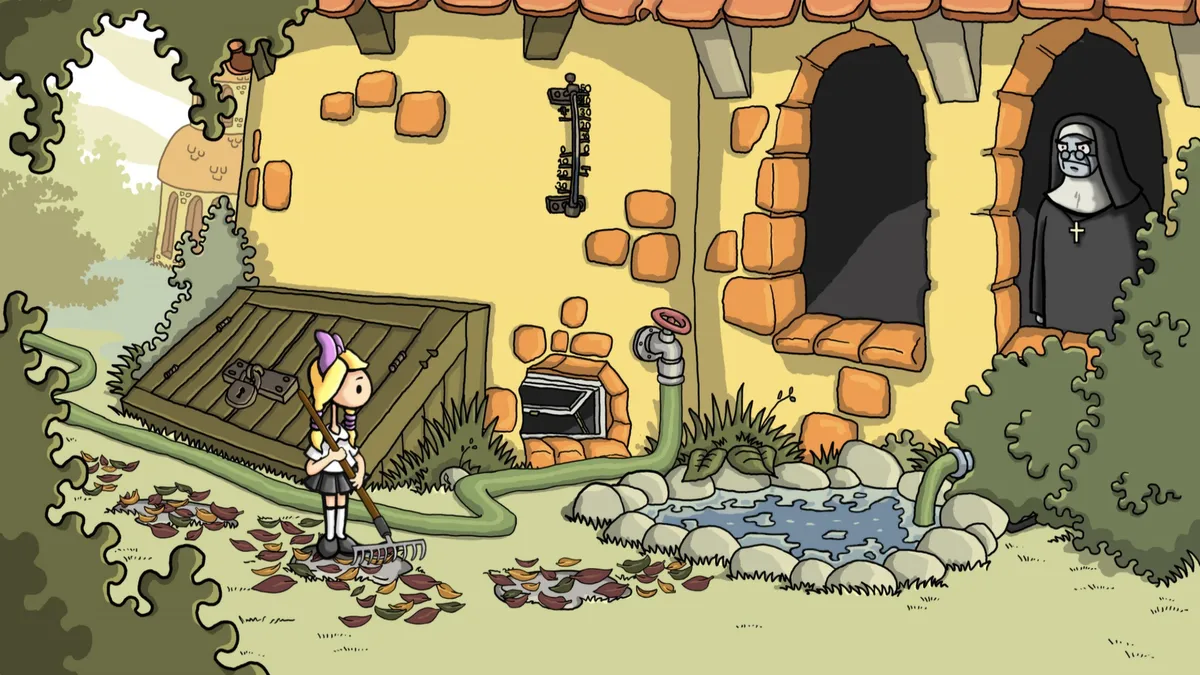
Premise: convent discipline and a disappearing friend
Lilli's starting position is a convent school and Mother Superior's strict rule. The source says only that her imagination helps her escape from that rule; it does not spell out a documented task of breaking out of the convent. What it does state plainly is the inciting event: Edna, her best friend, vanishes under mysterious circumstances, and Lilli must rise above her own [limits] and undertake a tough journey to get her friend back — and, in the same sentence, to confront her subconscious fears. So the rescue and the psychological reckoning are presented as one journey rather than two quests.
The character material gives that journey its texture. The description of Lilli as the world's best-behaved girl, diligently executing unfair orders with a shell of sweetness, explains why the game's premise reads as comic on the surface and uneasy underneath: the source itself calls her obedience both tragic and eerie and asks how long until the shell fissures. The fears Lilli confronts are therefore not abstract monsters but the pressure of that conformity, which is what makes a schoolgirl's missing friend a credible frame for a whole game.
The Censor-Gnomes: the world's strangest puzzle logic
The most distinctive piece of world-building in the source is the Censor-Gnomes: friendly little fellows who paint over anything upsetting in Lilli's vicinity with a pleasant pink color. The game pointedly leaves open whether those potato-shaped fellows are real or just a product of her subconscious. That ambiguity is not a throwaway joke — it is the clearest expression of the premise's theme, and it tells the player how to read the game's humor: odd, hand-drawn absurdity used to dramatize anxiety rather than just to decorate a puzzle.
It also fits the visual identity. The account of the gnomes painting pink over upsetting sights is an in-world behavior, not a confirmed puzzle item or mechanic; the source does not say players control a gnome or use one as a tool. What is supported is the broader design promise: bizarre characters and wacky humor delivered through unique cartoon graphics drawn by hand in 2D. The gnomes belong to that pitch, and a reader should treat them as flavor and theme rather than as a documented interactive system.
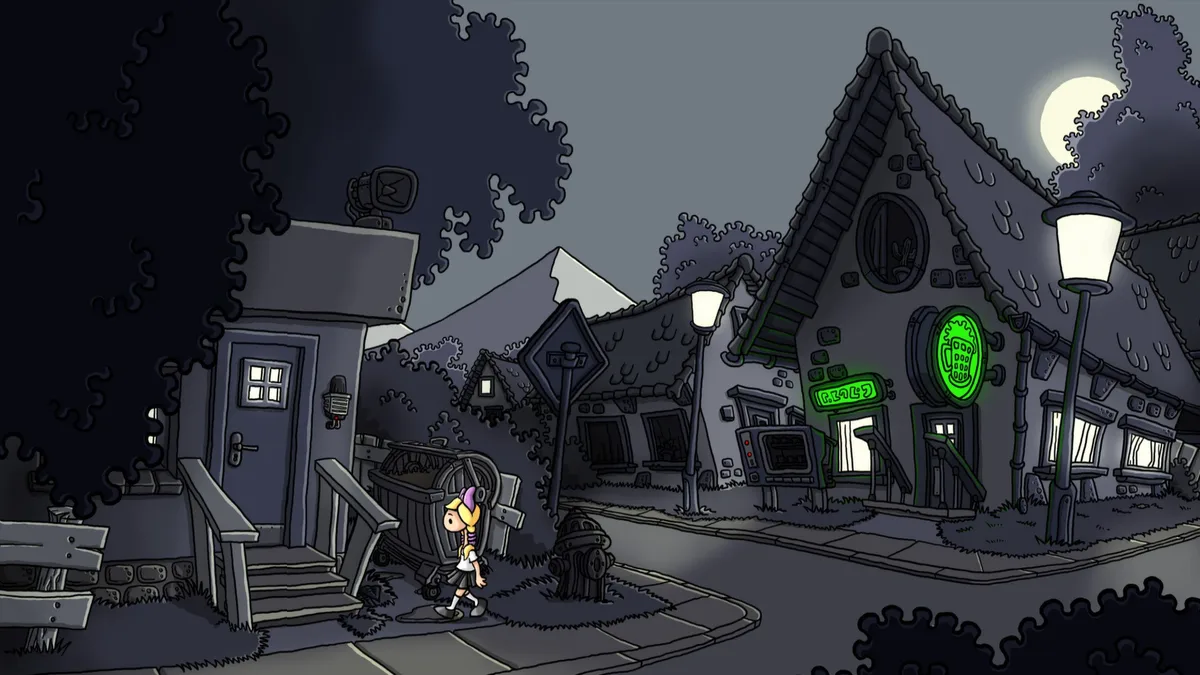
Hand-drawn 2D in Full-HD: how the look shapes the play
Technically, the game is a 2D adventure with visuals completely drawn by hand and implemented in Full-HD. In a point-and-click game this matters more than it might sound: everything you click is an illustration. Objects, characters and background details all share the same drawn cartoon style, so a puzzle's clues and its distractors live in the same visual register. The 53 locations are the delivery vehicle for that art — a large set of drawn scenes to read, explore and solve across.
The source bills the style as "unique cartoon graphics," and the combination — hand-drawn 2D at Full-HD resolution — is the concrete version of that claim. It also fits the tone: a game where a shy girl's fears are painted over in pleasant pink is served by an illustrative, storybook look, and the hand-drawn claim grounds the humor in visible craft rather than in-engine realism. Note that this is a 2D rather than 3D adventure; readers looking for a pre-rendered 3D Daedalic-style game should expect a flatter, drawn presentation.
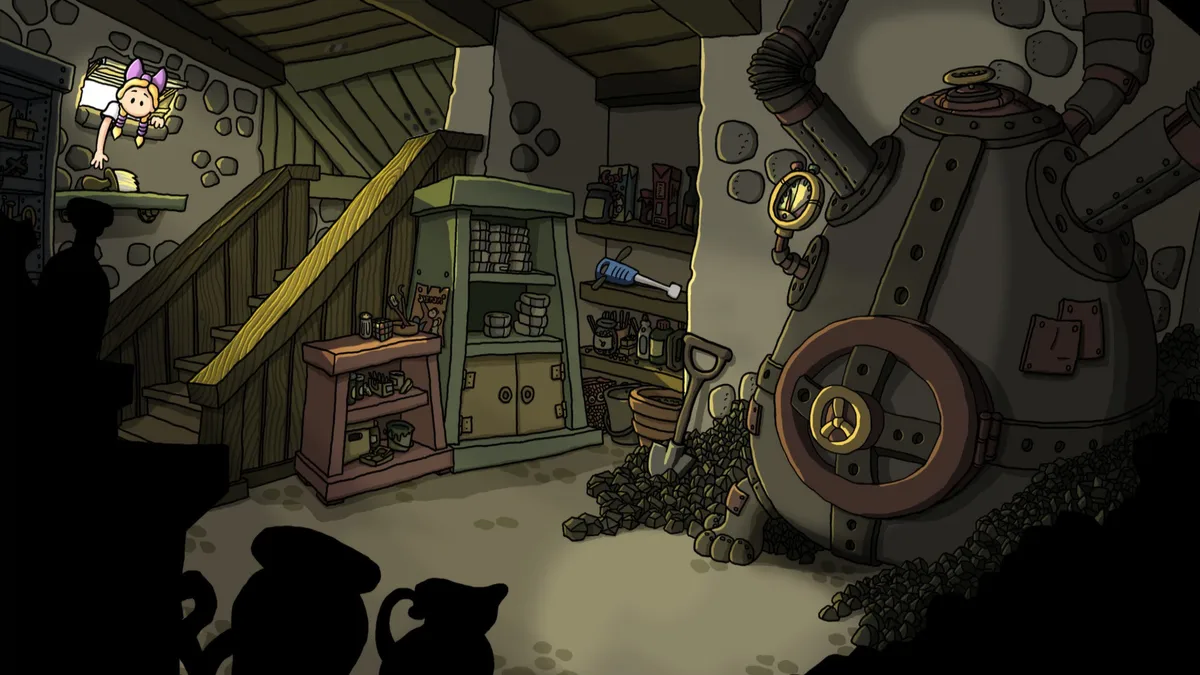
Starting guidance from the documented design
The source does not publish a walkthrough, so this is advice inferred directly from its documented design. First, exhaust conversations: hours of dialogue are a listed feature, and in a puzzle adventure that usually means the talk contains the information you need. Second, treat each new location as a fresh reading exercise — the art is hand-drawn and Full-HD, so examine the drawn scenery for the objects and oddities the puzzle expects you to notice. Third, expect the puzzles to bite: they are billed as challenging, so patience and persistence are part of the intended experience.
Read the story as design, too. Because the journey is framed as Lilli confronting her subconscious fears while searching for Edna, the game's wilder images — pink paint, potato-shaped tormentors, a convent's strict rule — are likely thematic rather than random. Approaching them that way will keep the absurdity funny instead of merely confusing. What this article cannot tell you is which specific items combine, which codes unlock what, or how long the game runs; those details are not in the publisher material, and no hands-on reference is available here.
Version and access notes
The official listing dates the game to 2012. It is developed and published by Daedalic Entertainment and sold for Windows, macOS and Linux, and is categorized as an Adventure and Indie title. The listing also positions it as coming from the creators of The Whispered World and Deponia. Those are catalog facts, not evidence of any later remaster, expansion or additional edition; nothing in the supplied material confirms or describes a different package, so the 2012 release is the version this article covers.
Taken together, the documented design describes a deliberately old-fashioned adventure: click to interact, talk to strange people, solve hard puzzles, and walk through 53 hand-drawn Full-HD locations as a shy girl named Lilli searches for her missing friend Edna and reckons with the fears that her pink-painting Censor-Gnomes keep at bay. It is a point-and-click game that treats conversation and illustration as the core of play rather than as polish around it.
Scroll sideways to see the full table →
| Field | Detail |
|---|---|
| Title | Edna & Harvey: Harvey's New Eyes |
| Release year | 2012 |
| Developer / Publisher | Daedalic Entertainment |
| Platforms | Windows, macOS, Linux |
| Genres | Adventure, Indie |
| Play style | Classic point-and-click adventure |
| Structure | Challenging puzzles, hours of dialogue, 53 locations |
| Art | Cartoon graphics drawn by hand in 2D, implemented in Full-HD |
| Protagonist | Lilli, a convent schoolgirl |
| Setup | Best friend Edna disappears; Lilli confronts her subconscious fears |
Sources & further reading.
- Edna & Harvey: Harvey's New Eyes — official game profileRetrieved Oct 27, 2026
First published .