 THE GAME ARCHIVE
The Silent Approach: Sneaking and Close Combat
Sneaking is the foundation of the silent approach in Hitman: Contracts. When Agent 47 enters sneak mode, his movement becomes completely silent, letting him cross guarded areas without being heard by enemies. The official manual treats this undetected traversal as a core skill: with patience and practice, nearly any environment can be crossed this way, and detection is avoided by sound as well as by sight. For players pursuing a quiet run, sneak mode is the baseline posture that keeps 47 out of earshot while he works toward his objective.
Close combat weapons function as silent-kill tools when used from behind an unsuspecting enemy. Reaching that position requires sneaking, because 47 must get close enough to strike without being noticed. Directly behind the target, a fully charged close combat weapon delivers a fatal blow. The same weapons can be swung in ordinary melee attacks, but the manual describes that effectiveness as much reduced. The rules therefore link stealth, positioning, and the weapon's charge state: a fatal silent strike depends on sneaking up first, then landing the blow from the sweet spot.
Disguises: Borrowed Uniforms and Suspicious Behaviour
Disguises in Hitman: Contracts serve two linked purposes: they let Agent 47 enter otherwise restricted areas, and they help him throw off pursuers after being spotted. The uniform alone is not enough, though. The documented rule is that 47 must perform actions that look natural for the character he is dressed as; alert guards and soldiers will notice suspicious behaviour, and they also react to inconsistent weapon usage. So a disguise works alongside the rest of the mechanics rather than replacing them, and the player has to keep behaviour and carried weaponry consistent with the borrowed role.
Disguises fit into the wider contract structure: the primary objective is to eliminate targets by any means necessary, and mission objectives can be completed through stealth, open combat, or a mix of the two. Picking up a disguise is one of the tactical approaches on offer, and the manuals framing treats costume changes as a tool for both access and escape. Within that structure the practical routine is to take a uniform, then behave as its wearer would while moving toward the target, since breaking character draws the attention the disguise was meant to prevent.
Weapons, Aiming and the Threat Meter
The weapon roster covers pistols and handguns, submachine guns, rifles, shotguns, and sniper rifles. Handguns trade clip capacity and long-range accuracy for concealment, and a silenced pistol is described as one of the most effective tools in the arsenal; firing two pistols at once raises firepower. Submachine guns are small, light, close-quarters weapons that often share pistol ammunition. Aiming is read off the crosshairs, which mark the exact point 47 is aiming at, while their size shows the accuracy of the equipped weapon: larger crosshairs mean a wider grouping of shots.
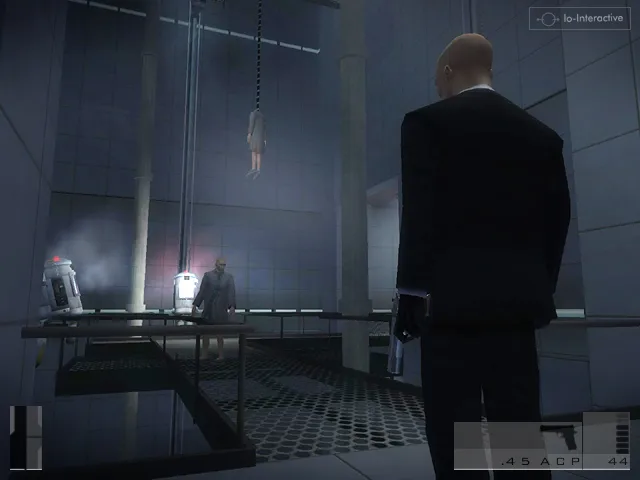
Two on-screen readouts sit beside each other next to the health bar. The threat meter indicates the danger 47 faces, and its movement rising signals increasing danger. The health bar drops whenever 47 takes damage, turning red once it falls below a quarter of capacity; damage is location based, so a head shot is almost certain to kill while an arm hit will not. In the bottom right, the weapon display shows an icon of the equipped weapon, and the ammo display gives both graphical and numerical counts for the loaded clip and all remaining clips.
Difficulty-Limited Saves and the Cost of a Mistake
Before a mission begins, players of Hitman: Contracts choose among three difficulty levels: Normal, Expert, and Professional. The choice does more than set a label, because the manual ties several rules to it at once. Guards and targets gain reaction speed and firing accuracy as the level rises, and the amount of damage 47 can absorb before dying changes too. Each setting also fixes a save budget, and that budget is the clearest way the difficulty shapes how a mission is played out.
The save allowance is counted per level rather than per action. Normal permits seven saves during a mission, Expert permits two, and Professional permits none at all during a level. Because the same setting that lowers the save count also sharpens enemy reactions and accuracy, a mistake becomes more costly as the allowance shrinks: on Professional there is no reload of an earlier moment inside the level, so a single run must carry through from start to finish without a progress save to fall back on.
Tools of the Trade: Map, Inventory and Camera Controls
The equipment screen gathers several tools that feed directly into mission planning. A map of the surroundings stays with Agent 47 at all times, and using it to plot a route can head off unwanted surprises while frequently revealing hidden access points. Binoculars serve surveillance, letting 47 watch targets from a distance. Night vision goggles amplify light in darkened areas so he can navigate them, but the same device carries a documented cost: guards or civilians who notice it will grow suspicious, so wearing it openly is a risk rather than a free aid.
Interaction runs through one context-sensitive key. Pressing E performs an action when only one choice is offered; when two or more choices are available, holding E and scrolling the mouse wheel or pressing W and S highlights the wanted option, which executes on release. The right mouse button opens the inventory screen at any point in a mission for fast access to weapons and items, and highlighting an entry with the mouse wheel or A and D plus a left click equips it; pressing G drops it instead. The F1 key switches between first- and third-person camera modes.
Windows Options: Graphics and Sound Toggles
The graphics options menu in Hitman: Contracts exposes a broad set of visual toggles and sliders. Blood and gore can be switched on or off, and weather effects are enabled or disabled from the same screen. Character shadows can likewise be turned on or off, and subtitles are selected here rather than under sound. Display resolution is set directly, while texture resolution uses a slider that increases texture quality as it moves right. A texture filter choice offers bilinear, trilinear, or anisotropic filtering, and DXT texture compression can be enabled or disabled. Gamma correction adjusts screen brightness, and a post filter slider changes the level of special graphics effects applied in the game. Other adjustable settings include draw distance and object detail.
A separate sound options menu configures the game's audio. Music, speech, and effects each have their own volume slider, so the music level, the spoken dialogue level, and the in-game sound effects level are tuned independently of one another. The same menu selects the 3D sound renderer, choosing between Directsound and Open AL, and provides an EAX option for enabling EAX 3D sound. These audio controls sit apart from the video settings, giving players a distinct place to balance the mix or change the rendering path without disturbing the resolution, filtering, texture, gamma, or post filter choices made in the graphics menu.
Sources & further reading.
- Hitman: Contracts — official game profileRetrieved Oct 28, 2026
- Hitman: Contracts — official game profile — publisher-supplied gameplay manualRetrieved Oct 28, 2026
First published .