 THE GAME ARCHIVE

Building Sentences: The Eight Command Buttons
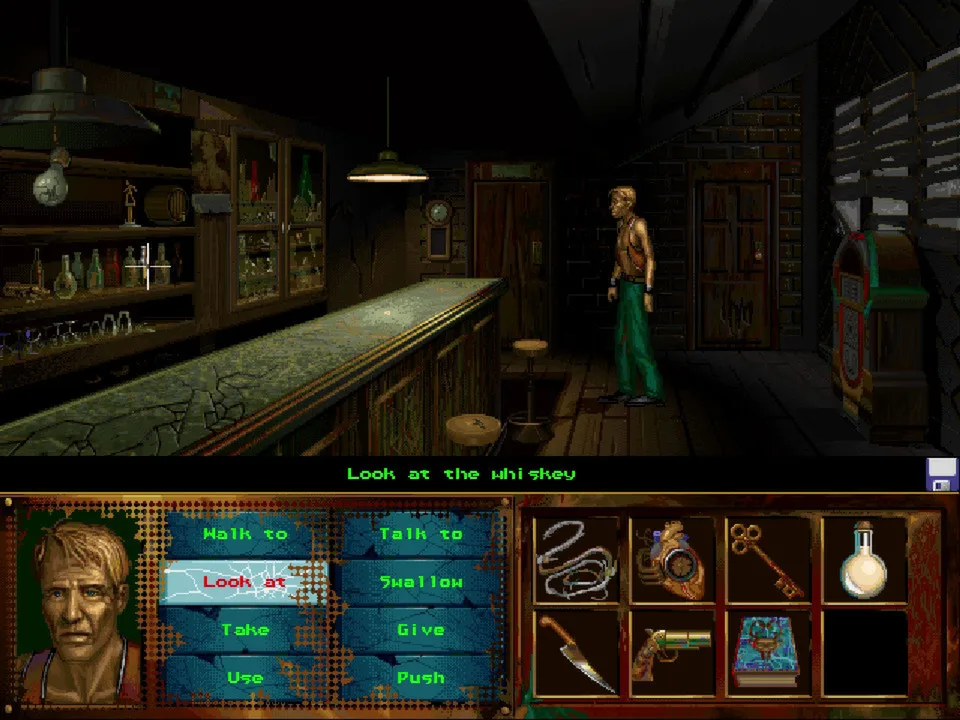
Actions in I Have No Mouth, and I Must Scream are assembled rather than clicked directly. The interface supplies eight command buttons: Walk to, Look at, Take, Use, Push, Talk to, Swallow, and Give, with the active one highlighted. Selecting a command and then choosing objects builds a sentence in the Sentence Line, such as walking to a dark hallway or talking to Harry. Commands and object names can run to more than one word, and keyboard shortcuts such as W for Walk and G for Give mirror the on-screen buttons.
A cross-hair is moved through the Action Window; resting it on an object of interest writes that object's name into the Sentence Line, so the player can identify what is selectable before pairing it with a command. Take places a found object into the Inventory List, which scrolls with up and down arrows once it holds more than eight entries. Use covers opening doors, working controls, handling tools and tying knots, and it also joins items, as when a knife is used on bread from the inventory or the room.
The Inventory List and the Psych Profile
The Inventory List runs along the right side of the screen and shows pictures of what a character is carrying, up to eight at a time. Every main character begins the adventure with only the Psych Profile in the list; nothing else is there until an object is taken or given. When a character takes a found object or receives one, its picture appears in the list. Once the list holds more than eight objects, arrows appear in a scroll bar beside it, and clicking the cross-hair on the up or down arrow moves through the remaining items.
The Psych Profile is itself an inventory item, a tome holding the cultural references, historical data and psychological analyses AM used to build each character's adventure. It serves as a clue source when a player is stuck. The manual also warns that not every object a character can pick up is helpful: the adventures contain no luck, so random trial and error can be fatal, and the successful player is the one who plays smart. Use can combine inventory items, as when a knife is used on bread.
Conversation Windows: Words, Bracketed Actions, and Irreversible Picks
When the main character speaks with another person or operates an intelligent machine, a Conversation Window replaces the Command Buttons and Inventory List. That window usually offers a list of possible things to say, and it may also include things to do. Action options appear inside brackets to separate them from spoken dialogue, so a command such as firing a gun reads as a bracketed action rather than a line of speech. The player reads the list and picks one entry, and the chosen entry then determines how the exchange continues.
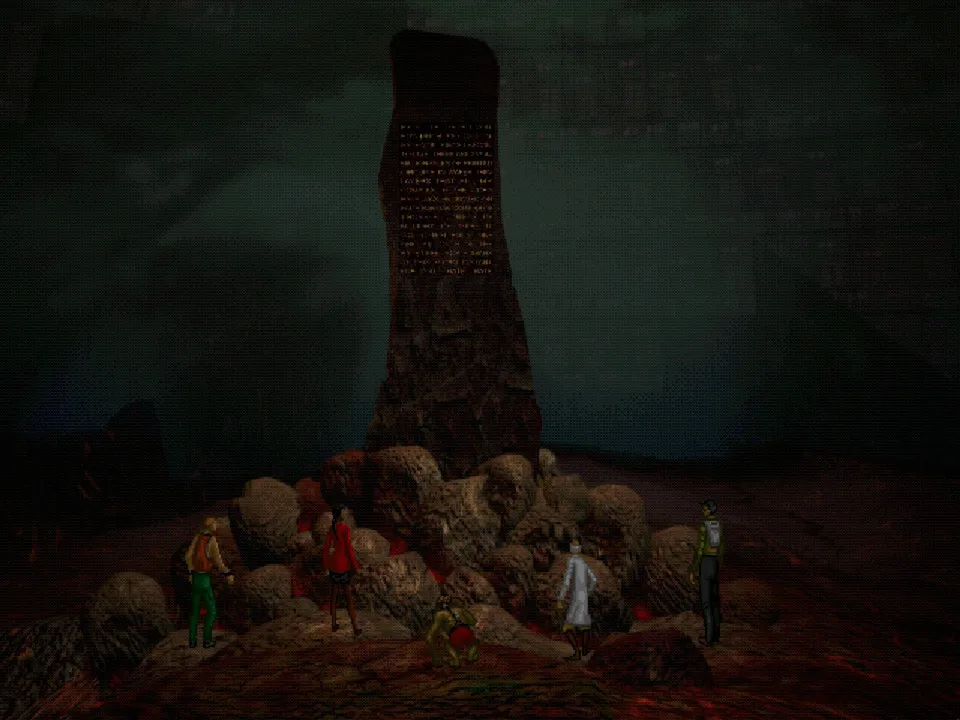
The manual stresses thinking carefully before choosing what to do or say, because some picks carry lasting weight: a choice can change the conversation's subject or direction, provoke anger in allies, or settle an agreement with a questionable character. These are irreversible in effect, so the same list that drives the talk also locks in its outcome once an entry is selected. Separately, play begins at the Hate Pillar, where AM, in an amiable mood, asks for a volunteer; the player moves the cross-hair onto a character and clicks to select who will take on that quest.
The Spiritual Barometer and the Fourth Wall
The Spiritual Barometer sits on the lower-left of the screen as a close-up portrait of the character currently being played. Its background changes color with the character's self-esteem: actions that build that esteem brighten it toward green, while actions that exploit a character's flaws dim it. Because building self-esteem is the route past each character's fatal flaw, the barometer doubles as feedback on whether the player is demonstrating ethical behavior, humanity and courage, or instead feeding the weaknesses AM built into the adventure. The manual advises watching its color intensity closely to gauge how well the character is resisting AM's attempts to crush them.
The fourth wall is a navigation mechanic rather than a narrative flourish. Unobstructed exits such as corridors and paths often lie in the invisible fourth wall at the edges of the computer screen, and they cannot be seen by simply looking at the Action Window. The player must move the cross-hair around the window's edges to search for them, and the object name then writes into the Sentence Line, allowing a Walk to command to that hidden exit. Obstructed exits behave differently: Walk to a locked door only carries the character within touching distance, and passing through usually requires Use, sometimes combined with an inventory object such as a key.
Sources & further reading.
- I Have No Mouth, and I Must Scream — official game profileRetrieved Oct 28, 2026
- I Have No Mouth, and I Must Scream — official game profile — publisher-supplied gameplay manualRetrieved Oct 28, 2026
First published .