 THE GAME ARCHIVE
Building a Team Through A.I.M.
Team construction runs through the Association of International Mercenaries, the hiring network known as A.I.M. From this roster you recruit a core group of skilled professionals, and Wildfire raises the squad ceiling to ten mercenaries. Eight new playable mercenaries join the pool, each carrying an individual history and distinct skills. Hiring is not a matter of filling slots with identical units: each recruit has unique personality traits, and the likes and dislikes mercenaries hold toward one another feed into the motivation and skill of the team as a whole.
Those relationships interact with memory. Mercenaries remember how the player behaves, and good and bad experiences each leave their own effect on the campaign. Because compatibility shapes motivation and skill, a lineup that looks strong on paper can underperform if personalities clash, while a well-matched group benefits from the same mechanism. Individual specialization matters too: the game supports building an optimal mercenary and developing skills over time, so recruits are shaped for combat and other tasks rather than fixed at hiring. Hiring through A.I.M. therefore begins a management loop of pairing skills, personalities, and remembered conduct.
Turn-Based Skirmishes and Real-Time Reconnaissance
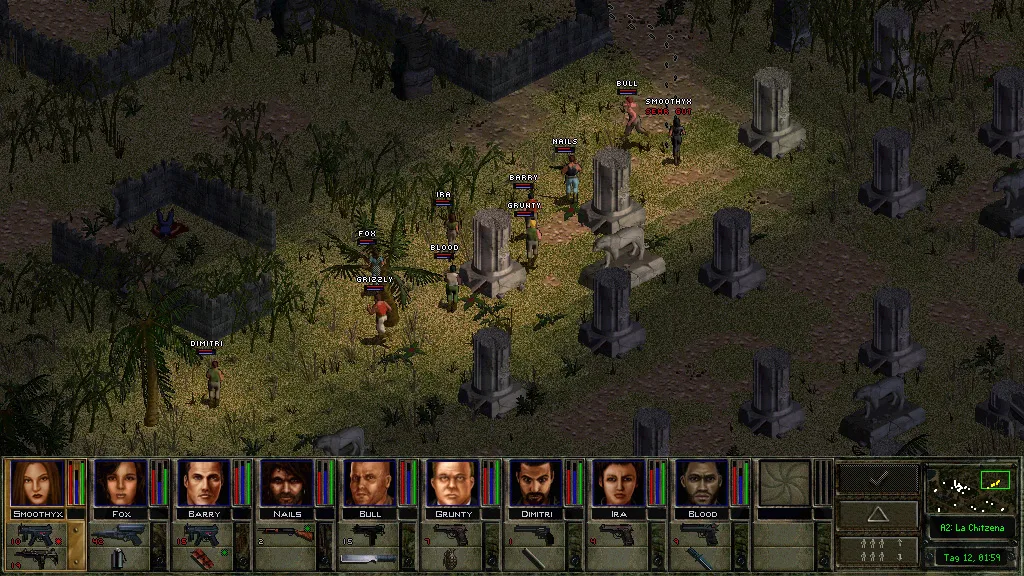
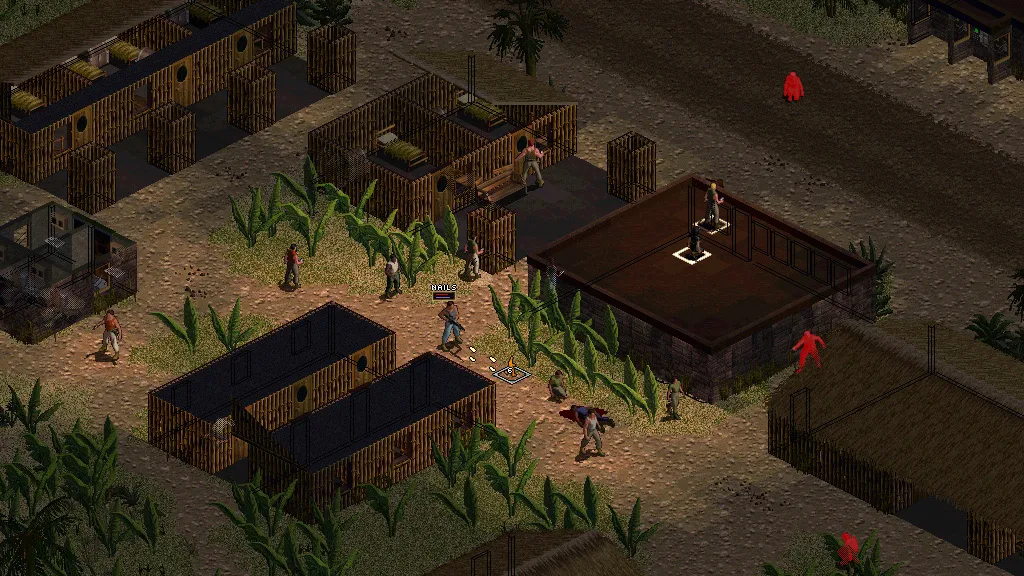
Skirmishes in Wildfire alternate with real-time reconnaissance, and once combat begins the flow turns turn-based. Within a turn you position mercenaries, issue commands, and manage shooting, movement, and item use as separate actions. Stealth movement trades many action points for silence, letting a mercenary creep close to an opponent without making a sound, while the action-point cost means the trade must be weighed against other activity in the turn. Positioning and cover matter as much as firepower, and because enemy behavior shifts, a flexible approach works better than a fixed plan; withdrawing from one sector to strike another flank is an option the design leaves open.
Elevation adds another layer to those skirmishes. A mercenary who has climbed to a higher place has the cursor set to the upper level automatically, and switching between upper and lower levels is done through the inventory screen buttons or a key press. From an upper floor or rooftop, a mercenary can target enemies on another level by changing the cursor level the same way, so an opponent placed above or below the squad can still be engaged. Terrain features such as rooftops and ground floors thus shape movement and shooting alike, and height becomes a tactical resource to hold rather than a backdrop.
Weapons, Ammunition, and Reloading Under Fire
Ammunition belongs to the inventory each mercenary carries, and reloading counts as its own action rather than a free step after firing. When a mercenary runs low on rounds, the aiming crosshair changes into an ammunition cursor, and a left click loads a new magazine at a cost of five action points. Because that cost takes a real share of a turn, the manual advises getting into cover before reloading. If the mercenary lacks the correct ammunition or has no rounds left, the cursor turns gray and the mercenary speaks a fitting line.
Weapon condition feeds directly into that reloading decision. Guns can jam, particularly once their condition has deteriorated, so upkeep of carried equipment affects whether fire keeps flowing. Wildfire rebalances every weapon and explosive around authentic characteristics, aiming for total realism in how weapons and protection systems combine, and it adds more than twenty new weapons, including models such as the UMP, MP5A3, G36, and MSG90. These handling rules sit inside the broader inventory system, in which mercenaries carry and use assorted weapons, items, and equipment with specific interaction mechanics.
Training, Militias, and Crossing the Map
Training in Wildfire is handled through orders that mercenaries execute over time. A mercenary assigned to practice a specific skill or attribute improves gradually, but the gain depends on the recruit: the higher the current skill level, the slower further improvement becomes, and training past level 85 yields little benefit. Instructor training works differently. When one mercenary is set as a trainer for a particular ability, every other mercenary in the same sector learns that ability far better than they would through self-study—provided the instructor actually understands the craft being taught.
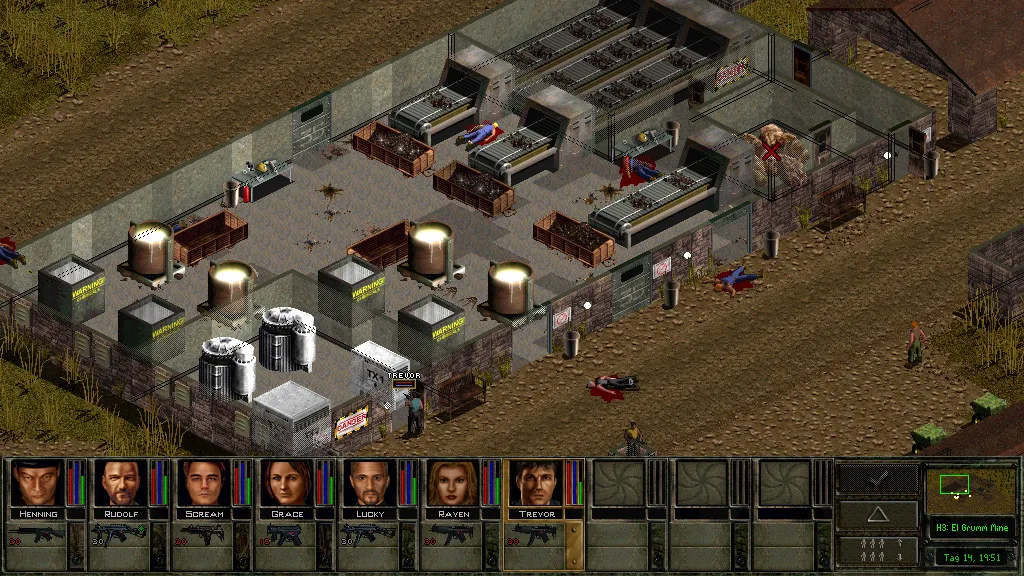
Local militias extend the team's reach. A mercenary given the militia-training assignment in a town without a militia recruits one for you; if the town's militia is already complete, the same assignment instead trains the existing force. Each time a new squad of militia begins training, money is spent on recruitment and equipment. Separately, the map screen is used to plan travel between sectors—mercenaries can move to adjacent sectors or to a specific location—and terrain matters en route, since crossing water requires swimming, which drains stamina under heavy equipment and can end in drowning if the energy bar empties.
Sources & further reading.
- Jagged Alliance 2 - Wildfire — official game profileRetrieved Oct 27, 2026
- Jagged Alliance 2 - Wildfire — official game profile — publisher-supplied gameplay manualRetrieved Oct 27, 2026
First published .