 THE GAME ARCHIVE
A Cute Cat, a Set of Keys, and a Door That Sometimes Appears
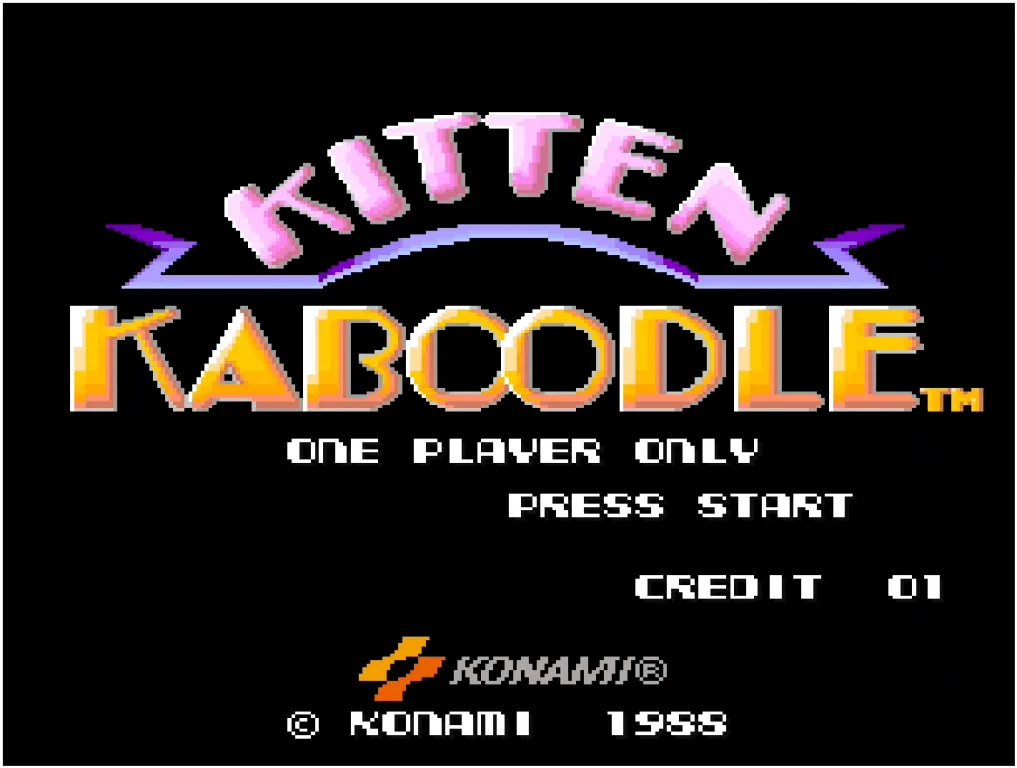
Kitten Kaboodle is an action game that Konami released to arcades in 1988, according to the publisher's catalog record. The description leads with its hero: the main character is a cute cat. That choice of lead sets the tone for everything the publisher documents about the game, which pairs a familiar action structure with a small, playful surprise tucked inside it.
The documented objective is compact: defeat enemies, collect keys, and advance to the next stage. Layered over that routine is an optional one. The publisher notes that players can sometimes find the entrance to secret stages, and that those areas offer other ways to play, such as shopping at secret stores or getting rich at the casino. The result is a game with a plain stated loop and a detour that rewards players who keep their eyes open.
The Core Loop: Clear Enemies, Gather Keys, Move On
The publisher frames the game around three tasks: defeating enemies, collecting keys, and advancing to the next stage. Read together, those tasks describe a stage-by-stage rhythm rather than a single continuous scramble. Each stage presents threats and collectibles, and the way forward is to deal with the former while securing the latter. The advance to the next stage is the visible payoff for doing both.
The pairing of combat with collection is what gives the loop its shape. Enemies are something to be overcome, but keys are the reason to keep moving through the stage. A player who treats every enemy as the whole job may clear a path without finishing the errand; a player who treats every key as the only job may wander into trouble. The documented objective asks for both, which encourages a search-and-secure approach rather than pure aggression or pure scavenging.
The stage-advance step is what turns those two jobs into progression. Rather than being ends in themselves, defeating enemies and collecting keys feed the move to the next stage. That structure also explains why the secret stages read as a genuine change of pace: they sit outside the ordinary sequence of enemies, keys, and advancement, offering something the main loop does not.
Hidden Entrances and the Secret-Stage Detour
The game's optional layer begins with discovery. According to the publisher, players can sometimes find the entrance to the secret stages. The word "sometimes" is doing real work here: the entrance is not described as a guaranteed feature of every stage, but as something that may turn up. That makes noticing it a skill in itself, separate from fighting and collecting, and it gives alert players a reason to scan a stage before moving on.
Inside those hidden areas, the publisher lists two documented activities: shopping at secret stores and getting rich at the casino. Both are presented as alternative ways to play rather than as part of the required objective. The main business of the game remains defeating enemies, collecting keys, and advancing stages; the secret stage is a bonus destination that branches off from that work.
The two activities pull in different directions, which is part of their appeal. Shopping implies spending something the player has accumulated, while the casino implies risking it for a larger return. Even without a described inventory or set of casino games, that contrast is enough to make the detour feel like a decision point: the cautious player may prefer the store, and the bold one may prefer the tables.
It is worth separating what the source states from what it leaves open. The publisher documents that secret stages, secret stores, and a casino exist, and that shopping and getting rich are possible there. It does not describe the stores' inventory, the specific casino games, or what rewards follow from either. Those gaps matter for how players should read the feature: the shops and casino are a documented design premise, not a fully specified economy with known prices or payouts.
Why the Cat Hero and the Side Attractions Fit Together
The cat is not a passing detail in the publisher's framing; it is the first thing the description establishes. The title itself, Kitten Kaboodle, sets a light, playful register, and the hero is described as a cute cat. That register makes room for a structure in which keys, enemies, and hidden shops coexist without feeling mismatched. A grim hero would make a secret store and a casino seem out of place; a cute cat makes them part of the charm.
The hero and the hidden-stage layer also work together as an invitation to explore. A stage that asked only for enemies and keys could be played as a straight line from start to exit; a stage that may hide a shop or a casino asks the player to look around. The documented rules do not describe how the cat moves or fights, so the appeal rests on the combination of the cute lead, the collectible keys, and the promise of hidden places rather than on a particular move set.
Starting Guidance From the Documented Rules
The first piece of advice follows directly from the objective: play for keys, not just for defeated enemies. Because the stated goal combines defeating enemies, collecting keys, and advancing, treat each stage as a search-and-secure task. Deal with the threats that block your path, then confirm the keys are gathered before expecting the next stage to open. A player who stops at a cleared screen may still be short of the documented objective.
The second is to watch for hidden entrances instead of rushing to the exit. Since entrances to secret stages sometimes appear, a player who only follows the obvious route may miss the stores and the casino entirely. Pausing to explore before advancing is exactly the behavior the secret-stage rule rewards, and it complements the core objective rather than competing with it, because advancement remains the main route.
The third is to treat the casino as a gamble in the ordinary sense of the word. The publisher frames the casino as a place where the cat can get rich, and getting rich is a hoped-for outcome rather than a promise. Since shopping and the casino are optional entertainments in the documented description, the safe approach is to keep the ordinary objectives in view and treat the secret stage as a bonus rather than a requirement.
Original Arcade Game and the Modern Reissue Context
Kitten Kaboodle is documented as an arcade game, and the catalog lists Arcade among its platforms. The source material also describes a modern licensed reissue context, which should be kept distinct from the 1988 arcade original. In that reissue, players can customize game settings, such as adjusting the difficulty level, and the release supports online score rankings, so players can compare high scores with others around the world.
Neither of those reissue features changes the underlying objectives. Difficulty adjustment alters the challenge of playing the same game, and online rankings give the resulting scores a wider comparison point. The cat's job remains defeating enemies, collecting keys, and advancing to the next stage, with hidden entrances still offering the chance of a secret store or a casino.
The source's description of the reissue series mentions that, depending on the title, the package can recreate the nostalgic atmosphere of CRT televisions. That is a series-level statement rather than a confirmation that this particular game includes such a display option, so it is treated here as background on the reissue line rather than as a documented feature of Kitten Kaboodle.
Scroll sideways to see the full table →
| Detail | Documented Value |
|---|---|
| Title | Kitten Kaboodle |
| Publisher | KONAMI |
| Release year | 1988 |
| Platform | Arcade |
| Genre | Action |
| Main character | Cute cat |
| Objective | Defeat enemies, collect keys, advance to the next stage |
| Optional layer | Hidden entrances to secret stages; secret stores and a casino |
| Reissue extras (series context) | Customizable settings such as difficulty adjustment; online score rankings |
Sources & further reading.
- KITTEN KABOODLE — licensed publisher game documentation Retrieved Oct 19, 2026
First published .