 THE GAME ARCHIVE
Flags, Not Orders: The Core of Indirect Control
In Majesty 2 you rule Ardania, but you do not push soldiers around a map. Heroes decide for themselves what to do, and the only reliable lever is gold. Tasks are set by attaching rewards to four flag types: an Attack Flag marks a monster, enemy hero, building or lair for destruction; an Explore Flag lures heroes toward uncharted territory or a chosen destination; a Defense Flag offers payment for protecting a hero, citizen or building; and a Warning Flag marks a place, enemy or monster to keep heroes from walking into needless danger.
The flag is only a signpost; the sum attached to it does the work. Larger rewards bring more applicants, and the more experienced a hero, the better the reward must be before it draws attention. Class temperament shapes the response as well: Rangers favor exploration and react swiftly to Explore Flags, Warriors respond to Attack Flags, and Rogues react to monetary incentives. Building a kingdom in Majesty 2 therefore means learning which heroes will bite at which price, and at what point a cheap bounty is simply ignored.
The Hero's Day: States, Errands and Fleeing
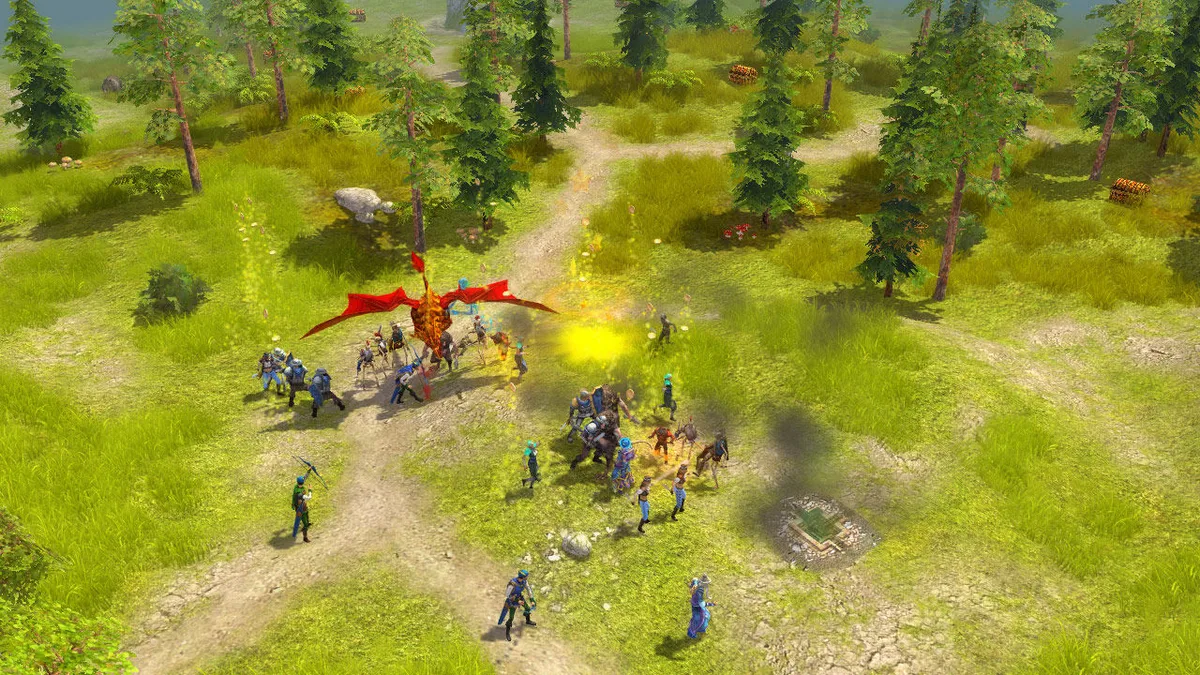
Once hired, a hero cycles through documented states rather than waiting for orders. A hero may be looking for an attractive target, such as a chest, a monster or a flag; fighting, or moving to join a battle; going home to the guild to rest or learn abilities; collecting a discovered chest of gold; responding to an Attack, Defense or Explore Flag; or fleeing. That last possibility is the reason indirect control has teeth: a hero can simply decide a fight is not worth it, and the ruler has no button that says otherwise.
The interface is built for watching and nudging rather than commanding. On the keyboard, E and Q add gold to flags, the arrow keys or WASD move the camera, and Ctrl+F5 and Ctrl+F9 handle quick save and quick load. This makes the practical rhythm of a mission a loop of scanning hero activity, raising or lowering a bounty, and letting the heroes sort out who takes the job.
Building the Kingdom: Economy, Guardhouses, Guilds and Temples
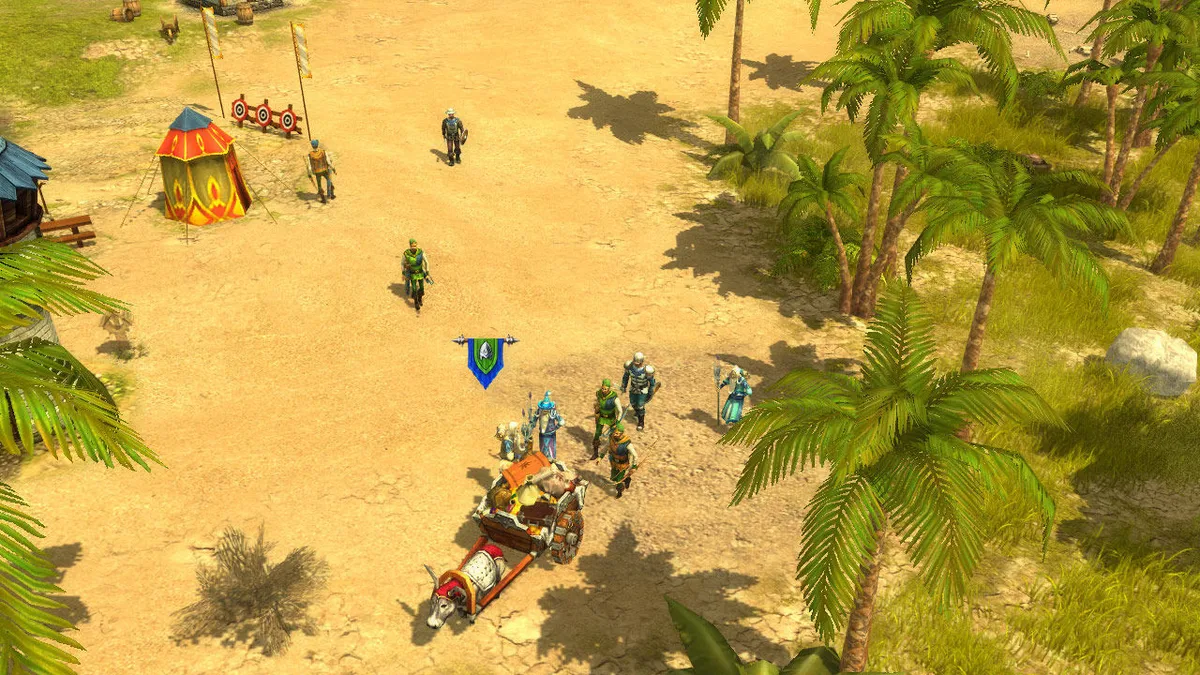
Construction splits into four categories, each answering a different need. Economic buildings generate income for the kingdom and also sell heroes weapons, armor and other equipment for a price. Guardhouses serve defense. Guilds handle hiring and training heroes, and some guilds supply the King with spells or other unique abilities. Temples are the seats of divine power in Ardania and let you recruit the kingdom's most powerful heroes. Because a mission begins with only a bare minimum of buildings, the success of a mission depends on which structures you choose to add.
The construction bar sits in the bottom-right corner of the screen. It displays the gold currently in the kingdom's treasury and includes a button that automatically selects the palace. From the palace you issue construction orders for all available building types: guilds, economic buildings, guardhouses and temples. Selecting a guild lets you hire heroes or invent something; selecting a hero lets you promote that hero to a temple hero, provided the corresponding temple already exists. Spells you have invented in guilds or temples appear as icons above the selected object's bar.
None of this is free, which is the central squeeze of the game: the same treasury pays for buildings, equipment, flag bounties and magic. Every new guild is a bet that its heroes will earn back their cost; every flag bounty is a temporary purchase of hero attention. A successful ruler therefore treats construction, bounties and casting as competing claims on one purse rather than separate menus.
Parties, Lords, and the Cost of Losing a Hero
Once the party ability has been researched, heroes can be organized into adventuring parties at one of Ardania's inns, following the structure of classic role-playing groups. The members act together, each supporting the others with its own unique abilities, so a party's strength comes from how individual skills combine. That teamwork is conditional: not all heroes like one another, and how well a group works together depends on the care taken when constructing it, so pairing compatible personalities matters as much as picking capable members.
Lords are drawn from the heroes who served during the liberation of a new province, where a regional governor is appointed to keep order and stability while the ruler is absent. The King may also give a promoted hero a new name. Summoning a Lord or Lady into a later mission requires constructing the Hall of Lords and paying a considerable sum for the privilege, but the returned Lord is generally more experienced and capable than an ordinary hero. Separately, a hero's character card records equipment such as weapons, armor, potions and artifacts, and the higher the experience level of a dead hero, the more expensive resurrection becomes.
King's Magic: Spells That Cost More the Farther You Cast
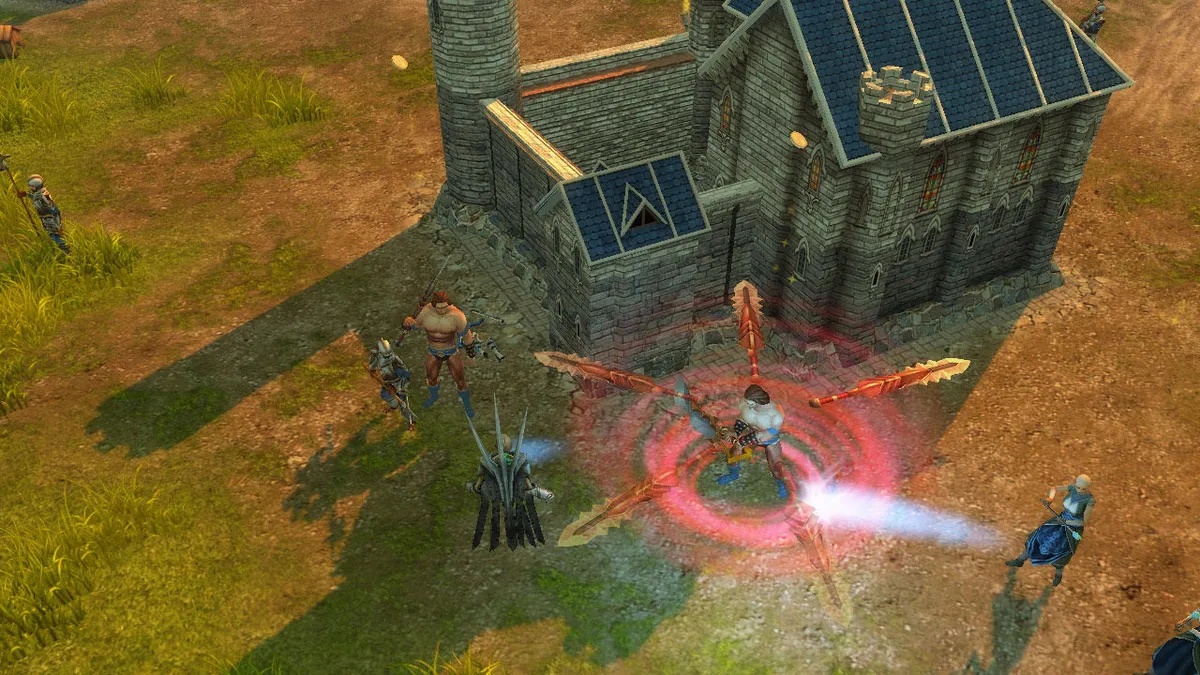
King's magic begins in the buildings that also produce heroes. A spell researched at a guild or temple becomes an ability you can cast directly. As documented examples, Holy Heal studied at the Clerics Guild restores an injured hero or citizen, and Lightning studied at the Wizards Guild rains bolts on enemies. Casting is never free; each use costs gold, so every heal or strike competes with the treasury's other demands.
Combat magic adds a distance rule on top of the base fee: the cost rises in proportion to the target's distance from the nearest Wizards Guild or Wizard's Tower. A bolt dropped close to that infrastructure charges little; the same bolt aimed far across the map charges more. Invented direct-cast spells appear as icons on the King's Spell Bar, and the minimap shows fog of war, friendly and enemy buildings, and battlefields, giving the ruler the layout needed to judge a distant cast's price.
Missions, Quests and the Campaign Ladder
The campaign spans 16 missions arranged into four chapters, with difficulty escalating across the sequence. Because the difficult missions are meant to be played in order, progression is gated: unavailable missions display their prerequisites beside the mission icon, so you can see what must be finished before that icon becomes playable. That makes completion itself the key to later missions, and the recommended order of increasing difficulty maps onto the chapter arrangement rather than a free selection of scenarios.
Inside a mission, the quest log button opens a window listing that mission's quests with their descriptions. Those quests are split into compulsory and voluntary categories, and some carry time restrictions, so a ruler can tell what must be done from what is optional and which entries press against a clock. Completed missions can be replayed. Practically, the log defines the tasks within a scenario, while the prerequisite labels on the mission selection screen define which scenarios are open at all.
Pacing, Reports, and Network Play
Mission pacing is regulated by a row of game speed buttons that pause the action, slow it down, or speed it up. The same interface stack keeps the ruler informed: a day counter tallies elapsed mission time in days from the start of the mission, the hero list shows each hero's health and current activity, a message line offers hints or subtitles, and the Current Events Log records important developments and changes in the kingdom's life.
Network play supports both LAN and Internet sessions. A ruler can create a new server or join one that already exists, and the server browser lists each server's name, the mission it hosts, its ping, the number of players the mission requires, and its status. Version matching is mandatory: client and server only connect when their game versions are identical. Ping reflects data-transfer delay, so a higher figure means a slower connection.
Starting Guidance for a New Monarch
The source rules point to a few practical priorities. Watch the heroes before you spend: a flag bounty that no one takes is wasted gold, and an experienced hero expects more before accepting. Expect the same gold to be pulled in several directions at once, because economic buildings, guilds, temples, equipment, resurrection and spells all draw on one treasury. Decide early which guilds the mission actually needs, since the opening building set is deliberately thin and each addition is a choice about which heroes and abilities will be available later.
Distance matters when magic is part of the plan: a Lightning strike far from the nearest Wizards Guild or Wizard's Tower costs more than one close by, so positioning magical infrastructure is itself a financial decision. When forming parties, weight compatibility as carefully as raw ability, because heroes who dislike one another make poorer teams. And remember that a dead hero's resurrection bill rises with experience level, which is a quiet argument for keeping veterans alive rather than feeding them into risky flags.
Scroll sideways to see the full table →
| Detail | Documented value |
|---|---|
| Developer | 1C:InoCo |
| Publisher | Paradox Interactive |
| Release year | 2009 |
| Platforms | Windows |
| Genres | Simulation, Strategy |
| Campaign length | 16 missions across 4 chapters |
| Flag types | Attack, Explore, Defense, Warning |
| Building categories | Economic, guardhouses, guilds, temples |
| Multiplayer | LAN and Internet, with version matching |
Sources & further reading.
- Majesty 2 — official game profile Retrieved Oct 20, 2026
- Majesty 2 — official game profile — publisher-supplied gameplay manual Retrieved Oct 20, 2026
First published .