 THE GAME ARCHIVE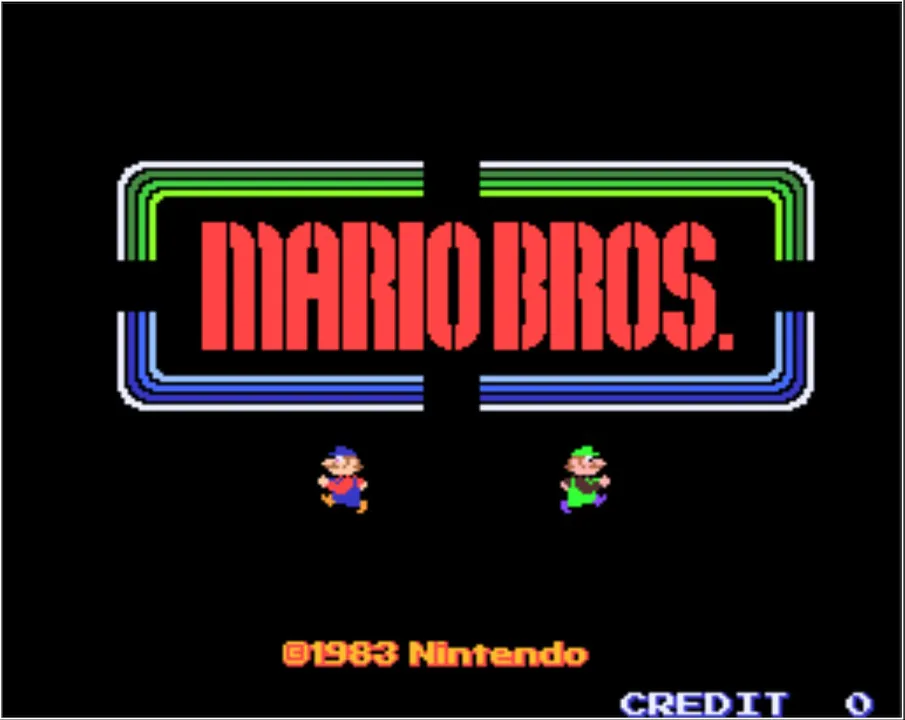
Mario Bros. on the Arcade Floor: 1983, Nintendo, Action
Mario Bros. is an action game released in 1983 by Nintendo for the arcade. The catalog lists it as an arcade title first and foremost, so this feature treats it as a cabinet game rather than a home conversion. Its genre is action and its publisher is Nintendo. The publisher description confirms the central loop: control Mario or Luigi, punch the enemies coming out of pipes from below to turn them over, then defeat them.
What the documentation does not specify is just as important as what it does. It gives a year, a platform, a publisher, a genre, and the punch-and-flip loop, but it does not describe stage layouts, timing windows, scoring thresholds, input devices, power-ups, or life counts. Those specifics are left out of this feature rather than guessed, so everything below stays with the documented pipe routine, the two-player choice, and the modern reissue wrapper.
Punch From Below: Flipping Enemies That Emerge From Pipes
The core routine centers on the pipes. Enemies emerge from them, and the player, controlling either Mario or Luigi, punches those enemies from below. That upward strike does not simply remove the target: it turns the enemy over. The flipped state is the opening, and defeating the enemy follows from it. So the sequence runs from an enemy appearing out of a pipe, to a punch delivered from underneath, to the turned-over enemy being finished off. The documentation names no further inputs, so the punching action and its result are the whole of the described interaction.
The documented objective is to eliminate all enemies. That goal ties directly to the flip mechanic: because turning an enemy over is the step that precedes defeating it, clearing the enemies depends on landing punches from below as they come out of the pipes rather than on any other listed action. The whole loop therefore reads as a two-beat problem — get underneath the emerging enemy, then convert the flip into a defeat — repeated until the screen is empty.
Because the flip is mandatory rather than optional, the mechanic shapes positioning. A punch from above or from the side is not part of the documented vocabulary; the player has to get below the pipe enemy to act at all. That makes the space under an emerging enemy the key piece of real estate on the screen, and it explains why the two-beat loop is worth describing carefully — the first beat sets up the second, and there is no shortcut that skips it.
Two Players, One Cabinet: Co-op or Head-to-Head
At the cabinet, the first player steers Mario while the second controls Luigi, giving each participant a named character rather than a shared avatar. The pipe routine stays the same for both: enemies come out of pipes, a punch from below turns them over, and the flipped enemy is then defeated. That punch-and-turnover sequence, established in solo play, carries directly into the two-player cabinet session, so neither player gets a separate verb or a different goal.
The two-player mode is explicitly a choice: both players can work together or work against each other, and the documentation frames this as a variety of ways to play. Cooperation means the two characters share the pipe-clearing job, with either Mario or Luigi landing the upward punch and finishing the turned-over enemy. Competition means the same two characters and the same enemies, but the players direct their flipping and defeating at cross purposes. The rules do not switch between these; the players pick the stance themselves.
That freedom is the most interesting documented design decision in the two-player game. The same enemy, the same flip, and the same defeat rule can serve either a shared clearing effort or a contest, which means the social layer of the cabinet session changes the meaning of an identical verb. Nothing in the supplied description tells us how a competitive round is scored or when it ends, so the safest reading is that the choice of stance is the mode's defining feature, not a scored match type.
The Modern Reissue Wrapper: Difficulty, CRT Look and Online Scores
The modern licensed reissue wraps the arcade original in a set of adjustable presentation and competition options. Players can customize game settings to their liking, including adjusting the difficulty level. Depending on the title, the reissue also lets players recreate the nostalgic atmosphere of CRT TVs from back in the day. These are reissue features, not elements of the original 1983 release, which the source explicitly distinguishes from the modern wrapper.
For competition, the reissue adds online rankings. Players can compete for high scores with players from all around the world through these online leaderboards. The difficulty adjustment, CRT visual simulation, and global score competition are documented only as modern reissue context, not as features of the original arcade release. They sit outside the pipe-punching and enemy-flipping rules described for the 1983 game.
Source-Backed Starting Guidance
- Treat each pipe enemy as a two-step problem: line up underneath it, punch from below to flip it, and finish it before moving on. Clear the whole screen, since the documented objective is to eliminate all enemies. In two-player sessions, decide with your partner at the start whether you are cooperating or competing, because the rules leave that choice to the players rather than the software.
Beyond those basics, the supplied documentation does not describe time limits, scores, lives, pipe navigation, or power-ups, so there is no reliable starting guidance on those fronts. The advice above is deliberately limited to what the publisher description establishes: the flip-first approach, the clear-all objective, and the explicit two-player choice.
At a Glance
- Title: Mario Bros. — Year: 1983 — Publisher: Nintendo — Genre: Action — Platform: Arcade — Core verb: punch pipe enemies from below, flip, defeat — Two-player: cooperate or compete — Modern reissue: adjustable difficulty, optional CRT look, online rankings
Sources & further reading.
- Mario Bros. — licensed publisher game documentation Retrieved Oct 16, 2026
First published .