 THE GAME ARCHIVE
A Turn-Based War Built on Hidden Loyalties
Massive Assault, developed by Wargaming.net for Windows, is a turn-based strategy game that sets the Free Nations Union against the Phantom League across distant planets. Its distinguishing idea is that loyalty itself is a resource: countries begin as Secret Allies, are disclosed a few at a time, and only then become targets that pay Indemnity when conquered. Around that hidden-loyalty system the manual documents a compact economy, a fire-once combat model, and a four-phase turn that gives every round a fixed rhythm.
The game's single-player menu offers four routes against a computer opponent: Training, Scenarios, World Wars, and Campaigns. World Wars are the full-scale version where Secret Allies are randomized and the Disclosure phase appears; Scenarios and Campaigns preset their allies and skip the Disclosure phases, and Scenarios cast the player as the Free Nations Union only. World Wars let a player command either side on any one of six planetary maps.
Four Phases, One Turn
Every turn is split into four phases: Disclosure, Guerrilla, Movement and Combat, and Recruitment. Disclosure appears only in World War games; other modes move straight into the remaining phases. After the initial Disclosure Phase, the Phantom League player always acts first each turn. This means a turn is not one undivided pool of actions but a short sequence, and the Guerrilla and Recruitment steps carry as much weight as combat itself.
World Wars open with a blind exchange. Both sides begin with an equal number of Secret Allies placed at random on the chosen planet and hidden from the opponent. On the first turn each side discloses two allies simultaneously, without seeing the other player's Initial Disclosure. A player discloses an ally by clicking its capital, and eligible allies show as yellow on the minimap during this phase. As the game continues, each side must keep disclosing allies during later Disclosure phases until all such countries are revealed; until then, hidden allies can be used against an unwary enemy.
Secret Allies, Disclosure and Money
In World Wars, both sides receive an equal number of Secret Allies chosen at random before the game and hidden from the opposing player or computer. Every country sits in one of three categories with different visibility rules: Secret Allies stay concealed, Disclosed Allies are open to both sides, and True Neutrals belong to neither camp. Because the opening is a blind commitment, a player cannot tailor an early disclosure to the opponent's revealed picks.
Disclosure also governs money. Conquering an enemy's Disclosed Ally earns a one-time Indemnity payment whose value depends on that country, and the payment goes into that country's Treasury for use during the Recruitment Phase. Secret Allies pay no Indemnity until they are disclosed, even if the enemy fully controls them, and Neutral countries pay nothing. Each country can pay Indemnity only once per game. Territorial superiority is the victory condition: players invade Neutral and enemy countries to capture them, and taking a Neutral country puts it under the enemy's control.
Terrain, Ranges and the Fire-Once Combat Model
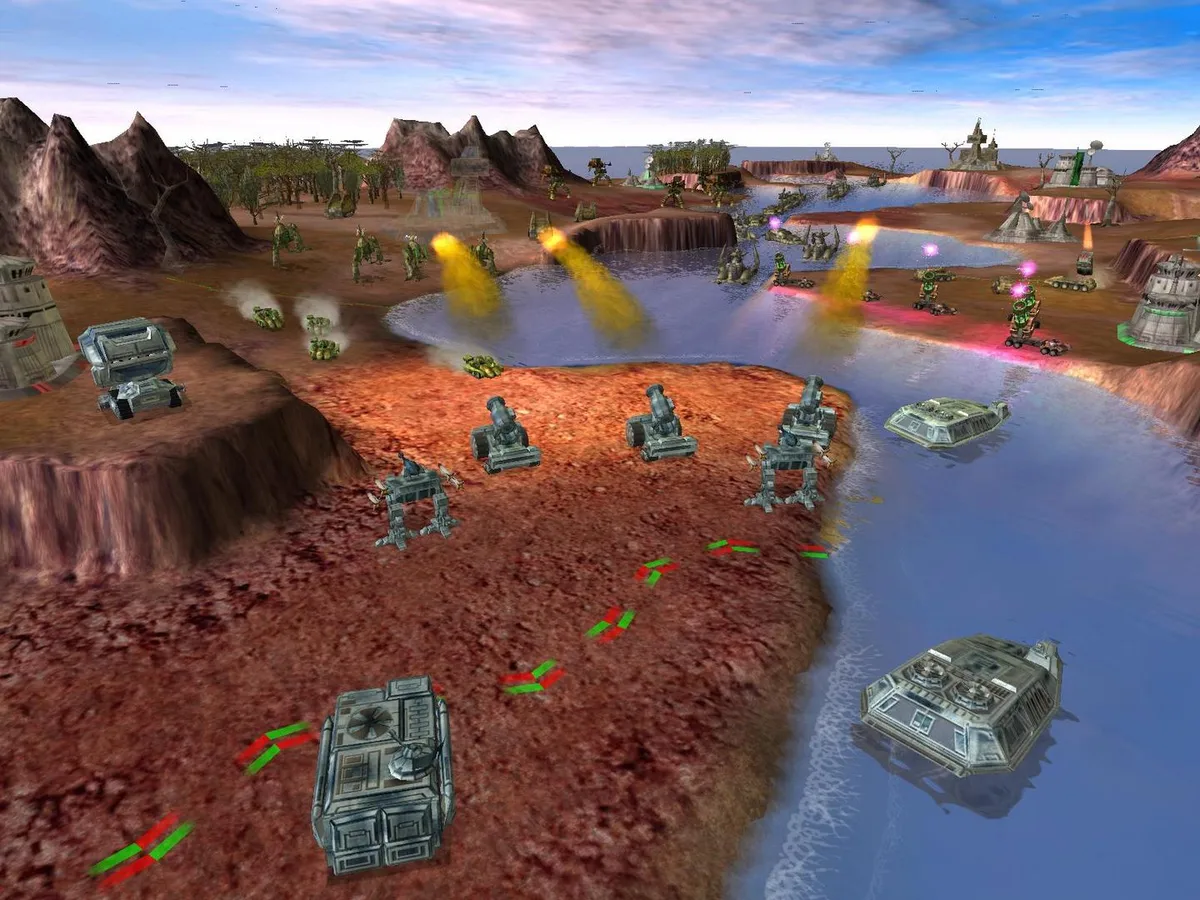
Selecting a unit reveals spots showing where it may move that turn, while a red circle marks its firing-range limit. Spots are colored by the terrain beneath them: white for roads, yellow for open ground, and red for woods or desert. Roads add one movement point for units with only a single movement point, woods and desert cost two points to enter, and mountains, ridges and cliffs are impassable to every unit except Tactical Bombers, which may fly over any terrain type within range.
Firing follows a fire-once model. To attack, the player selects a unit and clicks the enemy; holding the cursor over the target changes it to a fire cursor showing how much damage the target will take. If that number equals or exceeds the target's remaining hitpoints, the unit is destroyed. A unit that has already fired can undo that action to move instead and then take its fire action, so movement and shooting are ordered rather than freely interchangeable.
Revenue, Recruitment and Guerrilla Uprisings
Revenue comes from controlled countries, each generating income per turn according to its economy type. Money may be spent immediately or saved across turns, but it can only buy units created within the borders of the country that earned it; revenue cannot be shipped elsewhere. If another player captures a country, they also gain any unspent revenue held in its treasury. During the Recruitment Phase, each Disclosed Ally's treasury funds new units deployed inside that country, and revenue is collected immediately after the Movement and Combat Phase.
Because revenue is trapped in its home country and expensive units such as Aircraft Carriers, Battleships and Mobile Missile Platforms can cost more than one turn's income, saving a country's treasury over several turns becomes a deliberate plan. Invading a Neutral or enemy-controlled country triggers a Guerrilla Uprising: that country generates revenue for its owner, a Neutral country immediately joins the enemy's side, and the funds buy forces during the enemy's next Recruitment Phase, deployed inside the affected country. This happens only once per country per game.
Unit Rosters: LAVs, Land Transports and Tactical Bombers
Every unit is rated across five attributes: Hitpoints, Movement, Damage, Range and Price. The roster spans land, naval and air forces with distinct capabilities, and names differ by faction, so the Free Nations Union Light Armored Vehicle is the Phantom League's Smallfoot. That light vehicle has 4 hitpoints, moves 1 spot, deals 1 damage at range 1, and costs 1; it is the smallest and weakest weapon available, yet cheap enough to field in large numbers.
Land Transports carry two ground units and cover more ground than any other land unit: 3 hitpoints, 5 movement, no damage, no range and a price of 2. They are unarmed, so they depend on escorts and are vulnerable to enemy fire, but they matter for offensives, carrying troops forward faster than those units could walk. Paired with Mobile Artillery or MMPs, they form a mobile striking force. Tactical Bombers are the air exception: they operate from cities or Aircraft Carriers, strike out to six spots from that base because they need fuel to return, always fly back to the same base, and cannot land elsewhere.
Modes and Controls
Single-player brings four game types against a computer opponent: Training, Scenarios, World Wars and Campaigns. Training concentrates on the basics, spanning tactics, movement, combat mechanics and offensive and defensive techniques, and it is split into five short lessons that can be picked in any order. Scenarios are defined by duration as quick, medium or long and are played from the Free Nations Union side, while a World War can be fought as either faction across a full-scale global conflict on any one of six planetary maps.
Multiplayer is handled through hot-seat play and online play, including registration, issuing challenges and playing online turns. Mouse commands stay consistent: the left button selects a unit, moves it, fires it, or loads and unloads it from a transport, and air units are selected by clicking the capital or aircraft carrier they are based on. The right button deselects a selected unit or shows information about an unselected one, while A, S, D and W scroll the map left, down, right and up, and Page Up and the mouse wheel provide further map movement.
Starting Guidance from the Documented Rules
For a new commander, the manual's own route is Training first: its five short lessons cover tactics, movement, combat mechanics and offensive and defensive techniques, and any lesson can be taken in any order. In battle, remember that a unit fires once, so a wasted shot that cannot destroy its target still spends that unit's attack. Before committing, hover the fire cursor to check whether the shown damage meets or exceeds the target's hitpoints, and use the mapping shortcut of holding Shift while clicking a spot to mark which enemy units can attack it.
On the economic side, treat each country's treasury as a separate budget. Saving a rich country's revenue for several turns is the documented way to afford an Aircraft Carrier, Battleship or Mobile Missile Platform, and because an enemy who captures the country takes its unspent revenue, leaving a large stockpile in a threatened border country is a risk.
Scroll sideways to see the full table →
| Attribute | Documented Detail |
|---|---|
| Turn phases | Disclosure (World Wars only), Guerrilla, Movement and Combat, Recruitment |
| Turn order | Phantom League acts first each turn after the initial Disclosure Phase |
| LAV / Smallfoot | 4 Hitpoints, 1 Movement, 1 Damage, 1 Range, Price 1 |
| Land Transport / UPS | 3 Hitpoints, 5 Movement, 0 Damage, 0 Range, Price 2 |
| Guerrilla Uprising | Once per country per game; funds deploy in the enemy's next Recruitment Phase |
Sources & further reading.
- Massive Assault — official game profile Retrieved Oct 19, 2026
- Massive Assault — official game profile — publisher-supplied gameplay manual Retrieved Oct 19, 2026
First published .