 THE GAME ARCHIVE
Surviving the Surface: Gasmask Filters and Air Supply
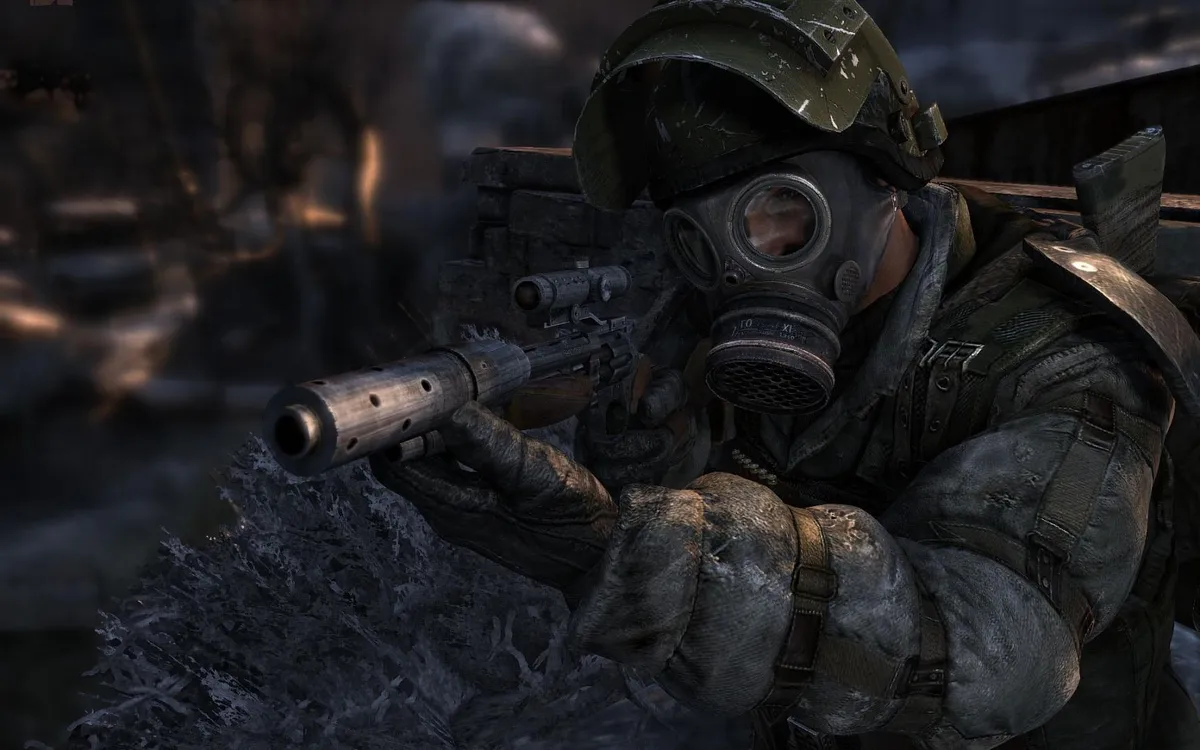
On the surface, Artyom relies on a gasmask whose filters purify the air but last only a limited time. The Gasmask and Filters counter sits beneath the Medkits counter on the screen, showing how many minutes of filtered air remain. Artyom can press the T key to check his watch and read the time left on the equipped filter. When the filters run out, mist covers the mask and Artyom begins to suffocate unless he leaves the area in time. A damaged mask turns red, signaling that a replacement is needed.
Mask control is split across two keys: pressing G puts the gasmask on, while holding G takes it off. The C key handles filters. Because air supply is finite, the manual stresses donning the mask only when necessary; when Artyom's filtered breathing becomes quiet, that signals the air may be safe and the mask can come off. Filters therefore work as a timed resource rather than a permanent shield, and the watch reading tells the player how long the current filter will hold before the mist and choking begin.
Bullets as Money: Dirty Ammo, Military Grade, and the Underground Economy
Most rounds Artyom finds in the metro are Dirty ammo, the standard munition that can be bought or found throughout the world. These cartridges are made by mixing powder with fillers, which lowers their power but stretches a single Military Grade bullet into more bullets. Dirty rounds give no bonus to damage or accuracy, and they cannot be used as currency. The ammo counter sits in the bottom right of the screen, so watching it carefully keeps Artyom ready for the next battle. Because most of the ammunition lying around is this weaker type, the choice of what to load becomes part of staying supplied.
Military Grade ammo is military-issue stock made before the blast, pure and untampered, and it deals greater damage than Dirty ammo when fired. It also serves as currency in the underground markets, forcing Artyom to decide between spending the higher-grade bullets in combat and saving them to purchase better equipment. Pre-blast weapons such as the AK-47 are highly valued for the manufacturing skill behind them; they are rare and very expensive, and they can chamber Military Grade ammunition. The same applies to the Kalash 2012, a modified, updated AK-47 introduced in 2012 as a standard-issue Russian military rifle and welcomed by soldiers.
The Arsenal: Knife, Revolver, and Silenced Rifles
Artyom's self-made knife is described as a highly efficient killing tool in close combat, and the manual directs it toward situations where enemies are near and ammunition is scarce. Because it consumes no cartridges, the blade covers the gap left by the metro's limited supply of rounds. The revolver, by contrast, is a standard six-round firearm that can be bought or found in several configurations; it may be equipped stock, with a silencer, with a scope, or with any combination of those add-ons. Silencing or scoping the revolver therefore changes how the same six-shot weapon is set up rather than replacing it.
The sniper rifle's main purpose is killing quietly, achieved through a very efficient silencer paired with lowered muzzle velocity; the weapon can chamber Military Grade ammunition. A second silenced arm, the Light Sniper Rifle, takes down enemies at a distance with minimal fuss and operates on compressed air rather than conventional propellant. Quiet kills thus rest on two different mechanisms: a suppressed firearm with reduced velocity, and a pneumatic rifle. Together with the knife and the configurable revolver, these weapons give Artyom close, mid-range, and distant options, each shaped by whether noise or ammo economy matters more.
Seeing in the Dark: Nightvision, Flashlight, and the Journal Compass
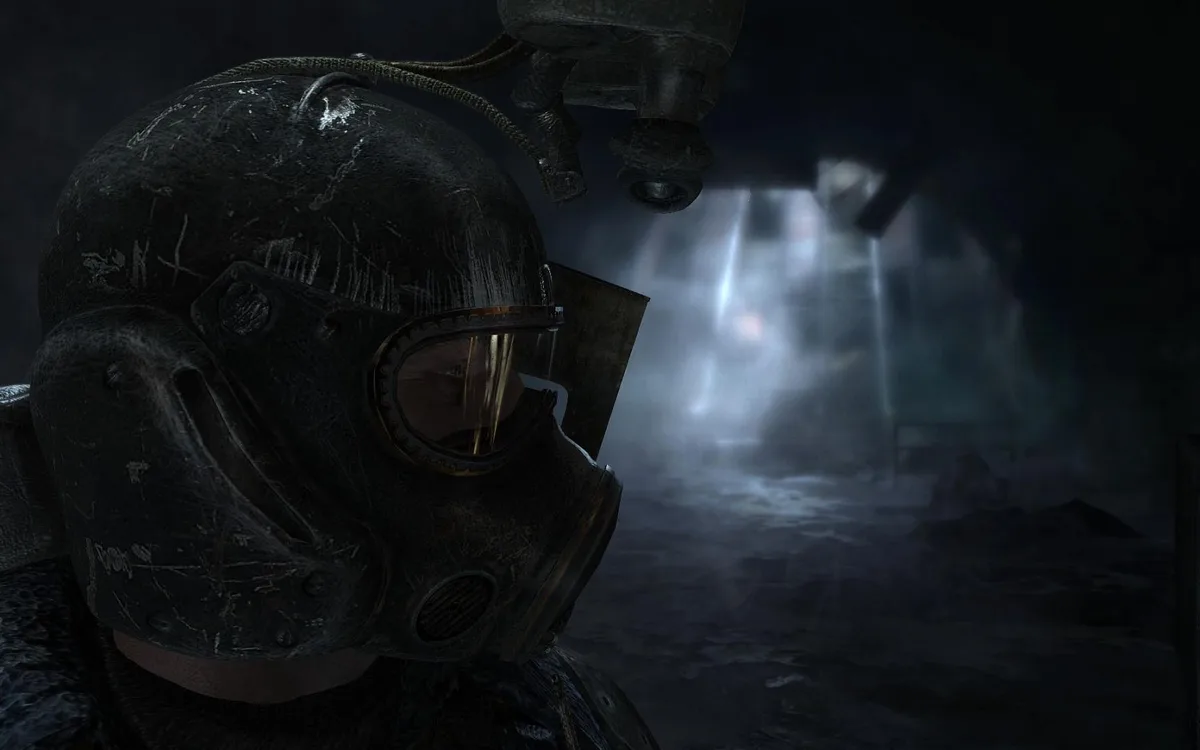
Lighting in Metro 2033 is a trade-off between sight and secrecy. The flashlight projects a directed beam in front of Artyom and draws on an infinite energy source, so it can be switched on whenever the tunnels go black. Its drawback is visibility: the beam makes Artyom instantly more noticeable to nearby enemies. The lighter behaves in much the same way, illuminating nearby objects while its glow can be seen by others and give away his location. Nightvision offers the opposite bargain, letting Artyom see in dark places without revealing his position the way a flashlight does.
Nightvision carries its own limits. In bright locations it makes seeing harder, so it should be taken off, and its batteries must stay charged through the Universal Charger, the same device that can brighten the flashlight for a limited time. For direction, the Journal holds a detailed breakdown of mission objectives, with a compass on its top-left side; that compass points Artyom toward his current objective, helping him orient himself in the underground mazes. Health is handled without bars or meters: the screen blurs and grows bloody as Artyom takes damage, and a red blur around the edge shows the direction of the attack.
Controls and Starting Modes: Moving, Reloading, and Loading a Save
Metro 2033's main menu organizes play around three entry points. New Game restarts the story from the very beginning and then asks for one of three difficulty settings: Easy, Normal, or Hardcore. Continue Game returns Artyom to the last checkpoint reached during a previous session. Load Game opens a separate menu listing previously played levels, each loaded from its own beginning rather than from a mid-level checkpoint. The title screen requires a key press before the main menu appears, and Options sits alongside these entries for adjusting controls.
Movement uses the W, S, A and D keys, with the left Shift key held for sprinting and the mouse controlling the view. A single press of Z toggles crouching, so the stance persists until pressed again, while the left Ctrl key crouches only while it is held. Space jumps, E performs the context use action, and R reloads. Holding R on an automatic weapon switches the ammunition type instead, and on a pneumatic weapon holding R and then clicking the left mouse button pressurizes the tank. The mouse buttons cover firing, aiming, and alternate fire, and the scroll wheel steps through weapons.
Sources & further reading.
- Metro 2033 — official game profile Retrieved Oct 16, 2026
- Metro 2033 — official game profile — publisher-supplied gameplay manual Retrieved Oct 18, 2026
First published .