 THE GAME ARCHIVE
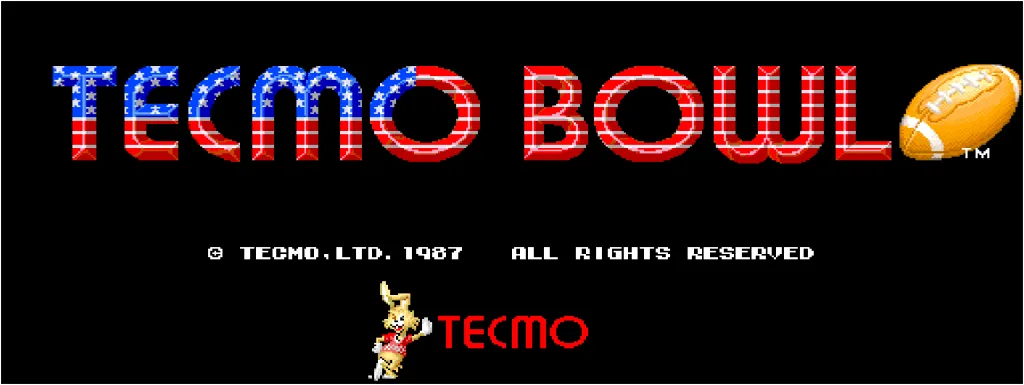
A Football Game Built on Foresight
TECMO BOWL is an American football game released by Tecmo in 1987 for arcades. The publisher's description states the four beats of the experience plainly: you play as either the Wildcats or the Bulldogs, you predict your opponent's moves and steal the ball, and you use passes and runs to cut through the opposing line to score a touchdown. Those elements are not separate modes bolted together; they describe one contest in which the attack and the steal are both acts of reading the other side.
What gives that brief its character is the role of prediction in possession. The description does not present the ball as something won by force alone; it links the steal directly to predicting what the opponent will do. Attacking is equally a problem of choice, since the publisher lists both passing and running as ways through the line. A defender facing two live methods cannot commit entirely to stopping one without leaving the other open, and that ambiguity is the documented engine of the match.
Choosing Your Team: Wildcats or Bulldogs
The first decision in a match is the side you take. The publisher's description frames every match as being experienced as a player of either the Wildcats or the Bulldogs, so the choice frames who you control before a play begins. The documented material goes no further: it does not list team ratings, playbooks or statistical differences between the two. Read the pick as your identity on the field rather than a roster comparison, and treat any claim about one side being faster or stronger as unsupported by this source.
Because both sides play by the same described rules, the team choice sets your role in the contest rather than a separate experience. Whether you hold the ball or hunt it, the game asks the same underlying question: what is the other side about to attempt? The pass-and-run attack and the prediction-based steal belong to whichever side you selected, which is why the team screen reads as the opening of a two-way contest rather than a turning point in a script.
The Attack: Passes and Runs Through the Line
The offensive toolkit is deliberately two-sided. Passing is one way through the opposing line; running is the other. The publisher presents them together as the means of cutting through the defense and links both to scoring an amazing touchdown, so neither appears to be an afterthought or a special case. The choice this creates is the central tension of a drive: throw over the line, or carry the ball through it.
That pairing shapes how each snap is approached. A defender must account for the pass threat even as the run threat remains real, and a run defense leaves space for the pass. An attacker who leans entirely on one method simplifies the opponent's problem; keeping both options in play keeps the defensive read honest. This is analysis of the stated rules rather than a description of specific formations, routes or button inputs, which the source does not provide.
The scoring objective is singular and clear: score a touchdown. Everything in the attacking half of the game feeds that goal. The source documents no point values beyond the touchdown, no field-position or clock rules, and no multi-stage progression between matches. From this evidence, the described arcade design is the drive to score and the contest over the ball that surrounds it.
Ball Stealing as the Prediction Gamble
The other half of the contest is compressed into one instruction: predict your opponent's moves and steal the ball. The pairing is the important detail. The steal is not described as a byproduct of a tackle or as an award for good fortune; it is presented as what follows from anticipating the other side. The documented emphasis therefore falls on reading the opponent, with the takeaway as the reward.
Set beside the pass-or-run attack, the steal creates a useful symmetry. On offense you present two threats and make the opponent choose; on defense you are the one choosing, trying to anticipate the method before it beats you. Both roles turn on the same gamble. The source does not explain how a steal is initiated, how often it can happen, or how correct anticipation is registered, so the mechanic is best understood by its purpose — turning a read into possession — rather than by a step-by-step procedure.
There is a small irony in the design: the offensive decision that keeps the defender guessing is also what exposes the attacker to a wrong commitment. A pass thrown into a defense that anticipated it, or a run into a line braced for it, is the counterweight to the same unpredictability that makes the attack work. The rulebook described by the publisher is a contest of guesses, and the steal is where that contest pays off.
Starting Guidance Drawn From the Rules
The plainest advice follows directly from the publisher's instruction: make prediction a part of how you play, not an afterthought. On defense, the steal depends on anticipating the opponent, so the mechanic favors a player who treats the pass-and-run choice as the thing to read rather than merely reacting to whatever happens. On offense, keep crossing the opponent's plan by using both passes and runs; the stated reward for cutting through the line with either method is the touchdown.
Beyond that, the rules imply patience with the drive: the touchdown comes from cutting through the line, so treat scoring as the result of working the ball past the defense rather than of any single documented action. Because the publisher specifies no controls, difficulty levels for the original, or match structure beyond the contest itself, more concrete starting tips would be invention. The honest beginner's summary is to pick a side, read the opponent's tendencies, and keep both passes and runs in play.
Why the Two-Threat Design Still Reads Clearly
For a 1987 arcade football game, the economy of the concept is its design strength. The publisher needs only four ideas — two teams, prediction, the steal, and the pass-or-run attack — to describe the whole experience. That brevity is not a lack of detail in the description; it reflects a game whose tension is meant to be grasped quickly by a player stepping up to the cabinet. The same ambiguity that makes the passing and running choice meaningful makes the prediction steal the natural defensive answer.
The 1987 Arcade Original and the Arcade Archives Line
Tecmo Bowl is recorded as a 1987 release, published by Tecmo, on the Arcade platform. That is the game described by the pass, run and steal rules above. It is worth separating the original from what came later: the publisher's modern notes refer to the Arcade Archives series, which reproduces classic arcade titles while adding its own presentation and competition features. Those additions belong to the reissue, not to the 1987 arcade release.
As described generically for the Arcade Archives line, players can customize game settings — adjusting difficulty, for example — and, depending on the title, recreate the nostalgic look of CRT televisions. The same passage states that players can compete for high scores with others around the world through online rankings. The source confirms the Arcade Archives name and describes those conveniences for the line generally rather than certifying each option for this specific title; treat the difficulty and CRT features as series-level possibilities until confirmed.
The distinction matters for how you approach the game. The 1987 arcade experience is the two-team, prediction-driven contest documented in the original description. The Arcade Archives line is a way to revisit that era of arcade titles with modern conveniences and a high-score board layered on top. Nothing in the source says the core rules changed between them, so the passing, running and steal mechanics described here remain the place to start.
Scroll sideways to see the full table →
| Fact | Detail |
|---|---|
| Title | TECMO BOWL |
| Genre | American football |
| Publisher | TECMO |
| Release year | 1987 |
| Recorded platform | Arcade |
| Playable teams | WILDCATS or BULLDOGS |
| Documented mechanics | Passing, running, ball stealing via predicting the opponent |
| Stated scoring goal | Score a touchdown |
| Modern reissue line | Arcade Archives, with online rankings (series-level description) |
Sources & further reading.
- TECMO BOWL — licensed publisher game documentation Retrieved Oct 19, 2026
First published .