 THE GAME ARCHIVE

Puzzle Dimension, released in 2010 by Doctor Entertainment AB, is a casual puzzle game built around a single tactile idea: a ball, a field of blocks, and the ability to make the world itself rotate beneath you. The main goal is to complete all 100 puzzles to finish the game, and each one asks you to collect the flowers and proceed through the portal. It is a compact, readable design, but the manual documents enough layered mechanics — slippery ice, timed fire, switchable spikes, and a scoring system tied to stripping the level down to nothing — that the puzzles become exercises in route planning as much as reflexes.
Rolling, Jumping, and Rotating the World
Movement is deliberately simple to teach. You roll the ball in four directions, with left and right rolling the ball sideways as a strafe. Rolling over an edge drops the ball to the block below if one exists, so ledges function as vertical transitions rather than dead ends. Jumping is used to clear gaps and traps. On the keyboard, the arrow keys roll the ball, the space bar jumps, A and D (or shift plus left/right) rotate the camera, W and S tilt it, C toggles camera mode, and Enter accepts. The manual also documents a gamepad scheme — left analog stick or digital pad rolls, A jumps, the right analog stick rotates the camera, and the triggers tilt it — and a keyboard-plus-mouse scheme in which roll is assigned to the scrollwheel and jump to the left mouse button.
The camera is not cosmetic. Turning and tilting it lets you view the puzzle from new angles, and the defining interaction is documented plainly: roll onto sloping surfaces to rotate the puzzle. That means the layout around the ball can be reoriented by the act of driving onto a particular tile, so repositioning the ball is a way of reconfiguring the board, not merely moving a token across it. With a mouse, holding the right button and dragging left or right rotates the view, the scrollwheel zooms in and out in camera mode, and pressing the scrollwheel toggles camera mode.
In practice, this makes each puzzle a three-part problem: choose which flowers to collect in what order, judge which sloped surfaces are worth driving over to expose a new gravity-relative path, and time jumps across the gaps and traps that interrupt the route. Rolling off an edge drops the ball to the block below when one exists, which turns vertical layout into part of the planning rather than a fall to avoid.
Flowers, the Portal, and the 100-Puzzle Climb
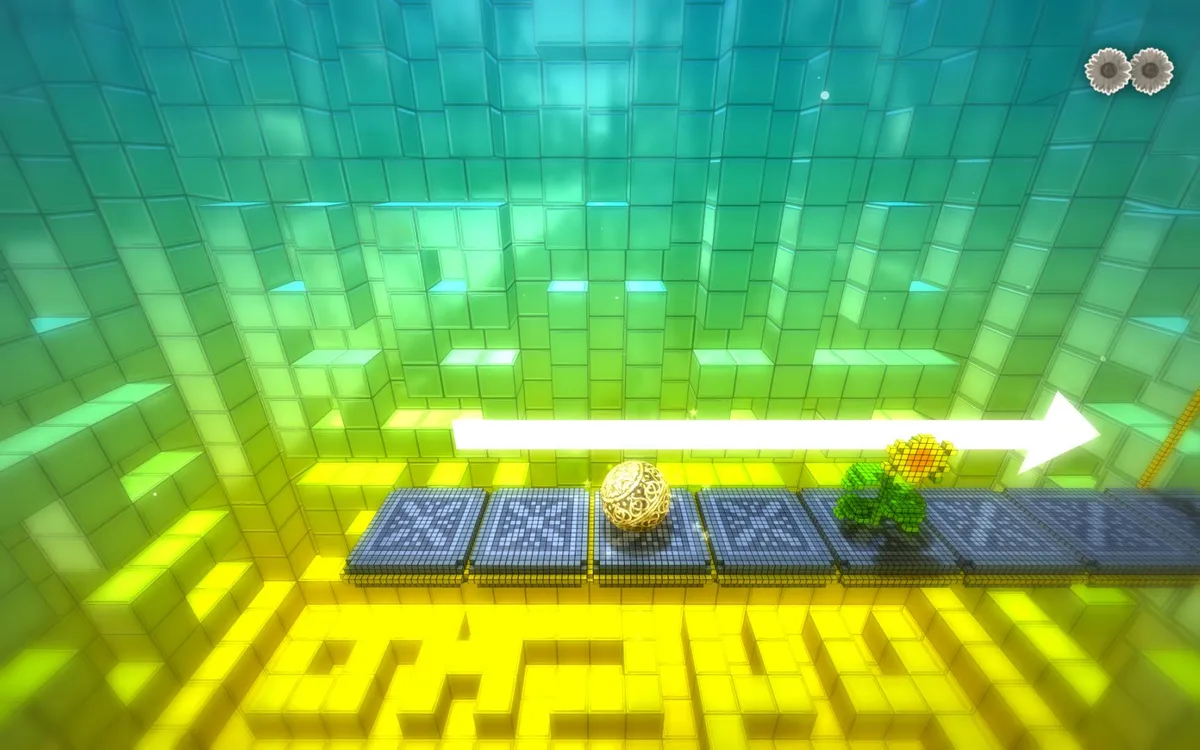
Each puzzle contains a set of flowers, and you must collect all of them to open up the portal. A dormant portal changes once every flower has been gathered: it activates and emits a blue light to signal that the exit is ready. Interestingly, you do not have to roll into the portal. You can also jump or fall through it. That small freedom matters in a game about verticality and rotation, because it means the final approach can end in midair rather than requiring a clean, flat runway. Entering the portal completes the puzzle and returns you to the puzzle selection menu.
The larger arc is completing all of the 100 puzzles, which finishes the game. Flowers pull double duty. Beyond lighting that puzzle's portal, the total number of flowers you collect unlocks more clusters of puzzles as well as alternative graphical themes to play the game with. The manual notes there are also leaderboards for players with high scores in each cluster and one for total score, along with 25 achievements to collect. A clean flower run therefore pays off twice: it clears the current portal and steadily broadens the pool of clusters and looks on offer.
Ice, Fire, Spikes, and the Blocks That Change the Rules
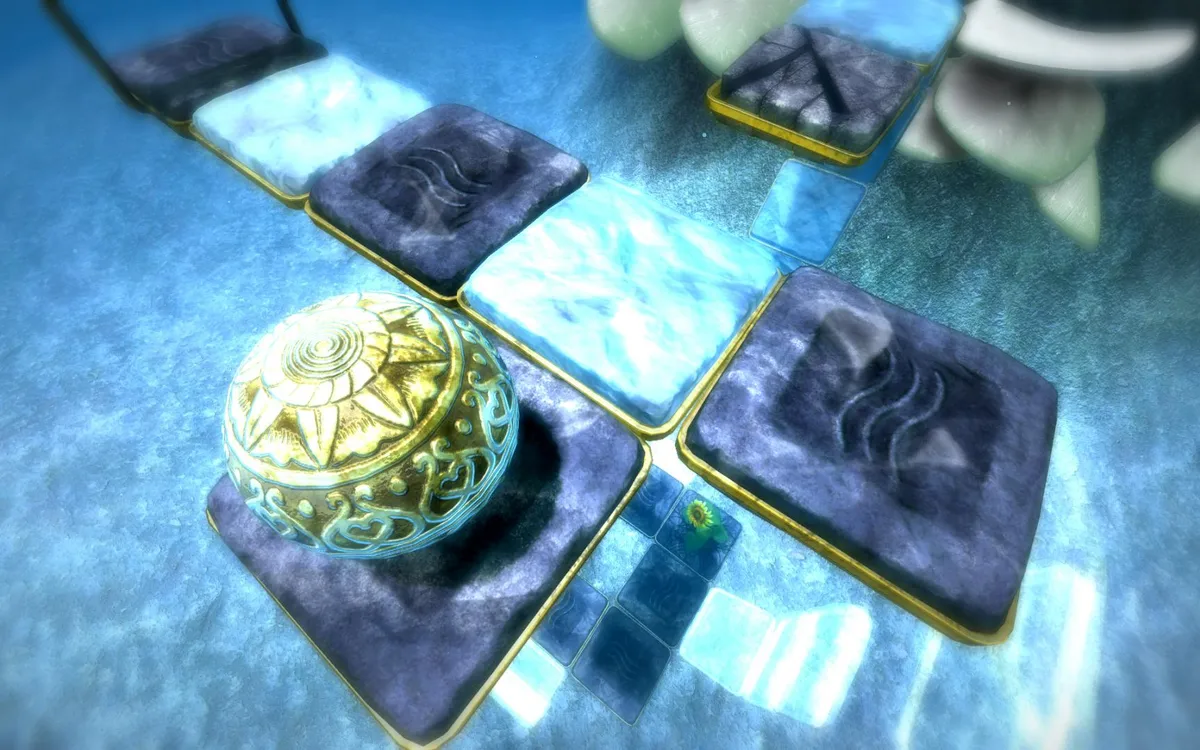
The special blocks are where the puzzle language gets expressive. An ice block is slippery: once you are on it, it will not let you change direction or stop. You can still jump in the direction you are rolling, and you can rotate the camera view while sliding, so ice is a commitment the player can see coming but cannot steer out of. Falling onto an ice block also carries momentum — the ball slides in the same direction it had when it rolled off the edge. A fire block looks peaceful until you touch its upper face; leaving the block produces hot flames the ball cannot handle, and the fire starts as soon as you leave, though it is always safe to roll on the other side.
Spike blocks protrude razor-sharp spikes on one side while active; touching them destroys the ball. Toggling a button somewhere retracts them. Toggle blocks react to the same buttons: pressing a button instantly toggles the blocks on and off, solid in the on state and absent entirely when off. The synchronization rule is important. The state of a button affects all other buttons in the entire puzzle, because they are always in sync, and toggling a button affects all spike blocks and all toggle blocks. You can also stand on a button and jump up and down to toggle it, which turns a single tile into a repeated switch you can operate mid-route.
These rules combine into planning decisions the manual's language directly supports. A route across ice removes the option to branch, and a route past spikes depends on a state shared across the whole puzzle. Because a button's state is global, toggling it to let the ball through one spot can simultaneously retract or extend spikes and add or erase toggle blocks elsewhere. The jump remains available even while sliding on ice, so the leap is a tool the player keeps in hand when committed to a slippery tile.
Unpixeling Everything for Score and Multiplier
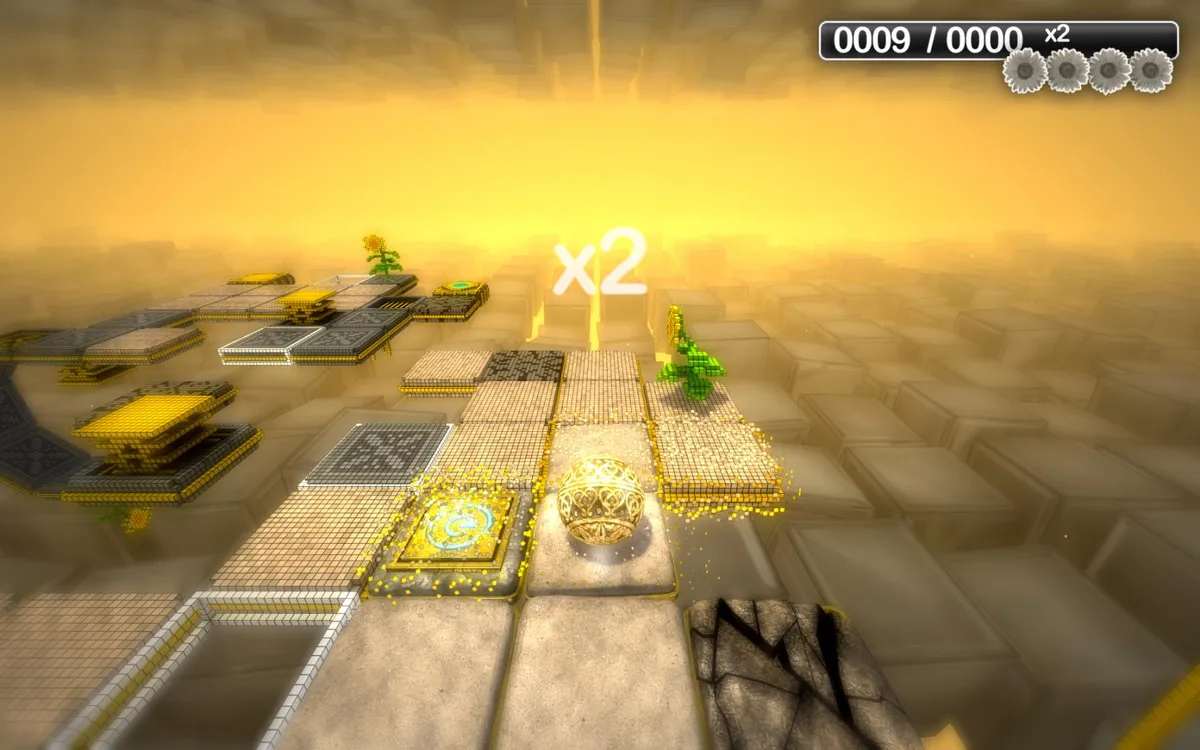
High scores rest on two documented pillars: unpixel every block and get a high multiplier. An unpixeled block is worth one point. Destroying broken blocks, collecting flowers, and exiting through the portal are also rewarded, and if all objects are unpixeled the player is awarded 10 additional points. All of these points are multiplied by the current multiplier and added to your score; the left score is your current total and the right is your previous best. The completion bonus is a fixed 10 points, while the multiplier scales everything you have accumulated, so the highest scores come from stripping every available object before exiting.
The multiplier bar sits in the upper right corner and fills by a small amount for each unpixeled object, counting blocks, flowers, and portals alike. When all objects have been unpixeled, the bar turns green to show the level has been cleared of pixels. That green signal reappears in the puzzle selector as a green dot in a white circle, indicating the puzzle was completely unpixeled; a puzzle finished without being unpixeled shows a white dot instead. The selector therefore records two distinct kinds of completion — finishing, and finishing cleanly — so a solved level still displays whether any pixels were left behind.
Unlocking Clusters and Themes
Progression beyond a single puzzle is tied to flowers. From the beginning there is only one cluster available; as you collect more flowers the other clusters get unlocked and become available. Once you have unlocked one or more clusters you can play them at any time, because you do not have to complete them in order. The same collection total opens up alternative graphical themes, and the manual notes that the locked graphical themes open up as you get further into the game. Selecting a theme loads the cluster menu. Because clusters need not be finished in sequence, a player can move between the unlocked sets freely.
The presentation reinforces that sense of progression. The retro look explodes in a fountain of pixels to reveal HD visuals, and the music reacts to your progress by blending between crystal-clear audio and 8-bit retro-style chip tunes; your movement and progression affect the graphics and music as you play. These adaptive audiovisuals sit alongside the 100 twisted puzzles, whose documented elements include blocks of ice and fire, teleporters, buttons, and spikes, with online leaderboards and achievements available for competition.
A Source-Backed Starting Approach
The manual's rules support a few practical habits. First, treat the sloping surfaces as tools: if a flower or portal is out of reach, rolling onto a slope is the documented way to rotate the puzzle, changing which direction the ball is pulled. Second, before exiting, remember that unpixeled blocks, broken blocks, flowers, and the portal all score, and that everything is multiplied — so stripping objects before the portal beats a quick finish. Third, when sliding on ice, remember that jumping in the rolling direction is still available and that camera rotation during the slide is allowed, so the slide does not eliminate those options. Finally, because you can stand on a button and jump to toggle it, a single tile can operate spikes and toggle blocks anywhere in the level, so plan your switch presses around what else they will change.
Scroll sideways to see the full table →
| Detail | Documented value |
|---|---|
| Title | Puzzle Dimension |
| Release year | 2010 |
| Developer / publisher | Doctor Entertainment AB |
| Platforms | Windows, macOS |
| Genres | Casual, Indie |
| Puzzle count | 100 |
| Achievements | 25 |
| Core objective | Collect the flowers, then exit through the portal |
Sources & further reading.
- Puzzle Dimension — official game profile Retrieved Oct 19, 2026
- Puzzle Dimension — official game profile — publisher-supplied gameplay manual Retrieved Oct 19, 2026
First published .