 THE GAME ARCHIVE
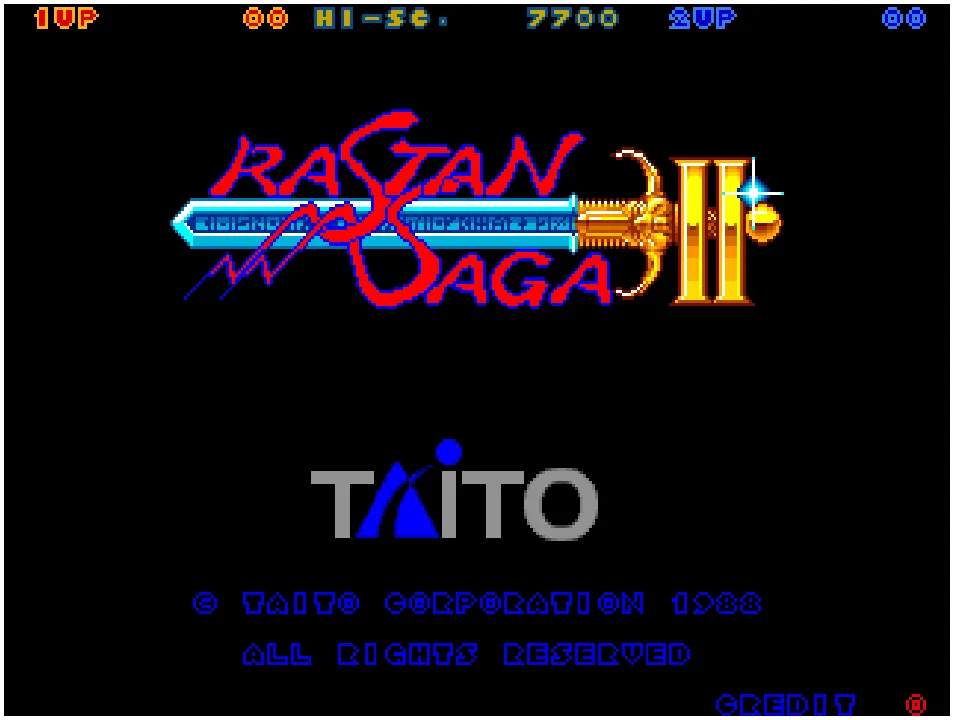
A Prequel Built on Defense and Acquisition
Rastan Saga II is an arcade action game released by TAITO in 1988, and the publisher frames it as a prequel to the original Rastan Saga. Where a sequel usually extends a story forward, this entry moves backward to explain how Rastan earned his name by saving the sacred land of Rastania. That premise gives the game its two anchors: a hero whose identity is still being established, and a homeland in need of rescue. The documented quest centers on protecting a temple called Skyscraper from a wicked cult, and the documented means of fighting that cult is obtaining various weapons and magic items during battle.
Those named elements matter because they are the whole of what the publisher documents about the play loop. Skyscraper is the fixed object the player must keep safe, the wicked cult is the named adversary, and weapons and magic items are the pickups gathered while fighting. The game's identity as an action title ties those pieces together: the player advances the rescue of Rastania by confronting the cult and by collecting equipment to use in that confrontation. What the documentation does not supply is just as important to state plainly. Controls, movement, combat inputs, enemy behavior, scoring, stage layouts, and progression gates are not described, so this profile does not manufacture them.
How Rastan Earns His Name
The prequel framing is more than a marketing label; it is the lens through which the mission reads. In the original Rastan Saga, the hero's name is already established. Here, the tale explains that the name is something he earns by saving Rastania. That gives the stated goal a personal stake: defending the land is how the protagonist becomes Rastan in the first place. The temple Skyscraper sits at the center of that effort, and the wicked cult is the force threatening it. A player approaching the game knowing only that setup can understand the objective without needing a chapter-by-chapter plot summary, because the publisher presents the rescue, the temple defense, and the earning of the name as one connected act.
The documented conflict is therefore organized around a place rather than a wandering journey. Skyscraper is not described as a staging area on the way to a final boss; it is the objective itself, the temple the player is charged with protecting. Saving the sacred land of Rastania and defending Skyscraper are presented together as the mission, which means the cult's threat to the temple is effectively a threat to the homeland. That relationship is the clearest statement of stakes the source provides, and it is what the game's premise asks the player to care about from the opening screen onward.
The Documented Play Loop: Fight, Collect, Defend
The core loop the publisher describes is a cycle of battle and acquisition. The player fights the wicked cult and, during that battle, obtains various weapons and magic items. Those pickups then serve the fight, because the entire equipment stream is described as feeding the quest to protect the temple Skyscraper. In practical terms, the player is meant to be improving their means of attack while the conflict is under way, not arming up in a safe hub before the action begins. That makes equipment an active element of play rather than a menu check performed between stages.
The distinction between the two pickup types is documented but not detailed. Weapons and magic items are named separately, which tells the reader that the game's arsenal is not a single undifferentiated pool, but the source does not explain what each category does, how items are selected or used, or whether they are temporary or persistent. Rather than invent a weapon-wheel or a spell-meter, this profile keeps to what is stated: both kinds of equipment are obtained in battle and both belong to the same quest against the cult. That framing gives the clearest actionable reading of the material: expect equipment to arrive through combat, and treat the temple defense as the throughline the equipment is meant to serve.
The action-genre label also frames how the player should think about the temple defense. An action game is driven by moment-to-moment confrontation, and the documented material places that confrontation squarely against the cult. The objective is protective, but the documented means are offensive: weapons and magic items gathered to battle the wicked cult. That gives the player a simple mental model despite the sparse source. The temple is what is being guarded, the cult is what is being fought, and the accumulating arsenal is what keeps the fight survivable and effective.
Starting Guidance for a Skyscraper Defense Run
For a player sitting down to Rastan Saga II, the publisher's own description suggests a practical priority list. Because weapons and magic items are obtained through battle, the first useful instinct is to engage the cult rather than avoid it; the fight is where the tools come from. Because the temple Skyscraper is the object to protect, the second instinct is to treat the defense of that landmark as the mission's measure of success rather than an incidental backdrop. And because the game is an action title, the player should expect the challenge to be resolved through continuous, active combat against the cult.
What this guidance cannot responsibly include is an attack pattern, a recommended opening move, or a route through specific stages, because the documentation does not contain them. The honest beginner advice is therefore structural rather than technical: understand that the quest is to save Rastania by defending Skyscraper, understand that the cult is the adversary, and expect the arsenal to grow through the fight itself. A player who organizes their expectations around those three facts will be working from the same evidence the publisher provides, without importing assumptions from the earlier Rastan game or from other arcade beat-'em-ups.
Arcade Original and the Modern Reissue Context
The catalog records Rastan Saga II as a TAITO game on the Arcade platform, published in 1988. The platform entry is critical to the record: this is an arcade title, and the description of its weapons, magic items, cult, and temple defense belongs to that original game rather than to a home conversion. The year 1988 is the catalog's listed release year, and the publisher is TAITO. Those dates and titles are the basic provenance a reader needs before talking about any later presentation of the game.
Modern licensed reissues of classic arcade titles are described by the publisher documentation as offering several conveniences around the original game. Players can customize game settings, including difficulty level, and depending on the title can recreate the look of older CRT televisions. Online rankings let players compare high scores with others around the world. Those features belong to the reissue context and are not mechanics of the original Rastan Saga II release. The documentation does not describe save, restore, suspend, or rewind functions for this title, so none of those can be attributed to it here.
Keeping the arcade original distinct from the reissue wrapper matters for how the temple-defense quest is understood. The cult, Skyscraper, and the in-battle equipment described in this feature are the original game's constants. Difficulty settings and online leaderboards are later conveniences layered around classic titles and do not change the documented objective. A reader curious about the game's action can therefore treat the premise and the equipment loop as the stable description, while treating any modern settings options as presentation and comparison tools rather than as part of Rastan Saga II's own design.
Scroll sideways to see the full table →
| Detail | Documented value |
|---|---|
| Title | Rastan Saga II |
| Publisher | TAITO |
| Release year (catalog) | 1988 |
| Platform | Arcade |
| Genre | Action |
| Premise | Prequel explaining how Rastan earned his name by saving Rastania |
| Objective | Protect the temple Skyscraper from the wicked cult |
| Mechanics | Obtain various weapons and magic items during battle |
Sources & further reading.
- Rastan Saga II — licensed publisher game documentation Retrieved Oct 19, 2026
First published .