 THE GAME ARCHIVE
The Double Agent's Dilemma: Trust, Objectives, and Access
Most missions in Double Agent force a choice between backing the priorities of the JBA or the NSA, and how you play moves your trust level with both groups up or down. The trust system is shown as two bars, one per faction, that fill or empty depending on which group you are supporting or undermining. It is not cosmetic: the trust you earn changes how other characters treat you and which equipment and upgrades you can access. The run is effectively over if either bar drops to zero, so both must stay above that line.
During a mission, the objective bar displays the next goal to reach, and completing objectives feeds into your standing with the two organizations. Because trust governs equipment and upgrade access, the objectives you pursue shape what tools become available later, while the two trust bars themselves appear in the trust meter of the in-game interface. Steering between the JBA and the NSA this way branches the story according to your choices, with mission outcomes and upgrade access both tied to the trust level you build.
Shadows and Sight: Understanding the Visibility Indicator
The visibility indicator sits on the heads-up display and reports how well-hidden Sam is by combining light exposure with the noise he is making. A solid green reading means he is in shadow and completely hidden, while solid yellow means he is lit and visible. When the indicator flashes between green and yellow, the color still reflects whether he is currently hidden or exposed, but the flashing itself signals danger because enemies are searching for him. Moving into shadow during that search keeps the green state relevant, giving you a way to break line of sight while being hunted.
Two basic moves feed directly into that indicator. Pressing the posture key crouches Sam; movement becomes slower but quieter, and he is less visible while crouched. Clicking the contextual move key puts his back to a wall, which decreases his visibility. Both actions work against the same two factors the HUD tracks, light and sound, so a crouched approach along a wall keeps the readout closer to green than walking upright through open, lit space. Swimming also relies on directional keys for movement with the mouse steering the heading.
Closer Than Close: Grabs, Interrogations, and Lethal or Non-Lethal Takedowns
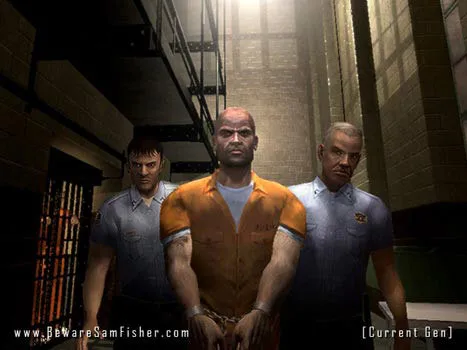
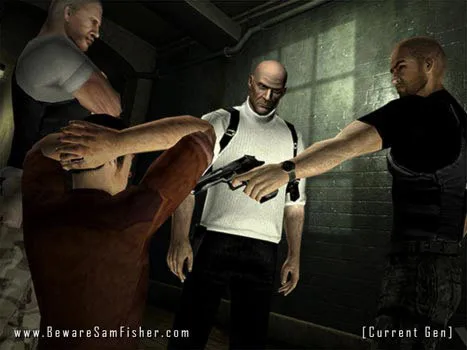
Grabbing follows the same close-range logic as the basic stealth moves. Sneak up on a non-player character undetected and press the grab command to take hold of him. Once held, the enemy can be knocked out with the secondary attack key or killed with the primary attack key, giving the same lethal and non-lethal split seen in close attack. Holding an enemy also opens other actions: press the pistol key to draw the weapon and fire at other enemies while using the captive as a human shield.
Interrogation happens while an enemy is in hand. With a non-player character held, select the interrogate interaction to make him talk and reveal mission information. A corner grab works from the back-to-wall peeking position: when a non-player character approaches from the opposite side, Sam pulls him into a submission hold. From that hold, interrogation is available if the option exists, and afterward the enemy is dispatched. Because the corner grab starts from the wall position that lowers visibility, it combines the back-to-wall stance with the close-attack takedown rules.
Above and Below: Split Jumps, Rappelling, and Underwater Kill Moves
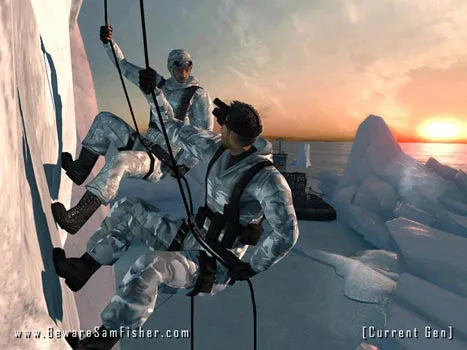
The split jump places Sam in a high corridor that is not too wide, where facing the wall and pressing the jump key sends him up into a braced position. From there, the drop action lets him descend, and dropping onto an enemy below knocks that enemy out. While in the split jump, Sam can also equip and fire his selected weapon. Rappelling begins at a hook point shown in the interaction menu; after selecting the rappel interaction, Sam moves up and down the rope, and the jump key kicks him off the wall. He can equip a firearm or directional microphone while on the rope, and hanging from a pipe lets him fire his pistol forward with legs down or backward when upside down.
The inverted neck snap works from a horizontal pipe or from a rope while suspended with legs up. To attack an enemy from that position, the primary and secondary attack keys supply the lethal and non-lethal outcomes. Swimming uses a separate control set: directional keys move Sam underwater, the mouse steers, the jump key ascends and exits the water, and the descend key goes lower. Pressing the speed key gives an extra burst of speed. These moves extend the same close-range logic into vertical and submerged spaces, where position and the correct key determine whether Sam knocks out or kills.
Cracking the Puzzle: Hacking, Lock Picking, and Email Decryption
Hacking an object opens a dedicated interface of four number columns, with a valid four-number code line at the bottom and a timer at the top. Each column supplies one element of the four-part code, and progress comes from validating frozen numbers as they appear. Two warning lights at the top count the attempts remaining before the attempt fails, and if the hack fails or the timer runs out, an alarm is triggered. The puzzle is therefore a race to lock in all four elements while the attempt budget holds out.
Lock picking trades speed for quiet: pressing two adjacent directional keys until a pin begins to move places the keys in the correct quadrant, and keeping them there releases that pin, repeating until all pins are out. This is silent and cannot be detected, whereas breaking a lock is the hurried alternative. Email decryption presents a virtual cube of 24 tiles, where a blue tile marks a correct value and a red tile an incorrect one; the primary attack key rotates the cube on the horizontal axis and the secondary attack key on the vertical axis, so rotation exposes new tiles for comparison until the sender's code is deciphered.
Field Tools and Modes: Gadgets, Difficulty, and Multiplayer
Sam's goggles anchor the field kit with three switchable vision modes. Pressing the first number key activates night vision, the second switches to heat vision, and the third engages wave vision, a mode that lets him quickly spot all electricity-using objects. The manual describes the goggles as a dual-purpose night-and-heat tool built for covert infiltration. To reach any weapon or gadget, hold the inventory key, use the mouse or directional keys to highlight the desired piece of equipment, then release the key to equip it. The Sticky Shocker and Sticky Camera are named among the available tools.
The startup screen offers two modes plus credits: single-player, listed as Solo mode, and Multiplayer. From the single-player menu you can load a saved game from the selected profile, start a new game after choosing or creating a profile, or enter a training option that reviews field competence. A new game lets you set difficulty to Easy, Normal, or Hard. Multiplayer sets two opposing teams of up to three players each, Spies against Upsilon Mercenaries, and covers Versus and Co-op Challenges modes; the online features are no longer functional.
Sources & further reading.
- Tom Clancy's Splinter Cell Double Agent® — official game profile Retrieved Oct 19, 2026
- Tom Clancy's Splinter Cell Double Agent® — official game profile — publisher-supplied gameplay manual Retrieved Oct 19, 2026
First published .