 THE GAME ARCHIVE
A Global Outbreak Told Through Four Campaigns
Resident Evil 6 takes the C-virus outbreak across North America, Eastern Europe and China, and tells that global story through four distinct yet intertwined campaigns. The structure is the organizing idea: you are not following one plot thread to its end before starting another, but moving between casts and locations whose paths cross. The documented objective is to complete the four story threads, and the game presents each with its own pair of protagonists. Leon S. Kennedy, Chris Redfield and Ada Wong return, joined by new characters such as Jake Muller, but the campaign set — not a single fixed protagonist — is what carries the story forward. Because the action spans multiple locations rather than a single confined setting, the campaign tour functions as a survey of the outbreak's reach.
The core play loop stays tied to those paired protagonists. Resident Evil 6 supports single-player and two-player co-op, offline or online, with Ada Wong's campaign documented as one-player only. That exception matters for how the game is approached: most of the campaign set can be played alone with an AI partner or with a second player, but one thread cannot be shared. The paired structure is therefore the baseline, and the game's more unusual multiplayer features sit on top of it rather than replacing it.
Crossover: When Two Pairs Become a Four-Player Fight
The Crossover mechanic is the campaign's most distinctive multiplayer rule. At significant points when the narrative draws pairs of characters together, up to four players can join together online to tackle that specific situation. The rule is situational rather than a general four-player campaign: the normal setup is solo or two-player co-op, and Crossover expands the group for the moment when two stories meet. In practical terms, a player working through one campaign can find the scene joined by players from the intersecting thread, turning a two-person encounter into a four-way one for that segment. The narrative overlap and the multiplayer overlap are the same event.
The same crossover structure also swaps the usual partnerships on some stages, which the source describes as increasing the depth of gameplay. That detail changes how the player reads the roster: the familiar pairing is not guaranteed for every stage, and a segment can place a character beside a different partner. For a co-op player, the pairing can shift at these documented points. Crossover is therefore best understood as a set of authored junctions in the campaign where the normal rules widen — more players, or different partners — before the game returns to its standard structure.
The Evolved Control System: Moving, Sliding and Taking Cover
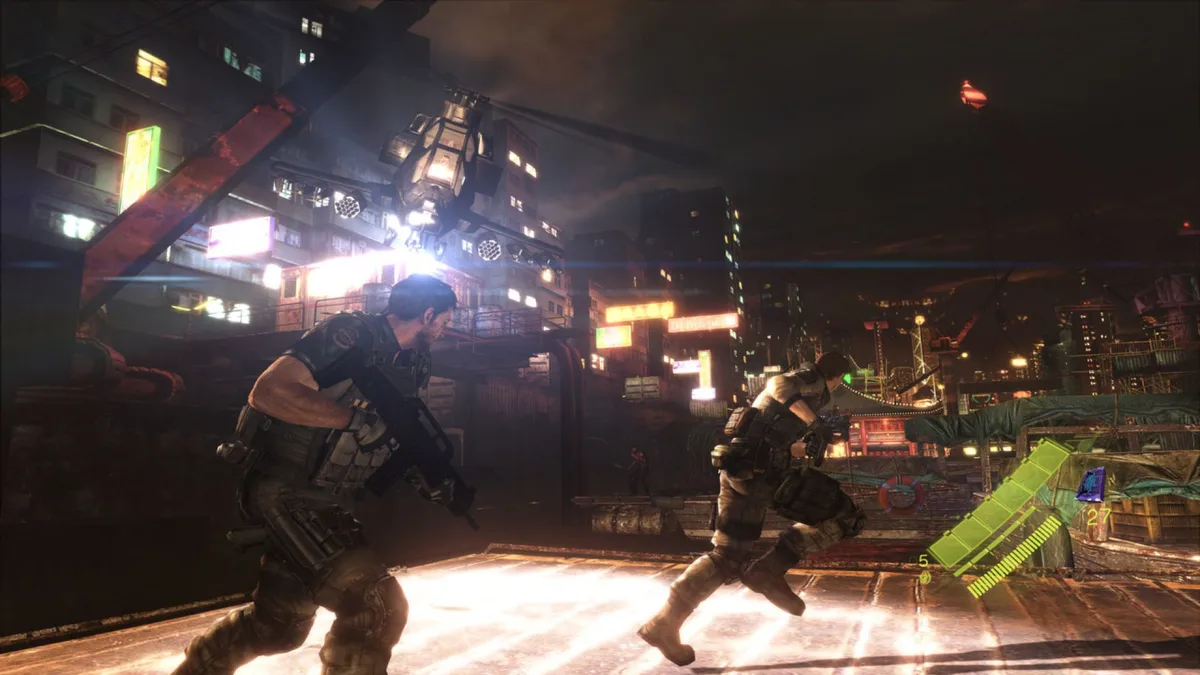
Resident Evil 6's redesigned control system is documented as an evolved control system that allows players to shoot while moving, slide, roll in any direction, and take cover, along with an enhanced melee attack. These are not separate modes but a connected set of movement and combat options. Shooting while moving means the player can keep the offensive going while repositioning; sliding and rolling in any direction provide the quick lateral or forward movement; cover gives a defensive position; and the enhanced melee attack adds a close-range option. The important design consequence is that evasion does not force the player to stop attacking, and attacking does not force the player to stand still.
Those options frame the encounter decisions the game asks of the player. A player who wants to hold ground can use cover; a player who wants to keep pressure can shoot while moving; a player who needs to break away can roll or slide in any direction. The enhanced melee attack sits within the same scheme as a close-range answer when firearms alone are not the right tool. The documented control set therefore ties the game's combat identity to mobility and choice of posture — moving, covering, or closing to melee — rather than to one fixed stance. Weapon variety is also part of the documented feature set, and skill points can improve firepower and reload speed, which changes how often the player can sustain that moving fight.
Character Skills: Spending Points on Reload, Firepower or Health
Progression runs through skill points and the Character Skill system. Points are spent to upgrade a character with faster reload speed, improved firepower, or an increased health bar. Each option answers a different pressure in play: reload speed affects how quickly a weapon is ready again, firepower affects the damage a weapon does, and the health bar affects how much damage the character can take. Because a player earns and spends points rather than receiving every upgrade automatically, the system presents a choice about which pressure to relieve first. The documented upgrade list is also the limit of what can be said: the evidence supports those three upgrade categories and no others.
That choice connects directly to the control set. Better reload and firepower feed a player who wants to keep shooting while moving, while a larger health bar supports a player willing to take more contact damage. None of the three upgrades is documented as a prerequisite for another, so the evidence supports treating them as separate investments rather than a fixed sequence. What the system adds to the campaign is a way to tune the same character toward different strengths over time, and the points become more valuable as the play style becomes clearer.
Agent Hunt: Playing the Enemy in Someone Else's Session
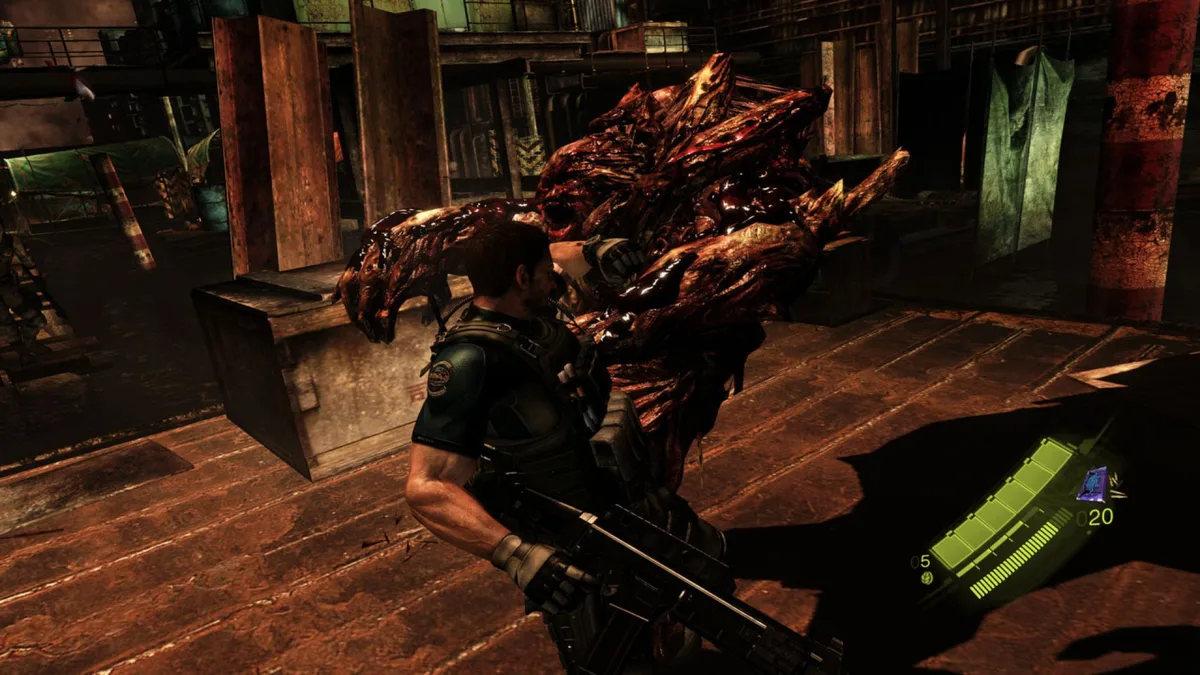
Agent Hunt Mode is the game's most direct inversion of the campaign. In this all-new online mode for the series, the player experiences the action from the other side: as a hunter, the player joins the enemy side, becomes one of the game's zombies, J'avo or other C-virus mutations, and infiltrates another active game session to eliminate the human characters. The role change is not cosmetic. In the campaign, the C-virus threat set — zombies, J'avo, Chrysalids and more — is what the player confronts; in Agent Hunt, one of those creatures becomes the player's means of interacting with someone else's campaign session.
Agent Hunt sits alongside the campaign's documented solo and two-player co-op structure. It is an online mode, and its purpose is to enter another active game session; the campaign proper remains the paired or solo experience, with Ada Wong's campaign restricted to one player. The documented modes therefore divide cleanly: the campaign is where the four interwoven stories are completed, and Agent Hunt is where a player steps into an ongoing session on the enemy side. That division is useful when deciding what to play with whom, since Agent Hunt's role is not a campaign variant but a separate online activity.
Mercenaries, No Mercy and the Left 4 Dead 2 Crossover Patch
Beyond the campaign, Mercenaries Mode returns. The PC version adds The Mercenaries No Mercy, an additional mode available only on PC and packed with twice as many enemies as The Mercenaries. The doubled enemy count is the defining documented difference: No Mercy takes the Mercenaries premise and increases the pressure by raising the number of enemies the player faces. For players choosing between the two, that is the documented trade: the standard Mercenaries mode, or the PC-only variant with twice the enemies.
The Left 4 Dead 2 Crossover Patch adds a second layer to No Mercy. It lets players blast through The Mercenaries No Mercy as their favorite Left 4 Dead 2 characters, with the Infected appearing as enemies as well. The patch was scheduled to be released for free through the April 5, 2013 title update. The mode and the patch therefore combine: the doubled enemy presence and the crossover characters are documented together in the same No Mercy experience, changing both the enemy mix and the playable roster for that mode.
Seven Extra Stages: PC Standard, Achievement-Unlocked
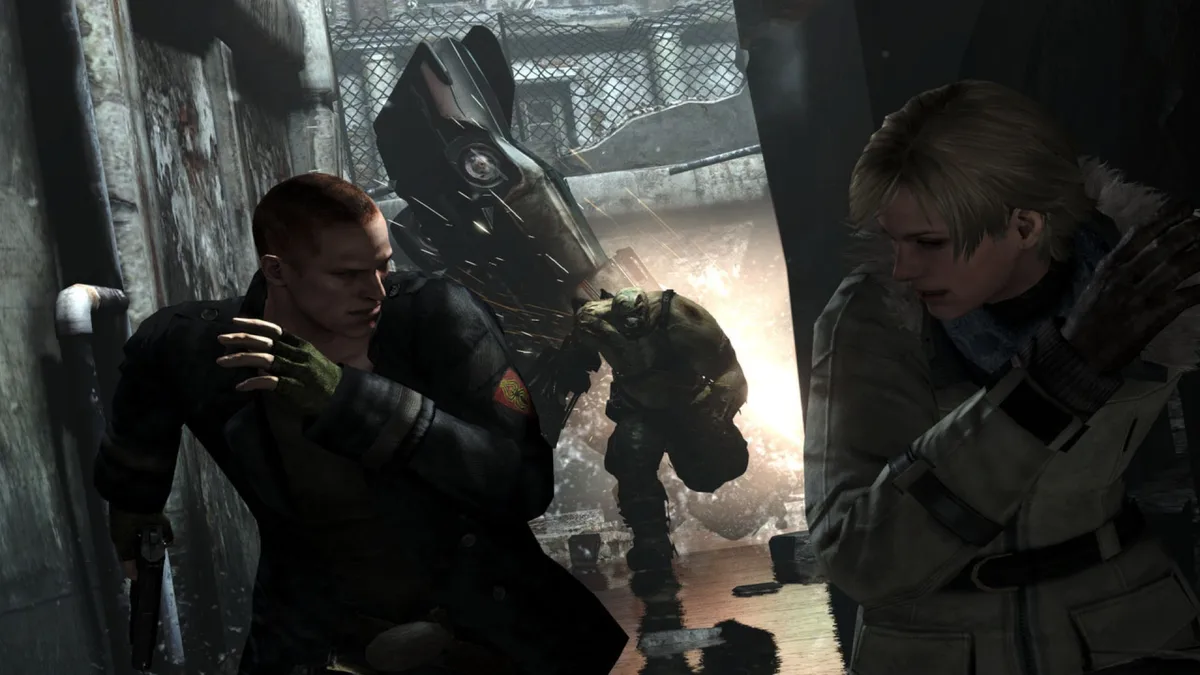
The PC version also documents seven additional stages for the extra content modes. On consoles these were previously available for purchase as DLC; on PC they come as standard, but they are unlocked via achievements rather than open from the start. That makes achievement progress the documented gate for those stages. The seven stages belong to the extra content modes rather than to the four story campaigns, so they extend the game's side content while the campaign structure remains the route to the main story. The PC version is further documented as compatible with all of the latest features added to the console versions; that compatibility statement describes feature parity and does not change the achievement-based unlock rule.
The practical consequence is that the extra content modes pull from both progression systems at once. The seven stages are earned through achievements, while the modes themselves include the returning Mercenaries Mode and the PC-only The Mercenaries No Mercy with its doubled enemy count. A player interested in the side content therefore has two different things to work toward: achievement completion for the stages, and familiarity with the Mercenaries variants for the mode itself. Neither replaces the campaign; the four interwoven stories remain the backbone, and the extra modes are where those additional stages and the enemy-dense No Mercy variant live.
How the Systems Fit Together
The documented systems serve different layers of the game, and knowing which layer does what is the best starting guidance the evidence supports. The four campaigns are the story spine, completed across their distinct threads. Crossover is the authored point where those threads meet and the online group can widen to four players, and some of those stages also swap partners. The control system governs moment-to-moment fights through moving fire, slides, rolls, cover and enhanced melee. Character Skills turn skill points into faster reload, more firepower or a larger health bar. Agent Hunt is the separate online mode for playing a zombie, J'avo or other C-virus mutation inside another active session. Mercenaries Mode and No Mercy, including the Left 4 Dead 2 patch content, sit in the extra modes alongside the seven achievement-unlocked stages.
For a player planning a session, the evidence suggests separating those layers rather than treating them as one progression. Co-op availability differs by campaign: two-player co-op is documented for the campaign set, offline or online, but Ada Wong's campaign is one-player only. Crossover is an online arrangement at specific narrative points, not a permanent four-player campaign rule. Agent Hunt depends on entering another active session, so it is a different kind of commitment from continuing a campaign. And the PC-specific extras, No Mercy and the seven stages, are the documented reasons the PC version differs from the console versions in mode availability and unlock method.
Scroll sideways to see the full table →
| Feature | Documented rule |
|---|---|
| Campaigns | Four distinct yet intertwined story threads across North America, Eastern Europe and China |
| Solo / co-op | Single-player and two-player co-op, offline or online; Ada Wong's campaign is one-player only |
| Crossover | At significant narrative points, up to four players can join online; some stages swap partners |
| Control system | Shoot while moving, slide, roll in any direction, take cover, enhanced melee attack |
| Character Skills | Skill points upgrade faster reload speed, improved firepower, or increased health bar |
| Agent Hunt | Online mode: play a zombie, J'avo or other C-virus mutation and infiltrate another active session |
| Mercenaries | Mercenaries Mode returns; PC-only The Mercenaries No Mercy has twice as many enemies |
| PC extras | Seven additional stages for extra content modes, standard on PC and unlocked via achievements |
Sources & further reading.
- Resident Evil 6 — official game profileRetrieved Oct 28, 2026
First published .