 THE GAME ARCHIVE
What Sniper Elite Asks of the Player
Sniper Elite is a Windows action game released in 2009, developed and published by Rebellion, and its gameplay is organized around a single proposition: a rifle shot is a calculation, not a reflex. The publisher describes an authentic World War II sniper simulation with realistic weapons, bullet ballistics and sniping skills, carried by a single-player campaign of 28 missions and 8-player LAN sniper battles. Read through the publisher-supplied manual, that pitch resolves into concrete systems the player manages at once — body position, breathing, wind, gravity, concealment and the risk of being located after firing. The sections below explain how those rules fit together in play.
Premise: A Lone OSS Sniper in Falling Berlin
The single-player side is built around a Berlin campaign that runs to 28 missions. The setting places a lone American OSS sniper in disguise as a German, working deep behind enemy lines as the Second World War closes and the first covert clashes of the Cold War begin. Within that frame the player's job is to stop Stalin's forces from gaining control of Germany's nuclear secrets — an objective that suits the sniper toolkit, because it rewards patience and a clean first shot over sustained fire.
On Foot: Movement, Posture, and Hiding Against Walls
On foot, movement uses the W key to advance, S to back up, A to strafe left, and D to strafe right. The mouse wheel adjusts movement speed, while holding Left Shift makes the character walk. Posture changes between stand, crouch, and prone by pressing the mouse wheel or the Z key, with a held Z going prone. These inputs define how the player traverses environments and sets the body position used before aiming or firing.
Visibility interacts with movement through wall hugging. To wall hug, the player pushes against walls while moving, which reduces visibility and the body target area to enemies distant enough from that position. This ties the movement keys to stealth: holding a direction toward a wall activates the reduced profile, and the effect depends on how far away an enemy is, so pressing into cover changes how exposed the character appears. The likely practical use is to hug a corner or façade while scanning, then break contact with the wall when a shot is needed — the same key presses that move you are the ones that hide you.
Scope Work: Wind, Gravity, Zoom, and the Empty Lung Shot
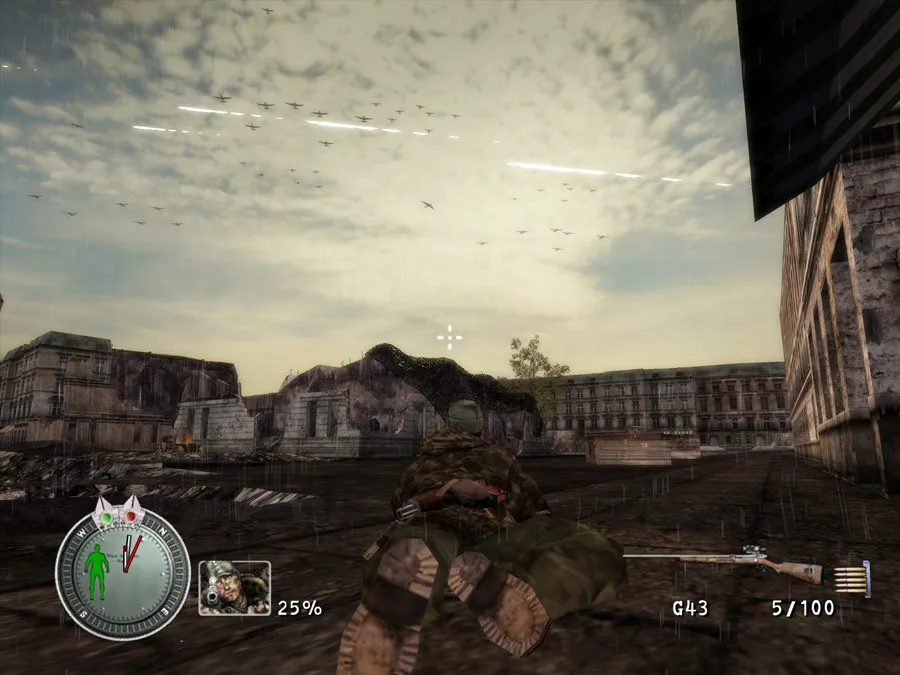
Scope work begins with the sniping view, toggled against the third-person view with the space bar or the right mouse button. Inside the scope, the mouse wheel zooms in and out, while in third person the bracket keys adjust camera distance behind the player and holding M changes that distance. Wind correction is read from an indicator above the scope, which displays how many notches opposite the wind direction the shot must be aimed; when the indicator shows the wind blowing two notches to the right, the correct hold is two notches to the left. Gravity is also modelled, so distant targets require aiming above them to allow for bullet drop. The manual treats the horizontal scope lines as notches for this holdover, and notes that the number of notches needed varies with how far the scope is zoomed — which makes zoom a firing decision as much as a viewing one.
The empty lung technique follows a breathing cycle: the sniper exhales, holds, and fires during the natural respiratory pause, with the lungs about two-thirds empty. The body is relaxed at that point, and six to eight seconds pass before muscle shake from lack of oxygen begins. A heartbeat monitor governs access to the shot, since the empty lung mode is available when the trace reads black. In the control scheme the mode is engaged with F while in the sniping view. Wind direction, gravity, posture and heart rate are all taken into account while sniping, and these simulation features can be switched off through the difficulty selection.
Staying Unseen: Camouflage, Sound Masking, and Relocation
Staying unseen leans on the terrain itself. Ruined buildings, piles of rubble, and wrecked vehicles serve as places of concealment, and the camouflage of the uniform adds to that reduced visibility when the sniper uses this environmental cover. Choosing a firing position is not only about the cover it offers; the spot must also be weighed for a safe route of withdrawal away from it. The manual notes that a position should be considered for both its protective value and the escape path it leaves open, so cover and exit are judged together before the first shot is taken.
Two rules govern what happens after firing. Once a few shots have come from one spot, the sniper should move unseen to another location before the enemy can work out where the shots originated. Separately, very loud environmental sounds such as artillery shells air bursting can mask the sound of gunfire, letting the sniper pick off enemies standing close to each other without raising the alarm. The two interact: masking the report buys time, while relocating after several shots denies the enemy a fixed position to investigate. Ammunition is not the only concern — the third documented firing rule is penetration. Sniper rifle bullets will often pass through two or three bodies, smaller trees and rusted cars, so a single round can kill two or even three enemies lined up behind one another. That rewards choosing a line of fire through clustered targets rather than the nearest one.
The Arsenal: G43 Rifle and Grenade Types
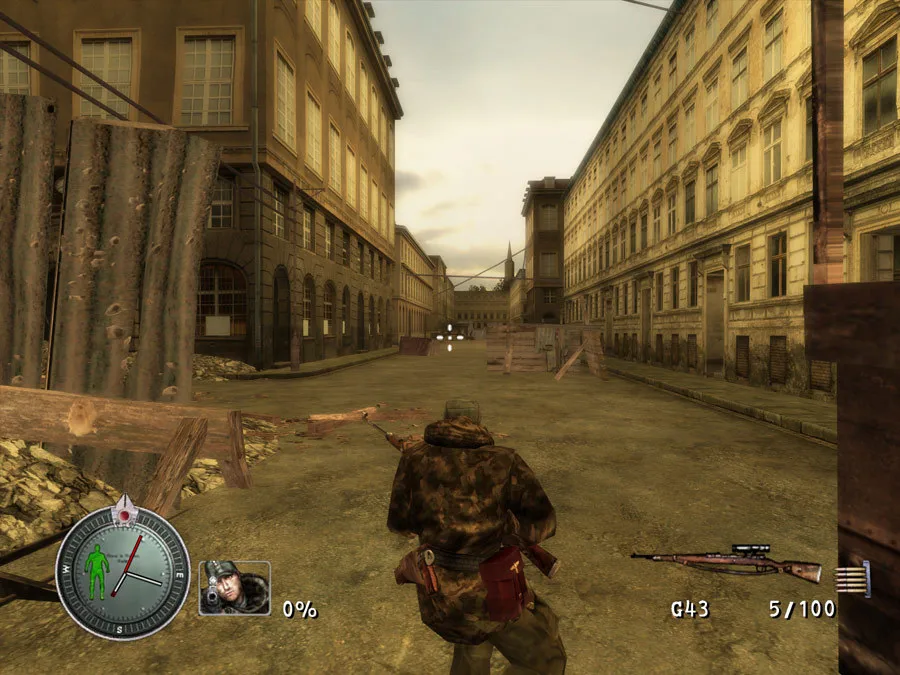
The weapon the manual illustrates in its HUD example is the G43 sniper rifle, which holds a five-round clip and carries 150 rounds in total. The weapon panel shows the current gun alongside its ammunition, separating the rounds left in the clip from the total carried, so a player can read at a glance when the next reload is due and how much reserve remains. Because the clip is small, each five-shot cycle is a visible unit of consumption, and the 150-round total defines the supply spread across an engagement rather than a single firefight.
Three grenade types round out the arsenal. The fragmentation grenade is built as an anti-personnel device, with an explosive charge inside a metal body designed to break into fragments. The stick grenade, issued in high-explosive and fragmentation versions, carries a larger charge than the fragmentation grenades given to US forces. The tripwire grenade is a cylindrical cast-iron stake mine whose body is scored but not pre-fragmented, producing fragments of uneven size and dispersal. Each type therefore differs in charge and fragment behavior rather than in delivery alone.
Modes and Missions: Campaign and LAN Battles
Beyond the 28-mission campaign, multiplayer extends the same sniping rules into eight-player LAN battles with three documented modes. Deathmatch awards points for killing other players or collecting the dogtags of dead players. In Team Deathmatch, players are split into teams, score by killing an opponent or picking up a dogtag from the other team, and lose points for killing a teammate; the team score is the sum of its players, and the game ends when a team reaches the score limit. Assassination automatically divides players into Russian and German teams. The dogtag rule matters in play: a kill is worth points, but recovering the tag creates a second, riskier trip to the body, which puts a sniper back into the open.
Difficulty and Scoring: From Rookie to Sniper Elite
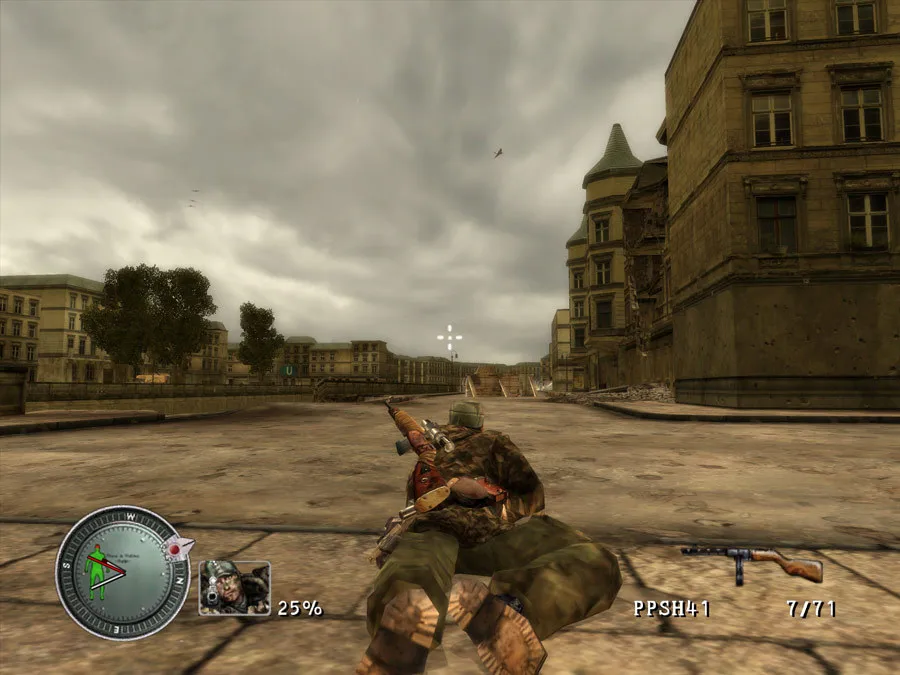
Before a game starts, the difficulty selection menu offers four preset modes: Rookie, Cadet, Marksman, and Sniper Elite. Each of these difficulties has preset parameters. A Custom difficulty mode also exists, letting the player set the various parameters manually rather than taking a preset. The simulation features described elsewhere, including wind direction, gravity, posture, and heart rate, can be switched off through this difficulty selection, so the chosen mode determines which of those rules remain active during play.
On the harder difficulty levels the game becomes more realistic, and the player is rewarded with the potential to achieve a higher score and ranking. The manual names maximum realism as the pinnacle of sniping skill, reached by setting the Instant Binocular/Scope option to off, which boosts scores further. The War Record screen shows detailed statistics for how the player performed during the current mission, while Points of Fame recognize skill by rewarding marksmanship and covert field skills. Together, the War Record tracks per-mission performance and Points of Fame convert accurate shooting and stealthy play into a score.
Source-Backed Starting Advice
- Pick a firing position for both its cover and its withdrawal route, as the manual treats the two as one decision. | Read the wind indicator above the scope and hold the same number of notches opposite the wind before firing. | Note your scope zoom when holding over for bullet drop, since the notches needed change with zoom, and adjust after watching where the first round impacts. | Fire from the empty lung pause when the heartbeat trace is black, and expect roughly six to eight seconds before oxygen shake sets in. | After a few shots from one spot, move unseen to another position before the enemy locates you. | Use artillery air bursts to mask gunfire when targets stand close together, and look for lines of two or three enemies that one penetrating round can pass through.
Access and Provenance
The official store catalog lists Sniper Elite as a 2009 Windows release from Rebellion, published by Rebellion, and carries the publisher manual that describes these controls and rules. That manual and store text are the basis for this feature; it has not been hands-on tested.
Scroll sideways to see the full table →
| Item | Documented detail |
|---|---|
| Release and platform | 2009, Windows; developed and published by Rebellion |
| Campaign | Berlin setting, 28 missions, lone American OSS sniper disguised as a German |
| Multiplayer | 8-player LAN battles: Deathmatch, Team Deathmatch, Assassination |
| Sniper rifle example | G43, 5-round clip, 150 total rounds shown in the weapon panel |
| Grenades | Fragmentation, stick (HE and fragmentation), tripwire stake mine |
| Difficulty presets | Rookie, Cadet, Marksman, Sniper Elite, plus Custom |
Sources & further reading.
- Sniper Elite — official game profile Retrieved Oct 17, 2026
- Sniper Elite — official game profile — publisher-supplied gameplay manual Retrieved Oct 18, 2026
First published .