 THE GAME ARCHIVE
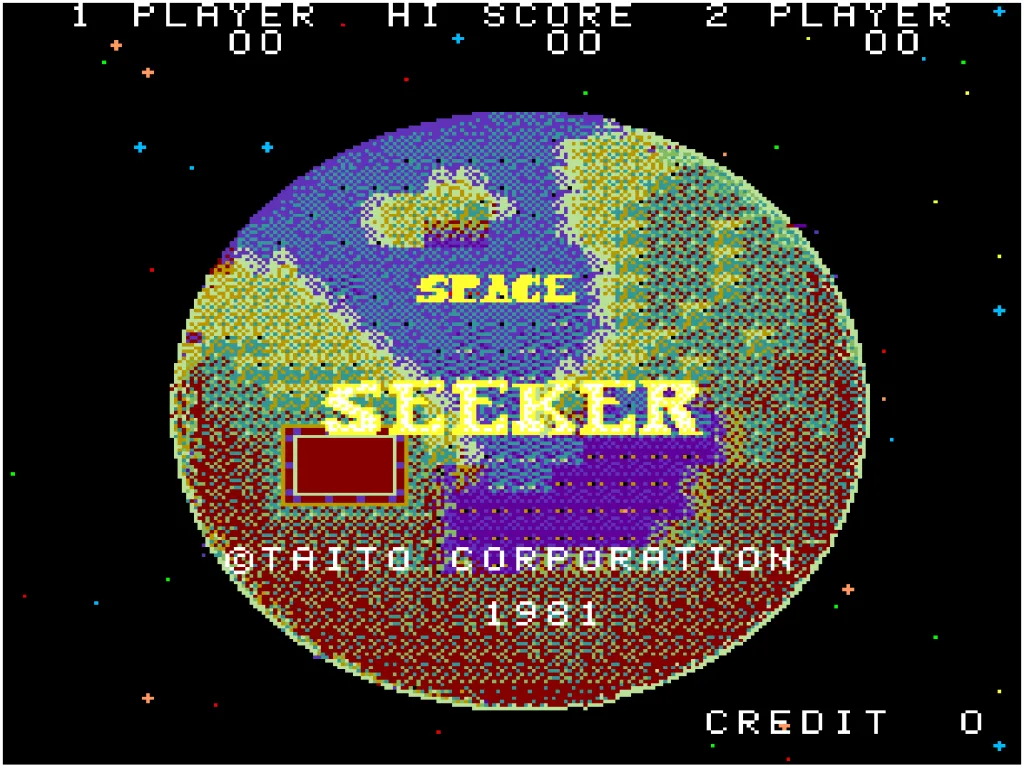
A 1981 Arcade Hybrid Where Strategy Frames the Shooting
SPACE SEEKER is a Taito arcade shooting game released in 1981. Its defining trait is a documented hybrid structure: the player battles ever-approaching waves of enemy air forces in first-person 3D, and mobile fortresses in side-scrolling 2D. These are not separate games bolted together arbitrarily. They are two battle views reached through a shared map that tracks the foe positions, and the publisher's description frames the whole thing as a hybrid strategy and shooting game. The strategy is deciding which threat to answer; the shooting is what follows once that decision is made.
What separates SPACE SEEKER from a straightforward wave shooter is the cost attached to staying in one engagement. The documented rule is blunt: use the map to track your foes and choose which to battle, but stay in one place too long and your bases will be overrun, losing you a life. That single sentence reshapes how the two battle modes relate. Target selection becomes a timed commitment rather than a free choice, and the bases become the resource you are implicitly defending through movement. The game is therefore played across two layers, one of judgment and one of reflex, joined by the map.
The Map as the Hub: Tracking Foes and Choosing Targets
The map is the game's connective tissue and its strategic layer. It displays the positions of the approaching foes, and the player consults it to decide which threat to battle next. Because two distinct target types appear in the same tracked space, the decision is not merely where to go but what kind of fight to take: air forces, which lead to the first-person 3D view, or mobile fortresses, which lead to side-scrolling 2D. Choosing a target transfers the action into the matching shooter mode.
This makes the map a decision screen that matters. In practice, the player is weighing one documented threat against another before a shot is fired, and the two options demand different actions once entered: forward-facing defense against incoming waves in one case, lateral assault on a fortress in the other. The map also keeps the pressure visible. Since the bases can be overrun if the player stays too long, the map functions as the place where the cost of time is made legible, even though the precise timing of that overrun is not detailed in the available material.
First-Person 3D Sorties Against the Air Waves
One half of the game is fought in first-person 3D against ever-approaching waves of enemy air forces. The wording matters: these are waves, plural and progressive, rather than a single fixed formation, so the mode is defined by repeated incoming attacks that the player faces head-on from a first-person perspective. This is the mode the player reaches by selecting the air forces on the map, and it is the more immediate of the two battle types, since the danger arrives from ahead rather than being sought out laterally.
The documented rule connects this sortie back to the map. Although the air combat is first-person and forward-facing, it is not a self-contained stage: it is one branch of a map-driven loop, and the same overrun risk applies while the player is engaged there. Staying too long, whether against the air waves or elsewhere, lets the bases be overrun and costs a life. The air sortie is therefore best understood as a timed engagement, one the player enters by choice and must eventually leave rather than grind through indefinitely.
Side-Scrolling 2D Assaults on the Mobile Fortresses
The other half of the game is fought in side-scrolling 2D against mobile fortresses. This view unfolds laterally rather than as a forward-facing defense, and it is the counterpart to the first-person air sortie within the same hybrid game. Selecting a mobile fortress on the map leads into this mode, so the fortress assault is one of the two consequences of target selection. The two battle types differ in presentation and in the kind of action they demand, which is precisely why the map choice carries weight.
The same time pressure governs the fortress fight. The player is not free to settle into a single engagement, because staying in one place too long lets the bases be overrun, costing a life. So the side-scrolling mode is a branch of a loop in which the player weighs which target to answer and how soon to move on. Engaging a mobile fortress is a decision with a clock attached, and the fortress assault is meaningful precisely because it competes for time with the air waves on the tracked map.
How the Systems Fit Together: Movement, Bases and Lives
Read together, the documented mechanics describe a tight loop. The player tracks foes on the map, chooses which to battle, enters either the first-person 3D air mode or the side-scrolling 2D fortress mode, and must avoid lingering too long, because the bases are the resource under threat and a life is the penalty for losing them. The loop pairs target choice with movement: movement between engagements is what keeps the bases from being overrun, and target choice is what decides which shooter mode the player enters.
The names of the systems hint at the intended balance. The foe-tracking map is a system of information and selection, the base-defense rule is a system of time pressure and consequence, and the enemy waves are a system of escalating incoming opposition. None of this implies a score system, power-ups, weapon varieties or level routes, and the available material documents none of those. What it does establish is a structure in which two shooter idioms share a single strategic frame, and that frame is the map plus the overrun clock.
Playing It Today: What the Record Supports
SPACE SEEKER is documented as an original 1981 arcade game from Taito, and that is the extent of the official product record available here. The material says nothing about later ports, remakes, compilation releases or any current commercial package, so readers should treat the 1981 arcade release as the reference point rather than as a claim about modern availability. Where and how the game is officially sold or re-released today is simply not established by the cited publisher documentation.
For anyone approaching the game through the record, the practical takeaway is a design one. The documentable interest of SPACE SEEKER lies in how it fuses a first-person 3D wave defense with a side-scrolling fortress assault and binds them together with a map and an overrun clock. That structure is unusual enough on its own, and it can be described entirely from the cited publisher material without recourse to claims about controls, scoring, difficulty or historical influence.
Scroll sideways to see the full table →
| Field | Documented Value |
|---|---|
| Title | SPACE SEEKER |
| Release year | 1981 |
| Platform | Arcade |
| Publisher | TAITO |
| Genre | Shooting |
| Game type | Hybrid strategy and shooting |
| Battle modes | First-person 3D air waves; side-scrolling 2D mobile fortresses |
| Navigation | Map tracks foes; choose which to battle |
| Penalty for lingering | Bases overrun, losing a life |
Sources & further reading.
- SPACE SEEKER — licensed publisher game documentation Retrieved Oct 18, 2026
First published .