 THE GAME ARCHIVE
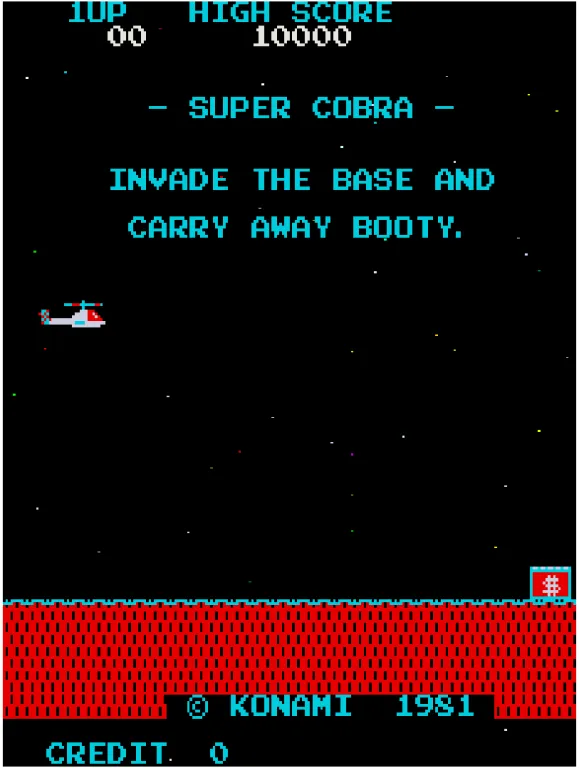
Charting the Mission: Helicopter, Enemy Base, and Spoils
In Super Cobra, the objective is a single continuous flight in a helicopter toward an enemy base that appears at the end of the run. The mission is framed as reaching that final installation and claiming the spoils of war once you arrive. The documented loop therefore ties two distinct tasks together: navigate the helicopter across the flight while managing threats, then finish at the base to collect the reward. The description treats the base as the destination and the spoils as the payoff for completing the trip, so the run is structured around getting the aircraft to that endpoint rather than around a mid-mission objective.
The same mission description sets enemy pressure and fuel as parallel hazards during the flight. The player is warned to watch for enemies while progressing and also to monitor the fuel level, because running out can cause the helicopter to crash and burn. These rules interact directly with the base run: the destination stays fixed at the end, but surviving the route requires handling both incoming enemies and a depleting resource. Super Cobra is identified as an arcade shooting title published by Konami in 1981, and the documented goal describes the original arcade version rather than a home-console release.
Fuel as a Second Enemy
Super Cobra treats fuel as a constraint that runs alongside enemy fire rather than as a separate stage or checkpoint. The player flies a helicopter toward an enemy base at the end of the run, and the fuel level must be watched during that flight; a low fuel level causes the helicopter to crash. The documented rules make the crash an outcome of running the resource down, not of a collision, so the fuel gauge becomes a second source of failure that advances on its own while enemies demand attention.
Because the same warning covers enemies and fuel together, both hazards have to be handled on a single trip to the base. Enemies appear as the helicopter progresses, and fuel drains while the helicopter is in flight, so time spent dealing with attackers is time the fuel gauge keeps falling. Managing the fuel level is therefore a named mechanic in its own right, not background bookkeeping: letting the level drop far enough produces a crash before the helicopter can reach the enemy base and claim the spoils.
Enemy Pressure on the Run to the Base
Enemies are a constant factor across the whole flight rather than a hazard confined to a single stretch of the route. As the helicopter moves toward the installation waiting at the end, attackers keep appearing, so the pilot cannot treat any part of the journey as a quiet transit leg. The threat and the destination are described together: the player is flying to the enemy base while enemies are present throughout, which means the approach itself stays contested. Every encounter along the way has to be answered while the aircraft is still pointed at that final base.
Because encounters are spread through the entire game, the run to the base is a continuous sequence of confrontations rather than a build-up to one battle. The player meets enemies while progressing, and the base appears at the end as the place where the spoils of war are claimed. That structure keeps the same pressure on the pilot from departure to arrival: enemies do not wait at the destination for a final stand, they are part of the progress itself. Reaching the base therefore depends on getting through the encounters that fill the route.
The 1981 Arcade Original and Its Arcade Archives Reissue
The documented reissue sits in the Arcade Archives series, a line that reproduces classic arcade games while, according to its own materials, staying true to the originals. For this section, the distinction is straightforward: the flight toward the enemy base, the fuel gauge that must be watched, and the enemies that keep appearing along the route belong to the reproduced arcade title. The reissue framing adds its own options and online functions around that game rather than altering the documented mission, so the base run and the fuel crash outcome remain as described elsewhere in this feature.
The documented reissue features are settings and competition layers. Players can customize game settings to their liking, including adjusting the difficulty level, and depending on the title, even recreate the atmosphere of CRT televisions from the era. The series also lets players compete for high scores with others around the world through online rankings. None of these documented options change what happens during a mission: the helicopter still travels toward the enemy base at the end of the run, enemies keep appearing as it progresses, and the fuel level still has to be watched so the aircraft does not crash and burn before the installation is reached and the spoils are claimed.
Sources & further reading.
- SUPER COBRA — licensed publisher game documentation Retrieved Oct 18, 2026
First published .