 THE GAME ARCHIVE
Voxel Shipbuilding and Advanced Build Tools
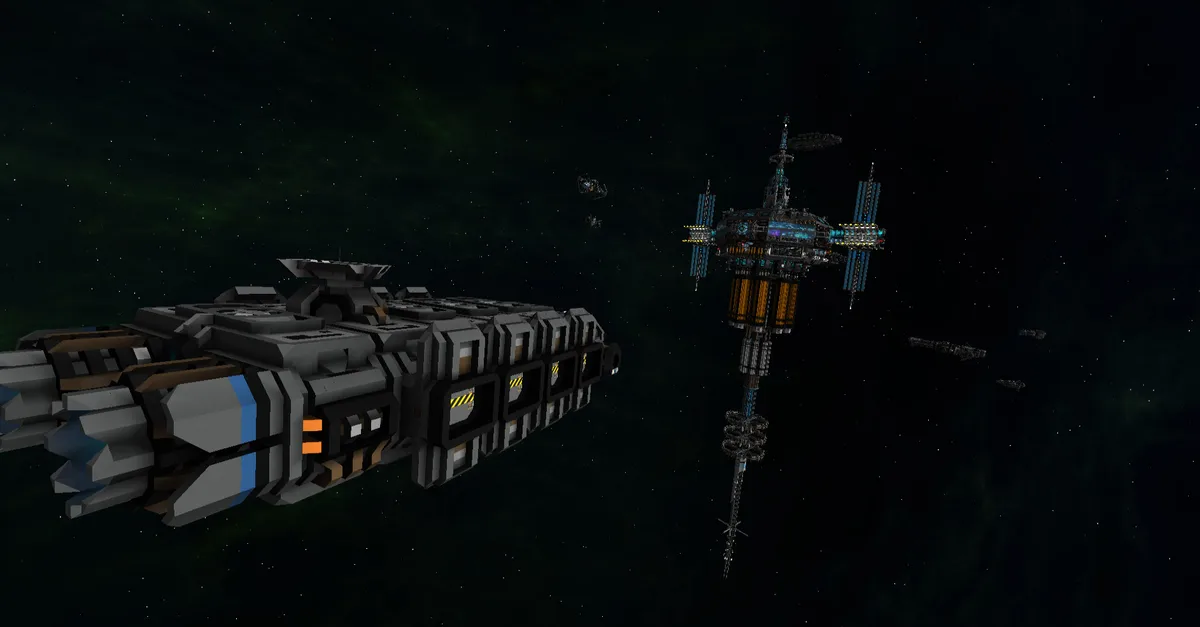
StarMade is built on voxel construction, and shipbuilding begins with placing blocks to form a hull of your own design. Because the sandbox is voxel-based and three-dimensional, a vessel takes shape block by block rather than through preset chassis, giving players direct control over a ship's outline and dimensions. The same construction approach carries over to stations: you can design your very own space station using the same kind of building freedom, so static outposts share the game's block-based design language with the ships you fly.
Once the hull exists, ship customization extends to equipment: weapons are described as completely customizable, so they can be fitted to your own ship rather than limited to a fixed loadout. That flexibility sits within a broader sandbox where the goals are to create your own ships, explore galaxies, stars and planets, and build stations and warp gates. The building and outfitting options therefore work together with travel and industry, since players also trade for a fortune and mass produce materials in large factories while customizing their vessels.
Modular Weapons, Rails, and Logic Circuits
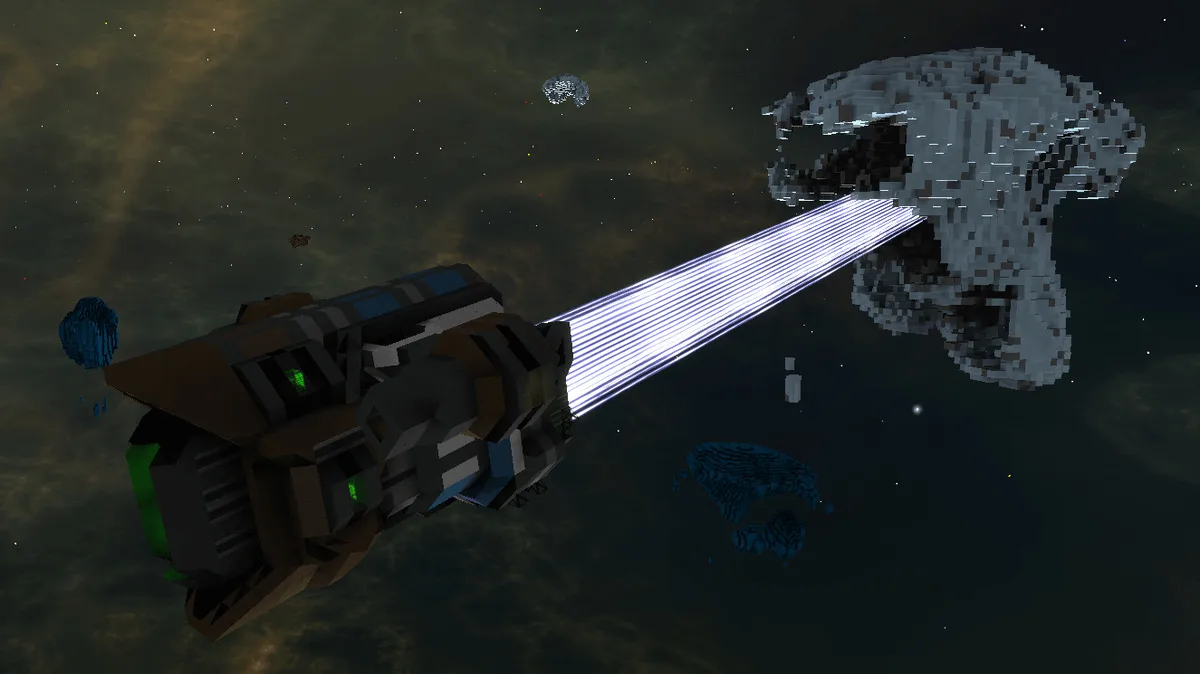
Weapons on a StarMade vessel are assembled rather than picked from a fixed list, because the modular weapon system lets you combine weapon systems into many different configurations. The stated examples run from sniper beams to swarm missiles, so the same fitting process can produce a precise long-range weapon or a launcher releasing a cluster of projectiles. Because the combinations are open-ended, the weapon block arrangement itself becomes part of the ship design task: you decide which systems to join together and how the resulting armament is configured on your own hull.
The rail system is used to build moving parts, with documented examples ranging from simple elevators and sliding or rotating doors to complex cranes. Logic systems then control any system in the game, whether weapons, lights, rails, or explosives, and cover all the basic gate types for convenient use, including AND gates. The two mechanics interact directly: rails supply the motion, while logic decides when a door slides, a crane moves, or a weapon fires. That lets a builder wire a mechanism to respond to conditions rather than operate it by hand.
Exploration, Salvage, and the Procedural Universe
The play space itself is procedurally generated and described as an infinite universe containing quadrillions of galaxies. Travel is scaled enormously: crossing from one end to the other is said to take roughly 10,000 years, and the world is built for scalability so it can host massive fully interactable objects. Within that setting, exploration sends you to new galaxies, stars and planets. You also discover and salvage space stations, and combat is available against pirates or opposing factions in multiplayer. Those activities share the sandbox with trade, factory mass production, custom weapon fitting and warp-gate construction.
Warp gates are the documented way to network the universe at your front door, so building them connects destinations rather than leaving each journey to a single long crossing. The scale figures make that practical concern concrete: an infinite procedurally generated universe with quadrillions of galaxies, and an end-to-end trip estimated at about 10,000 years. Salvage sits alongside this travel layer, since discovering and salvaging space stations is listed next to exploring galaxies, stars and planets, fighting pirates or factions, trading, and mass producing materials in factories.
Factions, Fleet Battles, Trade, and Multiplayer Servers
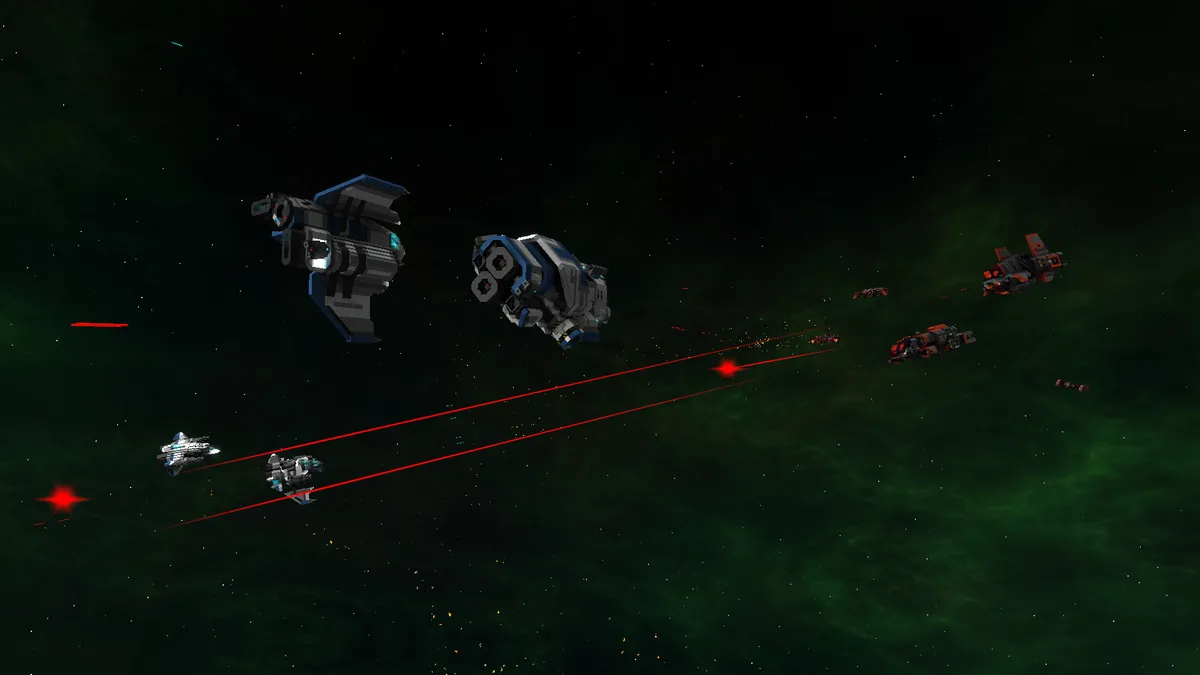
Fleet battles are one documented activity in StarMade, and they sit alongside alliances that players can form. The stated ambition is to dominate entire galaxies, whether the aim is an industrious empire or the destruction of others, and resource harnessing feeds that contest. Opposing factions appear in multiplayer, where fights against pirates are also listed. Trade gives a parallel path: players trade to make a fortune, while gigantic factories mass produce materials. So the sandbox links combat, cooperation through alliances, commerce and industrial output rather than treating them as separate modes.
Multiplayer runs through community-hosted dedicated servers, where you play with others. The documented configuration lets administrators customize core game mechanics for a tailored experience, and most settings can be tweaked for hardware performance. That server-level control is separate from the in-game systems builders use: logic covers basic gate types such as AND, OR, NOT, DELAY and Flip-Flop, permits in-flight control and wireless connections between entities, and can drive timers, switches, buttons, working clocks or even a real CPU. On a shared server, administrators adjust mechanics while players wire up gates and devices.
Sources & further reading.
- StarMade — official game profileRetrieved Oct 28, 2026
First published .