 THE GAME ARCHIVE

A Platformer Built on Teamwork Between Rectangles
Thomas Was Alone is described in its official profile as an indie minimalist 2D platformer about friendship and jumping and floating and anti-gravity. The framing is deliberately plain: the characters are a group of rectangles, and the tasks are set out as a sequence of obstacles across 120 levels. What makes the game distinctive within that description is the requirement to use the different skills of the rectangles together. The player is not asked to master one moveset but to understand how several abilities complement one another.
The store description sets out the basic shape of play plainly: guide a group of rectangles through 120 levels, using their different skills together to overcome a series of obstacles in each environment. That single sentence carries most of the game's documented design logic. The cast is plural, the abilities differ, the obstacles are grouped by environment, and the campaign is long enough that the combinations are meant to be learned rather than guessed once.
Thomas Was Alone is listed for Windows and macOS. The official profile gives a 2012 date and names Bithell Games as both developer and publisher. The genre field is Indie, which matches the profile's own description of a minimalist 2D platformer rather than a larger-budget production.
More Than Ten Rectangles, Each With a Job
The profile's key features invite the player to utilize the unique skills of 10+ characters to beat 120 levels. The same text describes the group as rectangles-slash-sentient-AIs and asks the player to become acquainted with them and learn their individual abilities. This is where the game's central learning loop sits: the cast is larger than a single avatar, and every member is defined by what it can do rather than by a shared baseline.
The premise frames those characters in narrative terms. Thomas Was Alone tells the story of the world's first sentient artificial intelligences and how they worked together. The characters are therefore not interchangeable tools but named personalities whose abilities are tied to a story about cooperation. Learning a rectangle's skill and learning who that rectangle is happen in the same act of play.
The profile does not enumerate which ability belongs to which rectangle, so the practical way to read the cast is as a toolbox introduced gradually: starting with Thomas, the player meets the wider group, learns their abilities, and then navigates them through the levels. The emphasis on individual abilities means the player's job is partly diagnostic. A stage is solved by recognizing which member of the group supplies the capability the environment is asking for.
The Core Loop: Read the Obstacle, Combine the Skills
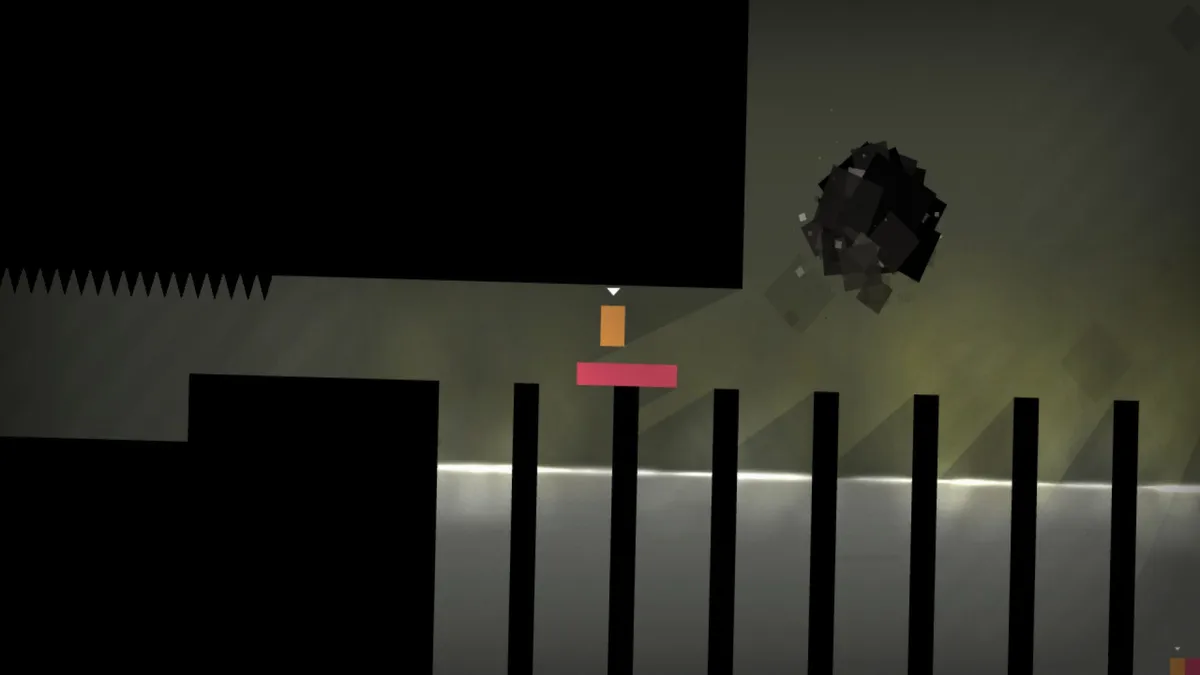
Each level is organized around a series of obstacles that the group must overcome using their different skills together. The profile describes jumping over blocks and barriers meticulously placed by Mike Bithell. Because the obstacles are authored rather than random, each one is a deliberate demand: a specific height, a specific barrier, a specific piece of terrain that the group must collectively answer.
The documented abilities show how that answer works in principle. The game is about jumping, floating and anti-gravity, and the characters have individual abilities that supply those actions in different combinations. A wall that defeats one rectangle's jump is the kind of obstacle another rectangle's ability is there to handle, and a gap that one character cannot cross is the point where the group's combined skills matter. Solving a level is therefore a matter of sequencing the group's abilities against the placement of the barriers in front of them.
That structure gives the campaign its rhythm. The obstacle set changes from one environment to the next, so the same basic instruction — use the different skills together — is tested against fresh arrangements of blocks and barriers. The player is repeatedly made to re-evaluate which member of the group is useful where, rather than relying on a single winning approach across 120 levels.
Hand-Placed Obstacles and the Environment Structure
The profile credits the obstacles to Mike Bithell and describes them as meticulously placed. For a minimalist platformer, that detail carries real weight. With a plain visual style, the layout is the main carrier of difficulty and intent, so the positioning of blocks and barriers is where the design does its communicating. A carefully placed block is also a signal: it tells the player which ability the level is expecting next.
The environment structure matters for the same reason. Obstacles are arranged as a series within each environment, which suggests a progression that builds from one arrangement to the next rather than a single undifferentiated set of screens. Combined with the 120-level total, the picture is of a campaign organized in blocks, each block with its own demands, with the player's understanding of the cast deepening as the surroundings change.
Bithell Games appears in the official profile as both developer and publisher, and the title is listed for Windows and macOS. The profile gives a 2012 date alongside that listing. Those are the plain catalog facts behind the design description; the rest of the article stays with what the game's own materials say about how it plays.
Narration and a Procedural Score
The story reaches the player through Danny Wallace's voiceover, described in the profile as read wistfully, a bit amusingly, and BAFTA-winningly. The narration is a key feature in its own right, and the profile invites players to chuckle along to it. Because the game's subject is the first sentient AIs and how they worked together, the voice supplies the emotional and comic register that the bare rectangles otherwise lack.
David Housden's score is described as critically acclaimed and procedural. The profile lists it alongside the narration as something to immerse yourself in, placing the audio on the same level of importance as the platforming. The narrative it accompanies keeps the plot twists and superhero origin stories under wraps, so the profile gives the setup — AIs becoming unexpectedly sentient — without spoiling how the story unfolds.
Taken together, the presentation reinforces the design. A game about a group of distinct characters working together is supported by a spoken narrative about how they work together, and by a score the profile treats as a signature element. The comedy in the narration sits alongside the deliberate simplicity of the platforming, which lets the story carry the personality while the layouts carry the challenge.
Progression: Starting With Thomas, Then the Wider Group
The documented progression is one of introduction. The player starts with Thomas, becomes acquainted with a group of rectangles-slash-sentient-AIs, learns their individual abilities, and navigates them through 120 levels of obstacles. That sequence — start, meet, learn, navigate — is the profile's own description of how the campaign unfolds, and it explains why the game's difficulty is bound up with the cast rather than with a single escalating moveset.
The length of the campaign gives that introduction room to breathe. Across 120 levels, the player has the space to build familiarity with more than ten characters and to see how their skills combine against changing obstacle arrangements. The profile does not describe unlock rules, scoring or collectibles, so the most defensible reading of progression is the one it states: a growing group, a growing understanding of their abilities, and a long series of hand-placed obstacles to apply both to.
There is also a narrative progression to match. The story is one of AIs becoming unexpectedly sentient and of the first sentient artificial intelligences learning to work together. The shift the characters undergo is therefore the same shift the player undergoes in learning the puzzle logic: what begins as a set of separate rectangles becomes a coordinated group whose members make sense in relation to one another.
Where to Begin: Reading the Game as the Profile Describes It
The most useful habit the documented design encourages is to treat each obstacle as a question about the cast. Rather than looking for one character who can handle everything, the game asks you to use the different skills together. When a barrier stops the group, the answer lies in which rectangle can supply the jumping, floating or anti-gravity action the obstacle calls for, and how that ability connects to the rest of the team's route.
A second habit is to watch the layout. Mike Bithell's obstacles are described as meticulously placed, so the arrangement of blocks and barriers is worth reading closely before trying anything. In a minimalist platformer, the geometry is the instruction sheet. Learning to interpret it — noticing where the terrain demands a particular ability — is the skill the 120 levels are built to develop.
The profile has no control scheme, no level routes and no difficulty settings to pass along, so this feature does not pretend otherwise. What it can say with confidence is what the source says repeatedly: the objective is to move a group through 120 levels by combining unique abilities, the obstacles are authored with care, and the whole thing is wrapped in a narrated story and a procedural score. Play with those three facts in mind and the design's intent is legible from the first screen.
Platform and Catalog Notes
For readers checking whether this is the game they remember or the one they want to try, the official profile lists it for Windows and macOS, with Bithell Games as developer and publisher and a 2012 date. The genre is given as Indie. Those catalog facts describe the version the store describes; the profile does not detail later ports, remakes or additional content, so this feature makes no claims about editions beyond the listed platforms.
Scroll sideways to see the full table →
| Field | Official profile value |
|---|---|
| Title | Thomas Was Alone |
| Developer / Publisher | Bithell Games |
| Platforms | Windows, macOS |
| Release date listed | 2012 |
| Genre | Indie |
| Levels | 120 |
| Playable characters | 10+ |
Sources & further reading.
- Thomas Was Alone — official game profileRetrieved Oct 27, 2026
First published .