 THE GAME ARCHIVE
A Toy Box You Have to Escape, Stage by Stage
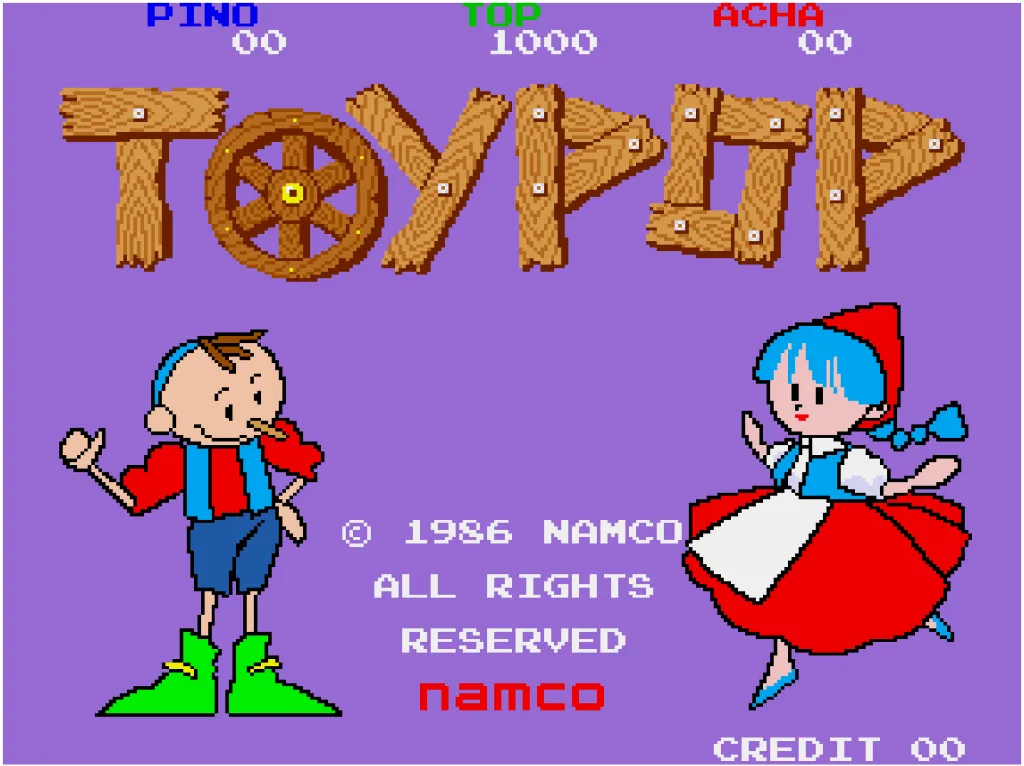
TOY POP is an arcade action game published by Namco in 1986. You control two characters, Pino and Acha, who pop out of a toy box; that box is also the stage you play in. The loop is stated plainly in the publisher's description: collect the hearts hidden in the box to open the door and advance. That single sentence sets the game's shape. Each screen is a container you have to search from the inside, and the exit stays shut until the hidden hearts are found.
The toy-box framing is more than decoration. Because the hearts are described as hidden in the box, the player's first job in any stage is to sweep the play space rather than simply move toward an obvious goal. The door is the goal, but the key to it is distributed across the stage in concealable pickups. Between the door and the hearts sit the enemies, and the second documented system, change targets, exists to help you deal with them. Those three elements, hearts, door and change targets, are the whole of the supported rule set, and they interlock tightly enough to explain how a stage is actually played.
Saving Toyland from the Witch in the Final Box
The destination is stated as clearly as the loop: defeat the witch in the final box and save the toyland. The fantasy setting gives the toy-box stages a reason to exist as a sequence. Each box you clear is a step through a toyland that ends at a witch's box, so the progression from door to door is also a march toward one named confrontation. The final box is not framed as a separate mode or a bonus round; it is the last stage in the same chain.
The cast is small and the roles are clean. Pino and Acha are the playable pair who pop out of the box, the witch is the final obstacle, and the toyland is what is at stake. Nothing in the supplied documentation describes a larger cast, a hub, or a story sequence between stages. That restraint matters for how the game reads: the premise exists to motivate movement through boxes, and the publisher's brief description spends its words on what the player does rather than on narrative.
The Core Loop: Find the Hidden Hearts, Open the Door
The heart hunt is the game's primary objective and its only documented route to the next stage. Hearts are hidden in the box, and collecting them opens the door; the door is how you advance. In practice that makes each stage a search problem with a hard completion condition. You are not deciding whether to bother with the hearts. You are deciding where to look and in what order, and the answer determines how long you remain exposed to the box's enemies.
The word the source uses for the hearts is hidden, and it uses the same word for the change targets. Both are concealed in the boxes, which means both require active discovery rather than being handed to the player at the start of a stage. That shared property is the core of the design: the stage's exit condition and its combat tool are both things you find, so exploration and fighting are not separate phases but two readings of the same act of searching the box.
The door is worth treating as a mechanic in its own right. It does not open for time survived or for enemies defeated as such; it opens for hearts collected. That gives the player a clean priority when a stage becomes dangerous: the hearts are the progress currency, and the enemies are the interruption. A run through a box is therefore legible as a race between the search for concealed hearts and the pressure the enemies apply while you search.
Change Targets and the Weapon Switch
Change targets are hidden in the boxes and are used to change weapons. In the publisher's sentence, the purpose of changing weapons is stated directly: use the change targets hidden in the boxes to change weapons and defeat enemies. The mechanic is therefore not cosmetic. The weapon exists to be used on the enemies in the stage, and the change target is the means by which the player obtains that weapon.
At the level the source supports, the switch is worth thinking about as parallel to the hearts rather than subordinate to them. Hearts satisfy the door; change targets supply the means to defeat enemies. Those are two different answers to two different problems inside the same box, and both are concealed. A player who finds only hearts has a way out but not necessarily the firepower to survive the walk to it; a player who finds a change target has the reverse. The stage rewards whichever discovery the search turns up first, because both are needed.
The documented description does not specify how many weapons are available, whether a change target swaps one specific weapon for another, or whether a found weapon persists from box to box. It also does not describe how combat itself is controlled. Those details sit outside the supplied evidence, and the honest reading of the mechanic is the one the publisher gives: targets are hidden in boxes, they change weapons, and the changed weapon is what you use against enemies. Everything a player actually decides, where to search and how to fight once armed, follows from those two linked rules.
Progression from Box to Box, Enemy Pressure and the Final Fight
Stage advancement is documented as something you do by collecting hearts, and the source separately covers defeating enemies as part of the game. Read together, the two make a straightforward escalation model. Early in a run, the search is the task and the enemies are an obstacle to it. The farther you push toward the final box, the more the two overlap, because every box asks for the same pair of discoveries, hearts and targets, under whatever enemy pressure that box applies. The final box simply ends that sequence with the witch.
The final box is the one stage in which the goal is stated as more than escape. Every earlier box is cleared by opening its door, but the last box contains the witch, and the game's stated win is defeating her and saving the toyland. In design terms that turns the accumulated habit of finding hearts and targets into preparation for a named confrontation. The same two mechanics, hidden hearts and hidden change targets, are the ones the player brings to that fight.
What the documentation does not provide is any count of boxes, any description of individual stage layouts, or any statement about how the witch is fought beyond the fact that she must be defeated. Those gaps are real, and they mean a reader should treat the progression as an outline rather than a route. The reliable shape is: box, hidden hearts, open door, next box, until the final box and its witch.
How to Approach a Box
The supplied rules imply a simple working order for any stage. Search for change targets early, because a switched weapon is what lets you deal with the enemies in the box, and a box that keeps interrupting your search is easier to search once you have one. Then complete the heart hunt, because hearts are the documented condition for the door to open. Neither step is optional in the sense of being skippable content; both belong to the same clearing of a box, and treating the stage as a single search for two kinds of hidden object keeps the priority straight.
Two cautions follow from the same evidence. Do not expect the door to open for enemy kills alone, since the supported condition is collecting hearts. And do not treat the change target as a scoring pickup: its documented function is to change weapons so that enemies can be defeated. Beyond that, the source does not describe scoring, extra lives, timers or a specific order in which the two hidden objects appear, and this guide does not manufacture them.
The 1986 Arcade Original and Today's Licensed Access
The game documented here is the original 1986 arcade release, published by Namco, with the arcade as its platform. That framing matters because the same publisher page also describes a modern licensed reissue context, and the two should not be blended. The boxes, hidden hearts, change targets, doors and the witch in the final box describe the original arcade design. The reissue context describes a separate way of playing classic arcade titles today, with its own series-level features, and none of that should be read back into the 1986 game's rules.
For a player meeting TOY POP today, the supported access is the Arcade Archives line, whose documented features at series level include adjustable difficulty, an optional CRT-style display atmosphere, score modes and online rankings. Those are properties of the reissue package as described, conditional on the individual title. What a local or online opponent population looks like, and how a given title's settings are exposed, is not established by the source. The safe expectation is the original arcade design with the option to tune presentation and difficulty around it.
Scroll sideways to see the full table →
| Item | Detail |
|---|---|
| Title | TOY POP |
| Release year | 1986 |
| Publisher | Namco |
| Platform | Arcade |
| Genre | Action |
| Playable characters | Pino and Acha |
| Stage exit condition | Collect the hearts hidden in the box to open the door and advance |
| Weapon system | Change targets hidden in the boxes change weapons to defeat enemies |
| Win condition | Defeat the witch in the final box and save the toyland |
Sources & further reading.
- TOY POP — licensed publisher game documentation Retrieved Oct 18, 2026
First published .