 THE GAME ARCHIVE
Warfare is the strategic team mode at the center of Unreal Tournament 3, and its appeal lies in turning a shooter map into a moving battlefront. Rather than fighting over one objective, two teams push a chain of control points called Nodes toward each other's home base, where a shielded Power Core sits at full health. The goal is to reduce that core from 100 percent to zero, but the real contest is over the path to it: the shield only falls once an attacking team links its way up to the defender's Prime Node.
This profile draws on the publisher-supplied manual and store material rather than hands-on play, so it describes documented rules and systems rather than personal match experience. The sections below cover the Warfare objective and Node chain, the Link Gun that builds and repairs Nodes, the other documented modes, the vehicle and deployable rules, and the Titan Pack additions bundled with the current release.
The Warfare Objective: Linking Nodes to Expose a Power Core
The stated objective is simple to describe and demanding to execute: destroy the enemy's Power Core by reducing its 100 percent Health to zero, in a Red-versus-Blue match played against a countdown clock. Each team's Power Core sits in its base at full health and cannot be repaired, so damage dealt to an exposed core is permanent. That rule changes the shape of a match — there is no way to undo a bad defensive stretch by patching the core afterward, which raises the stakes of conceding the Prime Node even briefly.
At the start of a match, a visible shield protects each Power Core. The shield drops only when the opposing team successfully controls a series of Nodes leading up to the Prime Node in the defender's base; once the Prime Node falls, the core becomes vulnerable to attack. If the defenders retake the Prime Node, the shielding returns. This creates a two-stage decision for both teams: attackers must invest in the Node chain before they can score any core damage at all, while defenders can undo an incursion by reclaiming the single critical point rather than fighting back every Node at once.
Controlling Nodes pays off beyond the objective itself. Each captured Node gives that team access to new weapons, new vehicles, and new spawn points, so ground captured along the chain doubles as forward staging. The manual also notes that some Nodes are not critical to linking toward the enemy Power Core but often grant access to special vehicles that can turn the tide, which means teams face a genuine routing choice: secure the short path to the Prime Node, or detour for a vehicle that changes the fight.
Overtime turns the Node count into a direct weapon. Should a game reach overtime, the Power Cores start to drain, and the more Nodes a team controls during overtime, the faster the enemy core drains. A team that spent the match holding a broad Node footprint rather than racing for the Prime Node is therefore rewarded once the clock expires, because territory converts into pressure without anyone needing to shoot the core.
Building, Repairing, and Linking With the Link Gun
Capturing a neutral Node starts with movement: running over its base flips it to your team's color, and the structure then builds itself as its energy bar climbs and plating materializes. Players can accelerate the process with the Link Gun's alt-fire, which focuses energy into the Node. The manual specifies that the Link Gun is accessed with the 5 key and its alt-fire is triggered with the right mouse button, and that multiple players using their Link Guns on the same Node increase the rate at which it is built.
The same focused beam heals a damaged Node, restoring it toward full health rather than requiring a fresh capture. That makes the Link Gun a core logistics tool in Warfare: a team that keeps a Link Gun on hand can shorten the window after a capture when a Node is still fragile, and can patch up a contested Node under fire instead of surrendering it. Because cooperation speeds construction, a pair or group of engineers clustered on a Node turns a slow build into a quick one.
The manual describes the Link Gun as Riordan Dynamic Weapon Systems' Advanced Plasma Rifle v24. Its primary mode is a standard rapid-fire plasma weapon; the alternate mode beam handles battlefield engineering, from repairing friendly vehicles to constructing power Nodes. An identification-friend-or-foe lens lets the energy matrix switch automatically, sending a deadly plasma stream into an enemy vehicle or soldier and a harmless carrier stream into a friendly target, offloading energy from the onboard cells and boosting the output of any teammate linked to the rifle — the property that gives the weapon its nickname.
Modes Beyond Warfare: Deathmatch, Duel, Capture the Flag, and Campaign Structure
Deathmatch is the free-for-all format, and Team Deathmatch splits the same frag-based action across two squads. Duel is a one-versus-one test of Deathmatch skill in which the winner of a round takes on the next spectator watching the carnage, so a single loss sends a player back to the bench. The Duel Deathmatch HUD matches the Team Deathmatch layout but changes the scoring display and shows the names of the current dueling players. Capture the Flag is team-based and follows the familiar rule — invade the opposing base, grab their flag, and return it to your own — while Vehicle Capture the Flag applies the same objective with vehicles in the teams' hands.
Instant Action drops a player straight into play against advanced, computer-controlled bots. The single-player campaign is story-driven and divided into five Chapter points; the Replay Chapter option lets a player restart from one of those five Chapters, but doing so resets all progress back to the beginning of the selected Chapter. Starting a new Campaign game means choosing a difficulty level, which determines the skill of the bot opponents encountered. A private game is played solo, while a public game can be advertised for others to join through the Server Browser, either on a LAN or on the Internet.
Campaign progress also feeds back into the rules themselves. While playing through the single-player campaign, certain in-game objectives award Cards, which can be played before a mission to tweak the rules of the game; some give a team additional reinforcements, others hurt opponents. Many Cards can be kept for use later, but some must be used in the mission immediately following the one they were awarded in, so a player must decide whether to spend a situational advantage now or hold it for a harder fight ahead.
Vehicles and Deployables in Vehicle Matches
The Axon Hellbender is described as the spiritual successor to the High Mobility Multipurpose Wheeled Vehicles of the 20th century. Its upgraded chassis provides strong maneuverability in the field, and its up-armored neutron panels give the occupants moderate protection. Its main strength is weaponry: the rear turret focuses a devastating bolt of plasma at a target, and the front-mounted shock cannon releases floating mines of unstable plasma that the weapon's secondary fire detonates; the mines can be chain-ignited, so a single trigger spreads the blast through the others.
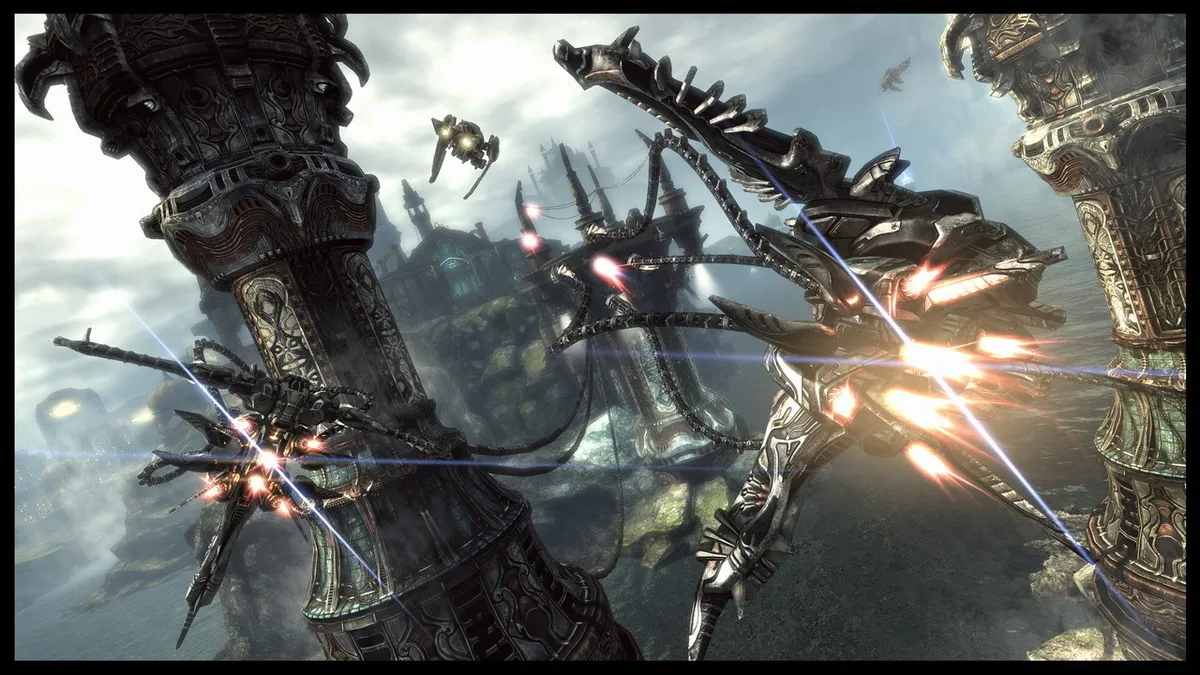
The Necris Scavenger works differently. A Scavenger barreling toward — and over — its enemies is described in the manual as a truly fearsome sight. Its pilot is enveloped in a sphere of modulated nanoblack that phase-cycles across the battlefield at great speed, barreling through obstacles and crushing infantry with reckless abandon. Nano-fueled tentacles deploy from the central sphere in multiple configurations; when partially deployed, the tentacles spin around the sphere, adding mobility and combat reach.
Powerups and Deployables: Berserk and the Shield Generator
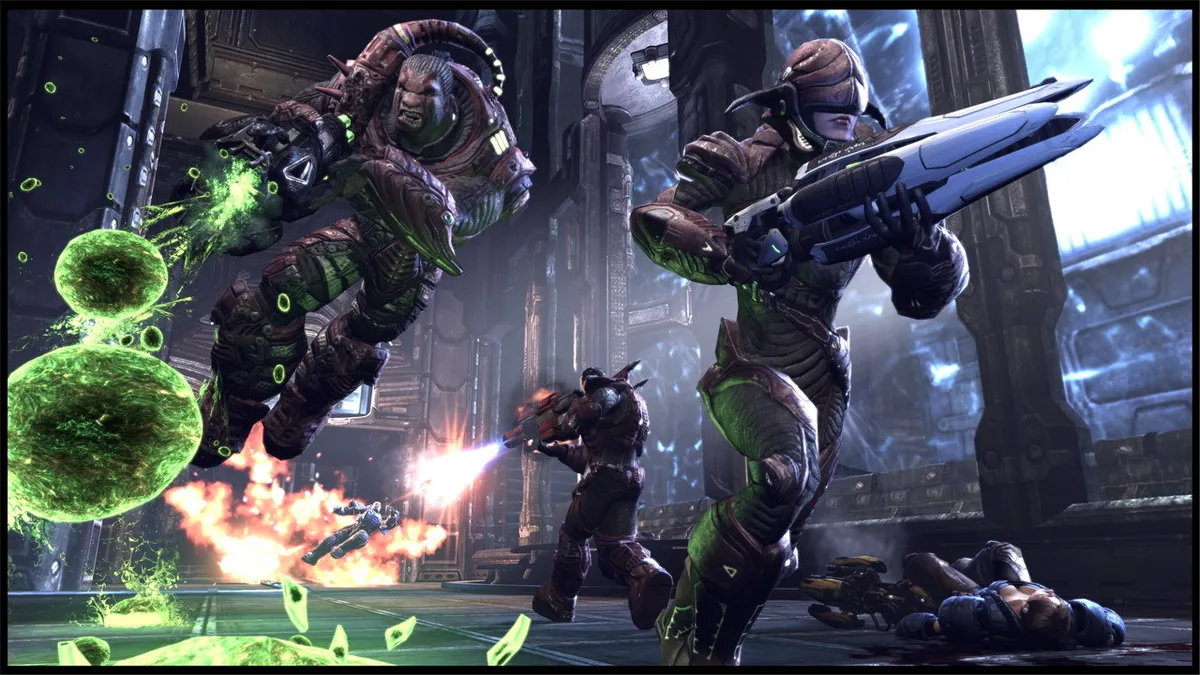
Berserk instills the primal rage of a blood-soaked Skaarj warrior, and the soldier's firing rate increases on all weaponry, resulting in massive damage output. The Shield Generator is a deployable that creates a massive multi-faceted shield that stops all weapon fire but allows passage of soldiers and vehicles. It is a wall against shots rather than against bodies: the barrier halts incoming fire while soldiers and vehicles can still cross the same line, so a team can stand behind it without being cut off from its own movement.
The Titan Pack and the Current Release
The current release includes the free Titan Pack expansion, which adds new environments, gametypes, the namesake Titan mutator, deployables and weapons, new characters, and the Stealthbender vehicle. The map package totals 16 environments new to the PC version — four Warfare, three vCTF, six Deathmatch, and three CTF maps — plus three bonus pack maps: CTF-Face, CTF-Searchlight, and DM-Morbias. The Titan mutator lets players overwhelm opponents as a 15-foot-tall titan or crush them as a 30-foot-tall Behemoth.
Also in the pack are the Greed and Betrayal gametypes, the Stinger Turret and Eradicator Cannon artillery weapons, the X-Ray Field and Link Station deployables, the portable Slow Field powerup, the Stealthbender — a new vehicle carrying two spidermine trap deployables, one EMP mine, and one each of the new Link Station and X-Ray Field deployables — and the characters Nova and Kana. The pack ships with 57 Steam Achievements, plus AI enhancements (especially in vehicle gametypes), networking performance upgrades, improved menu flow and UI usability, and better mod support. For PC players, the pack also brings client-side demo recording, a greatly improved Server Browser, a new maplist system, and mid-game mutator and gametype voting.
Scroll sideways to see the full table →
| Field | Detail |
|---|---|
| Game | Unreal Tournament 3 |
| Release year | 2009 |
| Platform | Windows |
| Developer / Publisher | Epic Games, Inc. |
| Genre | Action |
| Signature team mode | Warfare (Nodes, Prime Node, Power Core) |
Sources & further reading.
- Unreal Tournament 3 — official game profile Retrieved Oct 18, 2026
- Unreal Tournament 3 — official game profile — publisher-supplied gameplay manual Retrieved Oct 18, 2026
First published .