 THE GAME ARCHIVE
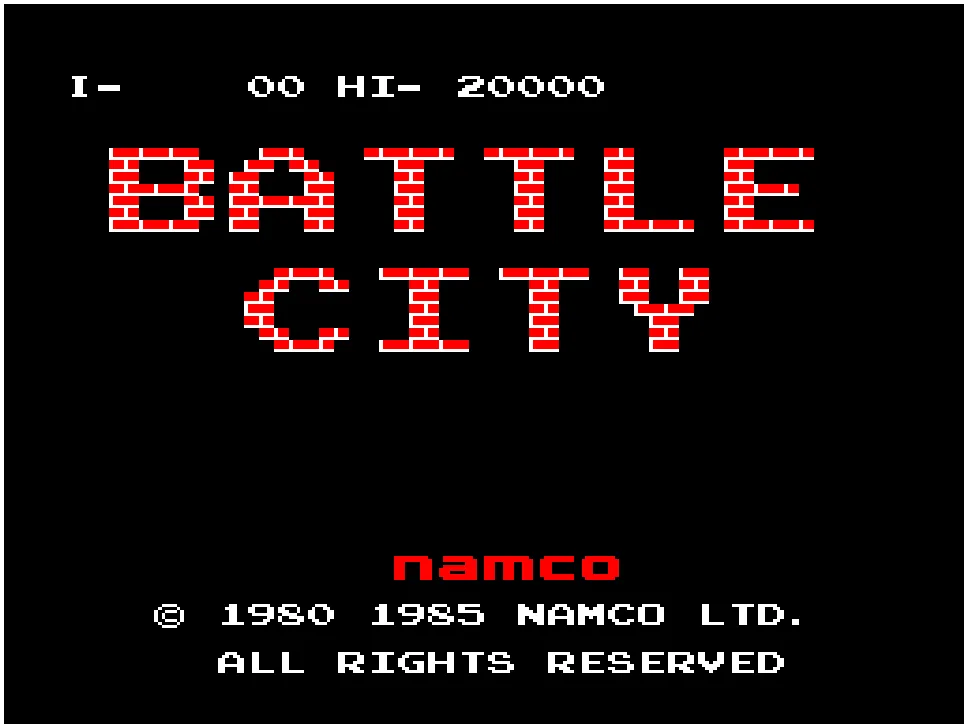
A Tank, an HQ, and a Map You Are Expected to Reshape
VS. BATTLE CITY is a Namco arcade shooter released in 1985 in which you take control of a tank and face down enemies while defending your own headquarters. The publisher describes the assignment as two things at once: you are the attacking force engaging hostile armor, and you are the protection for a fixed position you cannot afford to lose. Every decision sits between those poles. Push out to meet enemies and the HQ is left thinner; hang back and you give up the initiative the game expects you to take.
What separates the game from a straightforward shooting gallery is its documented shortcut to victory. Namco's own summary lists four linked moves: break down walls, create your own routes, lead enemies to fight where you have the advantage, and use the terrain tactically. These read as a sequence rather than four unrelated features. The walls you remove change where tanks can travel, the routes you carve let movement happen differently, and the ground you have reshaped becomes the place where you choose to fight.
That is the design identity of VS. BATTLE CITY: defense is not passive, and destruction is not incidental. A wall in front of you is a potential route, a possible firing lane, and a barrier you may want to keep or erase depending on what you need the battlefield to do next.
The Core Loop: Engage, Reshape, Redirect, Defend
The documented play cycle turns on facing down enemies while keeping the headquarters intact. You drive your tank, engage hostile tanks, and treat the HQ as the thing that must survive each exchange. The arcade format keeps the tension constant, because the HQ's safety is always the stake behind whatever aggressive move you attempt.
Interleaved with the shooting is demolition. Because the publisher names breaking down walls as part of the key to victory, clearing a barrier is not merely a side effect of fighting; it is a deliberate move the player is expected to make. The walls exist to be questioned: which one opens a better line of travel, which one protects a lane, and which one is worth time while enemies are still active.
The loop closes when the new geography starts working on the enemy. The publisher's stated goal is to lead enemies to ground where you have the advantage, which only becomes meaningful once your demolition has changed the options available to them. In practical terms, the battlefield you fight over late in a session is one you have helped shape through your own choices about which walls to remove and which routes to make real.
Walls as a Resource: How Demolition Changes the Board
The clearest mechanical statement the source makes is that walls can be broken down and that doing so lets you create your own routes. That single rule changes how the map should be read. A wall is not scenery or a hard boundary; it is temporary structure. Where a corridor is closed, the player has an option the map did not advertise. The battlefield is therefore only partly fixed at the start of a run, and the player's demolition work is a legitimate way of editing it.
The strategic interest comes from the trade-off implicit in that freedom. Opening a route for yourself may also open one for enemy armor pressing toward your HQ, because a corridor you carve is a path and paths get used. The documented advice to use terrain tactically fits here: the same breach that gives your tank a shortcut can become the channel you want hostile tanks to take, provided you are positioned to make that channel costly for them.
Because the publisher presents breaking walls and creating routes as part of the route to victory rather than optional extras, demolition deserves deliberate attention during play. The useful question is not simply whether a wall can be removed, but what the battlefield should look like a minute later. If the answer is a shorter path back to the HQ's defense or a narrower approach for incoming armor, the wall's removal is part of the plan rather than noise in the middle of a firefight.
Leading the Enemy: Turning Routes Into Traps
Once routes exist, the game's second layer opens: leading enemies to fight where you have the advantage. The publisher frames this as a key to victory alongside breaking walls, which means it is intended as a normal part of skilled play rather than an exotic trick. The tank you control is both a weapon and a lure. Where you position it relative to the openings you have made determines which ground the enemy armor ends up contesting.
This is where the HQ obligation and the aggressive option meet. If enemies can be induced to approach through ground you have shaped, your defense becomes more than standing still near the base; it becomes the act of choosing the battlefield on which the base is threatened. The documented emphasis on tactical combat and terrain use points to the same idea: the value of a position is relational, meaning your tank, the enemy tanks, and the walls between them all matter at once.
The linked structure matters for how a session feels. Firefights are not isolated duels in a fixed arena; they happen on a map that is being altered by the same actions that win them. A player who plans the shape of the battlefield while fighting is playing the game as the publisher describes it, turning demolition into strategy instead of a chore.
Starting Out: A Practical Reading of the Rules
- Treat the HQ as the priority and the enemy armor as the threat to it, because that is the objective the publisher states first.
- Break down walls on purpose: removing barriers and carving routes is a documented lever for victory, not just collateral damage.
- Think about what your new routes do to enemy movement, since the game's stated success state involves leading enemies onto ground that favors you.
- Connect both habits, so that the destruction you cause while fighting also shapes the ground the fight continues on.
These are inferences from the publisher's stated rules rather than a tested route through any specific stage. The source does not describe maps, timing, scoring, or enemy patterns, so readers should treat the advice as a way to interpret the design priorities it records.
1985 Arcade Origins and the Modern Reissue
VS. BATTLE CITY was released in 1985 on the Arcade platform by Namco, and the catalog classifies it as a shooting game. That date and platform belong to the original machine; they should not be confused with any later home or downloadable version. Within that arcade tradition, the game's pitch is a tank under the player's control against enemy armor, with the headquarters as the position in need of protection.
The same source page also describes the modern licensed Arcade Archives reissue, and those additions are reissue context rather than features of the 1985 original. The ACA series aims to stay true to the original arcade game while offering adjustable settings such as difficulty, optional CRT-style presentation depending on the title, and online rankings for high-score competition against players around the world. Readers coming to the game through the reissue should read the high-score competition as a modern layer around the arcade design, not as part of it.
What remains constant across the original and the reissue is the design thesis the publisher states for VS. BATTLE CITY: guarding the headquarters is the objective, and the route to it runs through destruction, redirection, and terrain. That is the part of the game no settings menu can change.
Scroll sideways to see the full table →
| Detail | Value |
|---|---|
| Title | VS. BATTLE CITY |
| Publisher | Namco |
| Release year | 1985 |
| Original platform | Arcade |
| Genre | Shooting |
| Documented victory elements | Defend HQ; break down walls; create routes; lead enemies; use terrain tactically |
Sources & further reading.
- VS. BATTLE CITY — licensed publisher game documentation Retrieved Oct 18, 2026
First published .